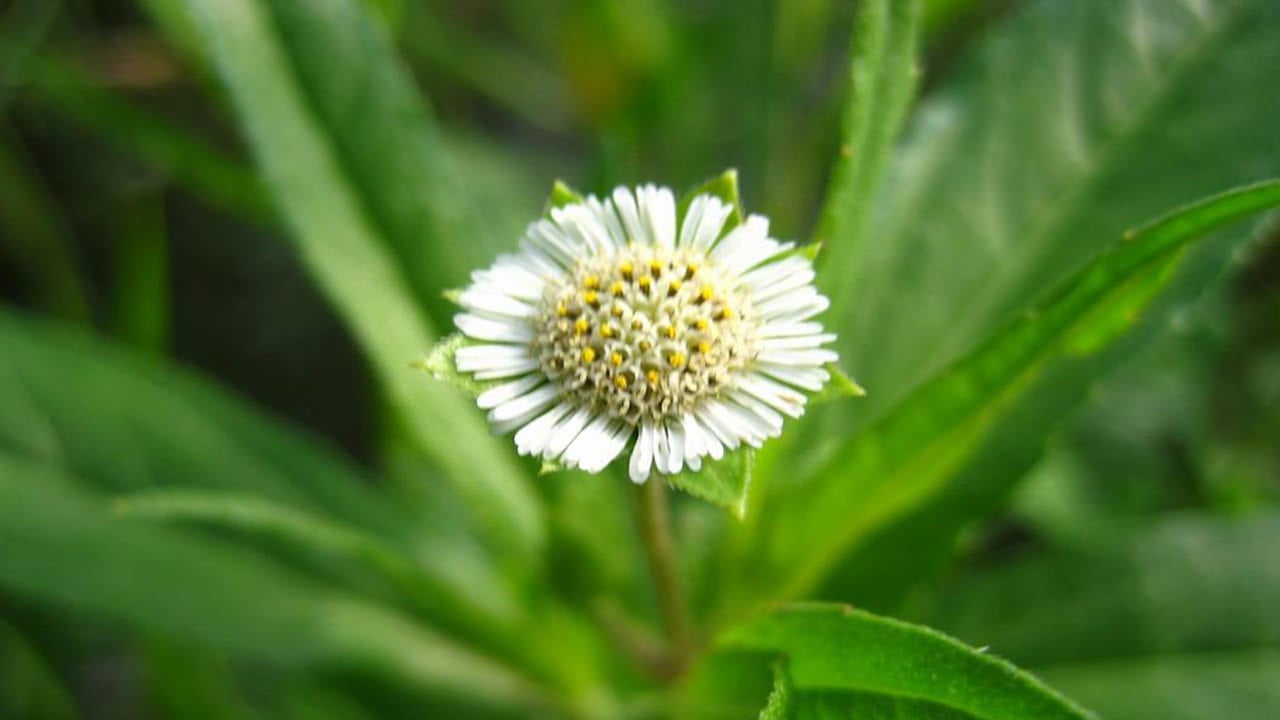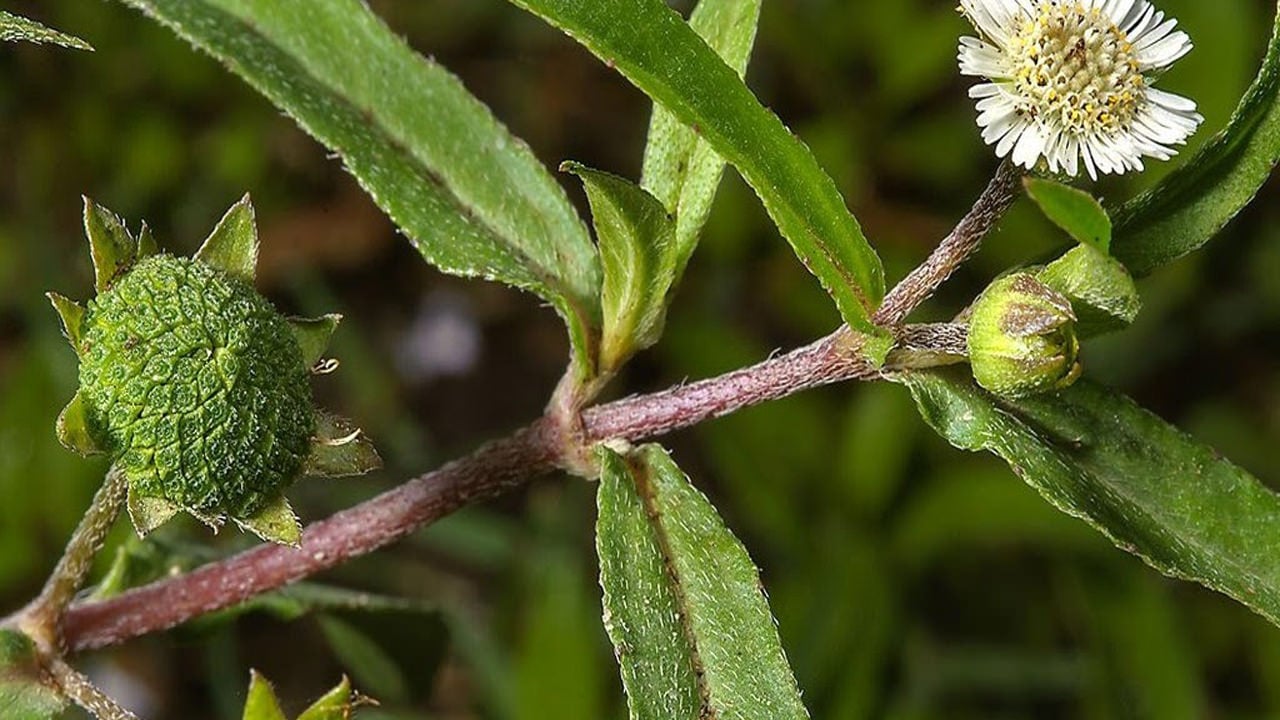
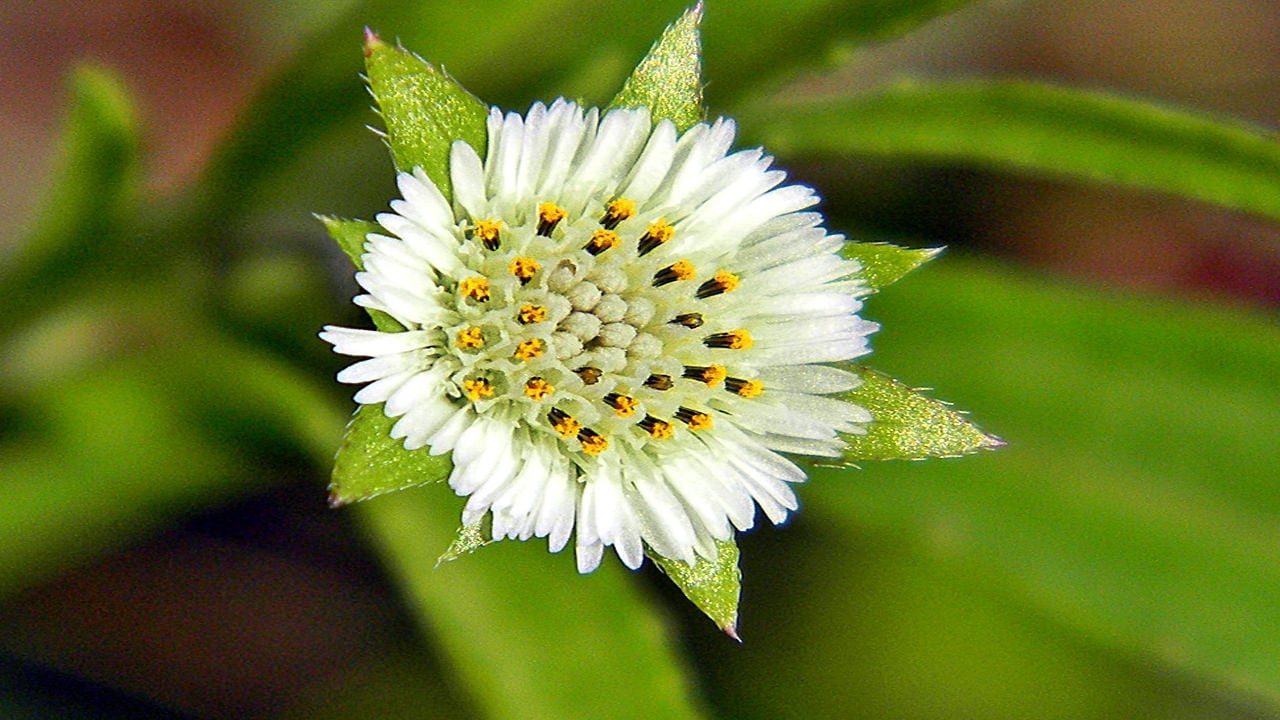

Eclipta prostrata, known in Sri Lanka as Keekirindiya (කීකිරිඳිය), is a small but botanically significant flowering plant in the sunflower family (Asteraceae). Widely distributed across tropical and warm temperate regions, it appears in rice paddies, moist roadsides, riverbanks, and disturbed ground across South Asia, Southeast Asia, East Asia, and parts of the Americas. Despite its modest appearance, this plant carries a long history of use in traditional medicine systems, particularly Ayurveda.
What does Eclipta prostrata look like?
The plant is an annual or short-lived perennial herb that grows low and spreading, often rooting at the nodes where it contacts moist soil. Its roots are cylindrical and greyish. The leaves are lance-shaped, rough-textured, and arranged oppositely along the stem. Flower heads are small — typically 6 to 8 mm in diameter — and bear white ray florets surrounding a dense central disc. The achenes (seed-like fruits) are compressed and narrowly winged, which aids wind dispersal. The overall appearance is unassuming, making it easy to overlook among the weeds of a rice field or a garden path.
Where does Eclipta prostrata grow in Sri Lanka?
In Sri Lanka, Keekirindiya grows as a common weed in humid, low-lying areas, particularly in and around paddy fields (kumbura). It thrives in waterlogged or seasonally flooded soils and is found across the wet and intermediate zones of the island at lower elevations. Because it tolerates disturbance well, it colonises irrigation canal banks, garden edges, and the margins of wetlands. Globally, the species is widespread in India, Nepal, China, Thailand, and Brazil, and has naturalised in many other tropical countries.
What are the traditional uses of Eclipta prostrata in Ayurveda?
Within the Ayurvedic tradition, Eclipta prostrata is most commonly known by its Sanskrit name Bhringaraj — sometimes spelled Bhangra or Bhangraj in north India. The plant is described as bitter, pungent, and dry in its qualities. It has long been associated with treatments for hair and scalp conditions, liver support, and skin health in classical Ayurvedic formulations. In Sri Lankan and South Indian folk medicine, the fresh or dried plant is used in various preparations, including oils infused with the leaves.
It is worth noting that a related plant, Wedelia calendulacea, shares some of the same regional names. To distinguish them, the white-flowered Eclipta prostrata is sometimes called white bhangra, while the yellow-flowered Wedelia calendulacea is called yellow bhangra. Understanding this distinction matters when sourcing plant material for traditional preparations. Keekirindiya is often referenced alongside other classical Ayurvedic compounds — including formulations such as Yogaraja Guggulu — that combine multiple herbs for holistic therapeutic effect.
How is Eclipta prostrata used in traditional food and culinary practices?
In parts of southern India, the fresh leaves of Eclipta prostrata are ground into a traditional chutney, particularly using plants gathered from rice fields. This culinary use remains localised and is deeply tied to agricultural communities where the plant grows as a field weed. In Sri Lanka, the plant is not widely used as a food ingredient, but its presence in paddy-growing regions means that rural communities are familiar with it. The overlap between wild food plants and medicinal herbs is common in traditional South Asian knowledge systems.
What does modern research say about Eclipta prostrata?
Laboratory studies have investigated a range of bioactive compounds in Eclipta prostrata, including wedelolactone, coumestans, and various polyphenols. These compounds have shown interesting activity in cell and animal studies, prompting ongoing scientific interest. However, as with many traditionally used plants across Southeast Asia, high-quality clinical research in human populations remains limited. Findings from in-vitro or animal studies do not automatically translate to proven therapeutic effects in people, and no regulatory authority has approved the plant as a medicine for any specific condition based on current evidence. Practitioners of integrative medicine often note the value of such herbs within a broader traditional system, while acknowledging the need for rigorous clinical investigation.
How does Eclipta prostrata relate to Sri Lanka's broader herbal heritage?
Sri Lanka's indigenous medical tradition, known as Deshiya Chikitsa, and the Ayurvedic system it draws from are both rich in plant-based knowledge. Plants like Keekirindiya sit within a continuum of herbal wisdom that also includes well-known species such as Pongamia pinnata and Acacia chundra. Government-registered Ayurvedic physicians in Sri Lanka continue to prescribe formulations containing Eclipta prostrata for various conditions, working within a regulated framework that recognises traditional medicine as a formal healthcare stream. The island's biodiversity — spanning rainforests, wetlands, and agricultural landscapes — supports a remarkable variety of medicinal plants, many of which remain understudied by international science.
Is Eclipta prostrata safe to use?
When used in the doses and forms recommended by trained Ayurvedic practitioners, Eclipta prostrata is generally considered safe. The plant is not known to be toxic at typical culinary or traditional medicinal amounts. However, self-medication based on online information alone is not advisable. People taking pharmaceutical medications, those who are pregnant or breastfeeding, or anyone with a diagnosed medical condition should consult a qualified healthcare provider before using herbal preparations containing Keekirindiya. Quality and purity of plant material also vary, so sourcing from reputable Ayurvedic suppliers is important.