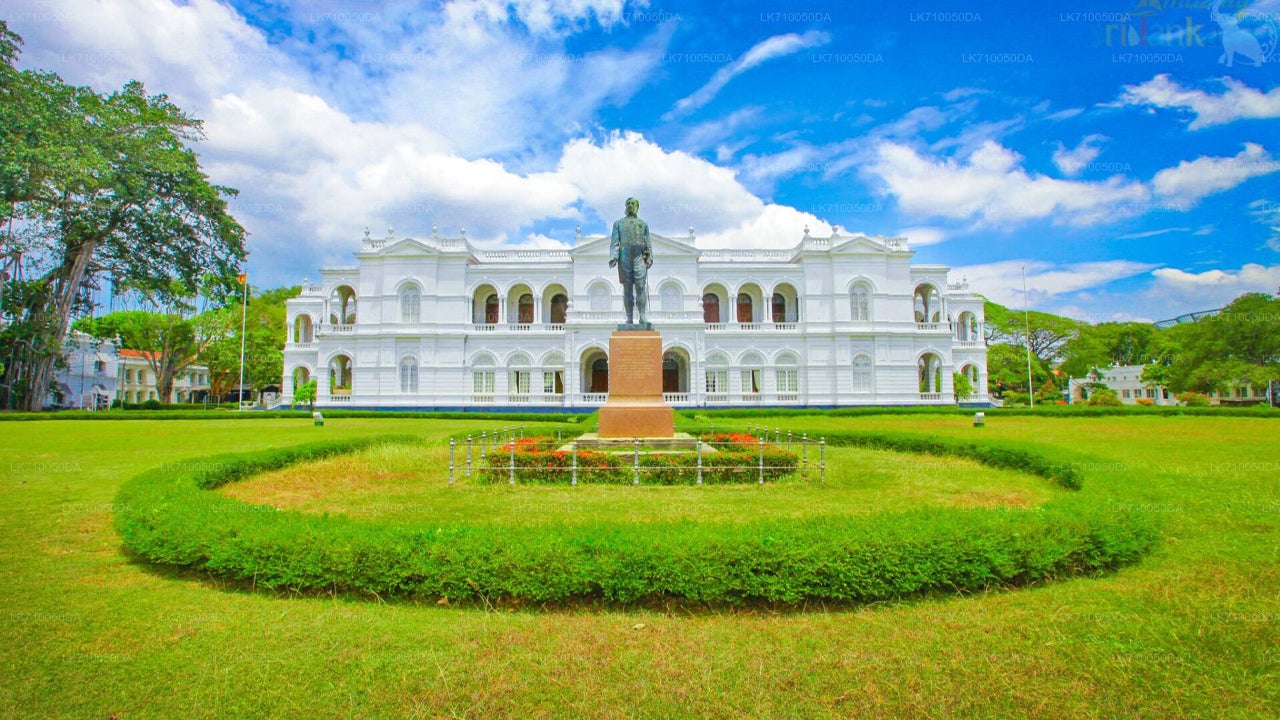
Tucked inside Colombo's busy Pettah district, the Dutch Period Museum occupies one of the oldest surviving colonial buildings in Sri Lanka. Built in 1692 as the official residence of a Dutch governor, the two-storey structure has served as a seminary, an orphanage, a military hospital, army barracks, a police training school, and a post office — before finally finding its most fitting role as a museum dedicated to the era that shaped it. Today it stands as a rare, intact example of Dutch urban architecture in South Asia and one of Colombo's most rewarding heritage stops.
Why was the Dutch Period Museum built, and who commissioned it?
When the Dutch East India Company (VOC) consolidated control over coastal Ceylon in the mid-17th century, it set about replacing Portuguese infrastructure with buildings that projected Dutch authority and permanence. Colombo, already an established port under the Portuguese, became a priority. In 1692, a colonnaded two-storey residence was completed for Governor Thomas van Rhee — the most senior Dutch administrator on the island at the time. The building's scale and classical proportions were deliberate: it signalled that the VOC intended a lasting presence.
Governor van Rhee's tenure ended in 1697, after which the building was repurposed rather than left vacant. Over the following century it housed a seminary for training clergy destined for Dutch-built churches across Ceylon, served briefly as the private residence of Colonel August Carl Frederick Von Ranzow, and was later converted into an orphanage administered by deacons of the Dutch Reformed Church and funded by the VOC.
How did the building change hands after Dutch rule ended?
The British took control of maritime Ceylon in 1796, and the former governor's residence entered yet another chapter. Military priorities came first: the building was converted into a hospital to treat soldiers wounded in campaigns around Colombo. It performed that function for roughly half a century before becoming military barracks in the latter half of the 19th century.
At the turn of the 20th century the British repurposed it again, this time as a police training school, which it remained until 1932. It then became Colombo's Pettah Post Office — a pragmatic use of a large, centrally located building that nonetheless did little to preserve its architectural character. The Dutch Fort in Negombo followed a similarly circuitous path under successive colonial administrations, illustrating how thoroughly the VOC's built heritage was absorbed and adapted across the island.
What nearly caused the museum building to be demolished?
By the mid-20th century, decades of heavy use and deferred maintenance had taken a serious toll. In 1971, heavy monsoonal rains caused sections of the outer walls to collapse. The government declared the structure unsafe and it was immediately abandoned. Given that the site occupied prime real estate in the heart of Colombo's commercial district, demolition was seriously considered.
It was civil pressure, not policy, that saved the building. The Royal Asiatic Society and the Dutch Burgher Union mounted sustained protests, arguing that the structure was irreplaceable. Their campaign succeeded: in 1973, the government reversed course and committed to a careful restoration. The project was eventually completed with assistance from the Dutch government, and the Dutch Period Museum opened to the public in 1982 under the management of the Central Cultural Fund of Sri Lanka.
What can visitors see inside the Dutch Period Museum?
The collection focuses on material culture from the Dutch colonial period, roughly spanning the mid-17th to the late 18th century. Exhibits are arranged across two floors and include:
- Furniture: heavy, dark-timber pieces typical of VOC-era domestic interiors, including cabinets, chairs, and four-poster beds brought from the Netherlands or crafted locally in the Dutch style.
- Ceramics and Delftware: blue-and-white tin-glazed pottery imported from the Netherlands alongside locally produced imitations.
- Maps and engravings: period cartography showing Dutch Ceylon and the wider Indian Ocean trade network the VOC dominated.
- Coins and trade artefacts: VOC coinage and objects that illustrate the commercial machinery behind Dutch colonialism.
- Portraits and documents: likenesses of Dutch governors and administrative records that place individual figures within the broader colonial story.
- Architecture itself: the building's colonnaded courtyard, wide verandahs, and thick lime-plastered walls are as instructive as anything inside it.
The ground-floor courtyard is particularly worth pausing in. The proportions and detailing — arched openings, heavy timber doors, a restrained classical facade — give a tangible sense of how Dutch administrators sought to recreate a familiar built environment in a tropical setting far from home.
Where is the Dutch Period Museum located, and how do I get there?
The museum is situated on Prince Street in the Pettah district, one of Colombo's oldest and most densely commercial neighbourhoods. Pettah lies roughly 3 kilometres north-east of Colombo Fort railway station and is well connected by city bus routes. Tuk-tuks and taxis from Colombo Fort or the Galle Face hotel area typically take around 10–15 minutes, depending on traffic. Parking in Pettah is limited, so arriving by three-wheeler or using a drop-off point is advisable.
A Colombo city tour can conveniently combine the Dutch Period Museum with other heritage sites in the Fort and Pettah area, including the Old Dutch Hospital complex a short walk away.
When is the best time to visit the Dutch Period Museum?
The museum is an indoor attraction, making it a good choice year-round regardless of the weather. It tends to be quieter on weekday mornings. Sri Lanka's two main monsoon seasons — the south-west monsoon from May to September and the north-east monsoon from October to January — can make outdoor sightseeing in Colombo uncomfortable, which makes museum visits particularly appealing during those months. Check current opening hours directly with the Central Cultural Fund or via the museum before visiting, as public holidays can affect access.
How does the Dutch Period Museum fit into Sri Lanka's broader colonial history?
Sri Lanka's colonial sequence — Portuguese (1505–1658), Dutch (1658–1796), British (1796–1948) — left overlapping layers of architecture, law, religion, and social practice that are still visible today. The Dutch period, though shorter than the British era that followed, was transformative: the VOC introduced Roman-Dutch law (elements of which persisted into the 20th century), established a network of Reformed churches, and built fortifications from Colombo to Galle. Understanding the Dutch period helps explain why Colombo's Pettah district still has street names, architectural fragments, and family surnames that point to the VOC's tenure. For travellers interested in this layered history, the Galle city tour offers a complementary perspective — the Galle Fort, a UNESCO World Heritage Site, preserves the most intact ensemble of Dutch colonial urban planning in Asia.
Nearby places
11 places within about 25 km, nearest first.
- Pettah Marketunder 1 km
- Old Town Hall, Colombounder 1 km
- Grand Mosque of Colombounder 1 km
- Pettah Bazaarunder 1 km
- Al Abra Mosqueunder 1 km
- Khan Clock Towerunder 1 km
- Pettah Floating Marketunder 1 km
- Red Mosqueunder 1 km
- Colombo Fort Railway Stationunder 1 km
- St Anthony's Churchunder 1 km
- Wolfendhal Churchunder 1 km
Related reading
8 pages on closely related subjects.