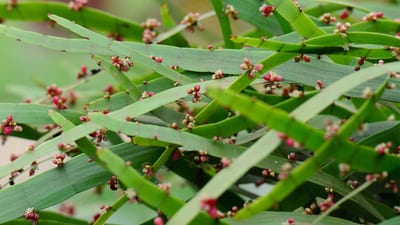
Dactyloctenium aegyptium is a grass species in the family Poaceae, recorded in Sri Lanka under the local name Potu thana. It is classified as native to the island. This profile summarises the recorded facts for the species.
What does Dactyloctenium aegyptium look like?
As a member of the Poaceae, Dactyloctenium aegyptium shares the general traits of the grass family: narrow, parallel-veined leaves, hollow jointed stems, and small wind-pollinated flowers arranged in spikes. Many species in this genus are low-growing annual grasses that spread along the ground before turning upward at the flowering stem, a habit that has earned related species common names such as crowfoot grass.
Where does Dactyloctenium aegyptium grow?
The species is recorded as native within Sri Lanka. Poaceae grasses of this type are typically found in open, sunlit ground such as disturbed soil, grassland and cultivated land, rather than in closed-canopy forest.
What is its conservation status?
The record lists Dactyloctenium aegyptium as native to Sri Lanka.
What is it called in Sinhala?
In Sinhala, the species is known as Potu thana.
Can Dactyloctenium aegyptium be eaten?
The record lists no edible parts for this species. It should not be treated as a food plant.
| Attribute | Recorded detail |
|---|---|
| Scientific name | Dactyloctenium aegyptium |
| Family | Poaceae |
| Sinhala / local name | Potu thana |
| Status in Sri Lanka | Native |
| Edible parts | None |