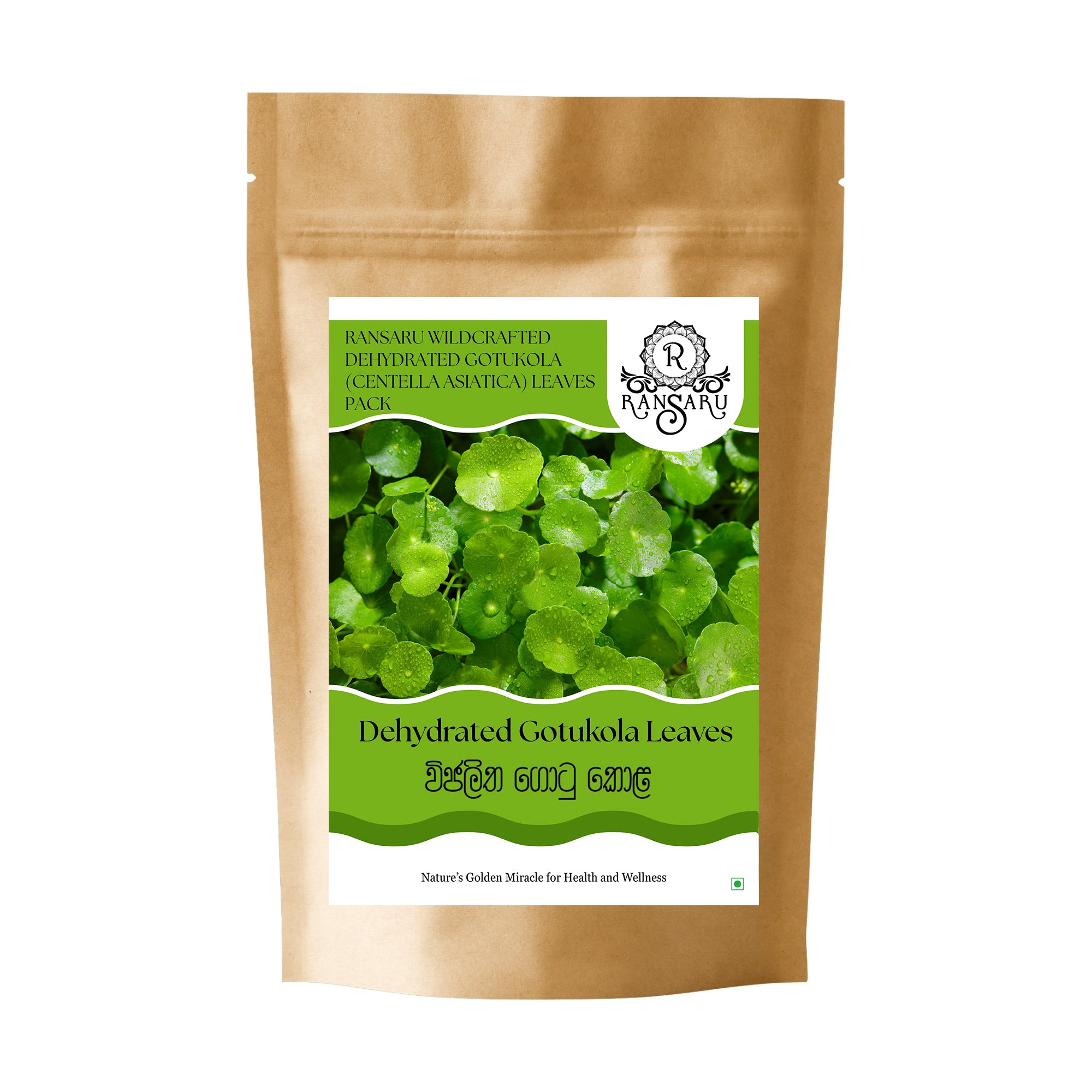
Centella asiatica — known locally as Gotu Kola (ගොටු කොල) — is one of Sri Lanka's most valued medicinal plants. A low-growing, creeping herb found across wetlands, stream banks, and home gardens throughout the island, it has been used in Ayurvedic and traditional medicine for centuries. Its unassuming appearance belies a long history of therapeutic application that spans Sri Lanka, India, and much of Southeast Asia.
What does Centella asiatica look like?
The plant grows as a mat of slender, creeping stolons that range from green to reddish-green, connecting individual plants along the ground. Its leaves are distinctive: rounded, long-stalked, and smooth-textured, with palmately netted veins. The petioles typically reach around 2 cm in length.
Below ground, vertical rhizomes form the rootstock, cream-coloured and covered in fine root hairs. Flowers are small — under 3 mm — and appear in tight, rounded clusters (umbels) close to the soil surface. They are white or crimson and partly enclosed by two green bracts. Each hermaphrodite flower bears five stamens and two styles, with five to six corolla lobes. The fruit are densely reticulate, which helps distinguish Centella asiatica from the related genus Hydrocotyle, whose fruit are smooth, ribbed, or warty.
Where does Gotu Kola grow in Sri Lanka?
Centella asiatica is indigenous to the Indian subcontinent, Sri Lanka, and much of Southeast Asia, with naturalized populations in wetland areas of the southeastern United States. In Sri Lanka, it thrives in the moist lowlands and intermediate zones, often found along irrigation channels, paddy field margins, and shaded riverbanks.
Because the plant is essentially aquatic by preference, it is particularly sensitive to chemical and biological pollutants in water, which can be absorbed directly into the plant tissue. This makes sourcing from clean, uncontaminated environments important for medicinal or culinary use. That said, Gotu Kola can be cultivated in drier soils provided they receive consistent irrigation — making it a practical choice for home gardens across the island.
The plant is listed in the official catalog of Ayurvedic medicinal plants of Sri Lanka, reflecting its deep-rooted place in the island's botanical heritage. Like Acacia chundra and other indigenous species, it forms part of a broader tradition of plant-based healing that continues to be practiced today.
How is Gotu Kola harvested and cultivated?
The crop reaches maturity in around three months. Harvesting is done manually and typically involves the entire plant, roots included. Centella is rated as a highly invasive species in non-native environments, spreading readily via its creeping stolons, so cultivation outside its natural range warrants careful management.
In Sri Lanka, small-scale cultivation is common in rural home gardens and organic farms. Wildcrafted plants — gathered from unmanaged natural habitats — are also widely available and considered by some practitioners to carry greater potency than cultivated varieties, provided the growing environment is free from contamination.
What are the traditional uses of Centella asiatica?
In Sri Lanka's Ayurvedic tradition, Gotu Kola is considered a medhya rasayana — a class of herbs believed to support cognitive function and mental clarity. It has long been used in formulations addressing nervous system health, wound healing, and skin conditions.
- Cognitive support: Traditional texts reference Gotu Kola as a tonic for memory and concentration, and modern research has begun examining its active compounds — primarily triterpenoids such as asiaticoside and madecassoside — for neuroprotective effects.
- Wound healing and skin health: Topical preparations derived from the plant have been used to support tissue repair and manage inflammatory skin conditions.
- Culinary use: In Sri Lanka, fresh Gotu Kola leaves are a routine ingredient in mallum (a shredded leaf salad) and sambol, often paired with grated coconut. The leaves have a mildly bitter, grassy flavour.
- Herbal teas and juices: Fresh leaf juice and dried-leaf infusions are consumed as daily tonics, particularly in rural communities.
Modern research into Centella asiatica is ongoing. Several clinical studies have investigated its potential role in wound healing, venous insufficiency, and anxiety reduction, though it is important to consult a qualified practitioner before using concentrated extracts medicinally.
How is Gotu Kola used in Sri Lankan cooking?
Outside the pharmacy, Gotu Kola is a genuinely common ingredient on the Sri Lankan table. Freshly chopped leaves are mixed with grated coconut, green chilli, shallots, and lime juice to make gotukola sambol — a side dish served alongside rice and curry across the country. The leaves can also be blanched and incorporated into mallum, a dry-fried green preparation common in both Sinhalese and Tamil cooking.
Cold-pressed or blended Gotu Kola juice, sometimes combined with other herbs or coconut water, is sold at roadside stalls and Ayurvedic wellness centres. Dehydrated leaves are increasingly available for those who want to incorporate the herb into their diet at home without access to fresh supplies — a practical option for travellers returning from Sri Lanka.
What is the relationship between Gotu Kola and Ayurveda in Sri Lanka?
Sri Lanka has a continuous Ayurvedic tradition that dates back over two millennia, and Centella asiatica occupies a prominent position within it. The plant appears in classical Sanskrit texts as mandookaparni and is referenced in Sri Lankan Ola leaf manuscripts as a key ingredient in formulations for longevity and mental vigour.
Today, licensed Ayurvedic physicians across the island incorporate Gotu Kola into compound preparations such as Yogaraja Guggulu and related formulations targeting joint and nervous system conditions. Government-registered Ayurvedic hospitals and private wellness retreats both use the herb, reflecting its enduring credibility within Sri Lanka's formal healthcare landscape alongside its informal, everyday use in cooking.
Can I buy Gotu Kola products to take home?
Fresh Gotu Kola is widely available at local markets throughout Sri Lanka, but it perishes quickly and cannot be carried through most international customs in fresh form. Dried and dehydrated leaf preparations are a practical alternative — they retain much of the nutritional profile of fresh leaves and can be stored for extended periods. Wildcrafted, dehydrated Gotu Kola leaves sourced from clean environments in Sri Lanka are available through Lakpura for travellers who want to continue using the herb after returning home.