Tucked into the forested hills above Kitulgala, Belilena Cave is one of Sri Lanka's most significant prehistoric sites. Sitting roughly 2,000 feet above sea level and reachable only on foot through rubber plantations and jungle, it rewards the effort with a rare window into human habitation on the island stretching back more than 30,000 years. For travellers interested in archaeology, natural history, or simply an off-the-beaten-track half-day walk, Belilena offers something that few sites in South Asia can match.
What makes Belilena Cave historically significant?
Archaeological excavations at Belilena have unearthed skeletal remains and artefacts belonging to Homo sapiens balangodensis — popularly known as the Balangoda Man — dated to around 12,000 to 16,000 years before present, with some fossil material believed to be more than 32,000 years old. This sub-species of anatomically modern humans is thought to be an ancestor of the Vedda people, Sri Lanka's indigenous community.
The cave is vast, and a shallow lake forms a short distance from its mouth, beyond which the deeper chambers remain largely unexplored. Stalactites and stalagmites — conical calcium carbonate formations — rise from the floor and hang from the ceiling throughout, some reaching heights comparable to a small child. The scientific study of these formations and the broader cave environment is part of a discipline called speleology, which has gained quiet momentum in Sri Lanka over recent decades.
Belilena is one of several important cave sites concentrated in the wet zone hills. Sri Lanka's best-known prehistoric cave, Fa Hien-Lena (Pahiyangala), has yielded evidence of Balangoda Man dating to around 37,000 BP — the earliest confirmed record. Batadomba-Lena follows at roughly 31,000 and 18,000 BP. Belilena fits into this broader network of sites that together tell the story of Sri Lanka's earliest inhabitants.
Where is Belilena Cave and how do you get there?
The cave lies approximately 8 km from Kitulgala town, near the Inoya estate. The approach involves a walk through rubber plantation and secondary jungle — wear sturdy footwear and expect some uneven terrain. There is no paved road to the cave entrance, so private vehicles can only take you to a certain point. From Kitulgala, a local guide is strongly recommended both for navigation and for context when you reach the site.
Kitulgala itself sits roughly 70 km east of Colombo along the A7 highway, making it a feasible day trip from the capital. The drive typically takes around two hours depending on traffic. Alternatively, Belilena can be combined with a night in Kitulgala, particularly if you are also planning white-water rafting on the Kelani River, for which the town is well known.
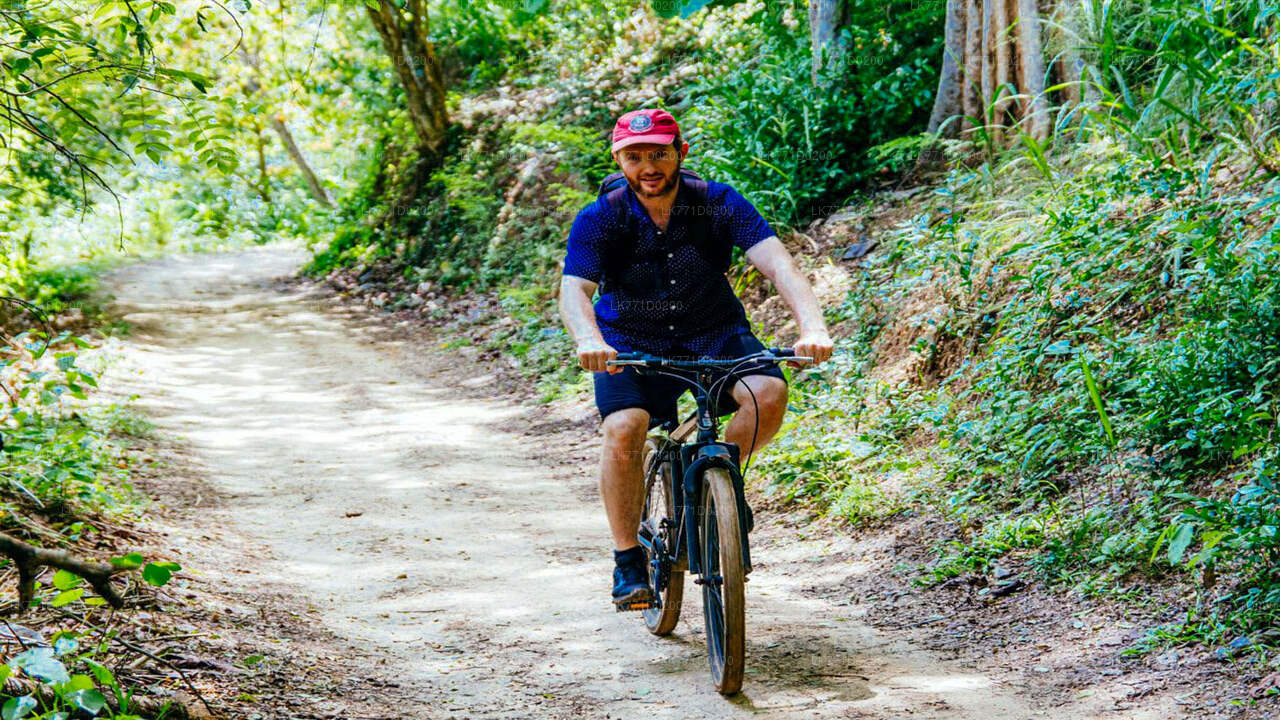
If you prefer to explore the area on two wheels, the forest trails around Kitulgala lend themselves to a cycling approach to the cave — an option that adds physical challenge and a closer encounter with the surrounding Makandawa Rainforest.
What is the surrounding landscape like?
Kitulgala sits in Sri Lanka's wet zone, receiving rainfall from two monsoons each year, which keeps the forests dense and the Kelani River well fed. The town is surrounded by lowland rainforest rich in bird life. Sri Lanka's most recently described endemic bird, the Serendib scops owl, was first heard calling in these forests by naturalist Deepal Warakagoda. The hills above the rubber plantations are also good habitat for mountain hawk-eagle, crested treeswift, and Layard's parakeet.
Film enthusiasts may recognise the river: David Lean's Academy Award-winning The Bridge on the River Kwai (1957) was shot on the Kelani near Kitulgala. The bridge itself no longer stands, though concrete foundations remain visible from the riverbank, and the submerged carriages from the film's climactic scene are reportedly still on the riverbed.
The driest and most comfortable period to visit is roughly December through March, with February generally seeing the lowest rainfall. At other times the jungle path to Belilena can become muddy and slippery after heavy rain.
What should you know before visiting Belilena Cave?
- Guide: Hire a knowledgeable local guide from Kitulgala. The path is not always clearly marked and the archaeological context greatly enriches the experience.
- Footwear: Closed-toe shoes with grip are essential. The jungle trail and cave floor are uneven.
- Torch or headlamp: Bring your own reliable light source. The interior is dark and the formations are best appreciated up close.
- Wildlife: The cave and surrounding forest are home to bats and various insects. Expect both inside the cave.
- Time: Allow a full half-day from Kitulgala: roughly an hour's walk each way plus time inside the cave.
- Preservation: Do not touch or remove any stalactites, stalagmites, or fossil material. The site retains scientific value and removal is illegal.
How does Belilena relate to other cave sites in Sri Lanka?
Sri Lanka's cave network stretches from the Ritigala hills in the north through the central highlands to the southern lowlands. Beyond their prehistoric significance, many caves serve as important bat colonies — Wavulpane cave in the south, for example, is estimated to shelter tens of thousands of bats and takes its name from the Sinhala word for bat. Cave exploration as a recreational and scientific pursuit remains relatively niche in Sri Lanka, which means sites like Belilena see far fewer visitors than the island's better-known attractions, preserving much of their atmosphere and ecological integrity.
For travellers combining Belilena with a broader hill-country itinerary, the Sinharaja Forest Reserve — a UNESCO World Heritage Site — lies roughly two hours south and offers another dimension of Sri Lanka's natural heritage.
When is the best time to visit Belilena Cave?
The most reliable window is between December and March, when the wet zone receives less rainfall and the jungle path is more manageable. February is typically the driest month in Kitulgala. Visiting during the inter-monsoon or monsoon periods is possible but the trail can become hazardous, and the cave entrance area may be waterlogged. Early morning starts are advisable year-round to avoid afternoon heat on the approach walk.
Nearby places
14 places within about 25 km, nearest first.
- Handun Ellaunder 1 km
- Makandawa Rainforest1 km
- Sandun Ella1 km
- Abseiling1 km
- The Bridge on the River Kwai1 km
- Hakgedi Ella Waterfall1 km
- Rafting2 km
- White Water Rafting2 km
- Kithulgala Belilena Caves4 km
- Olu Ella5 km
- Pinnawala Railway Station8 km
- Aluth Nuwara Devalaya10 km
- Asupini Ella Falls10 km
- Deraniyagala11 km
Related reading
3 pages on closely related subjects.