
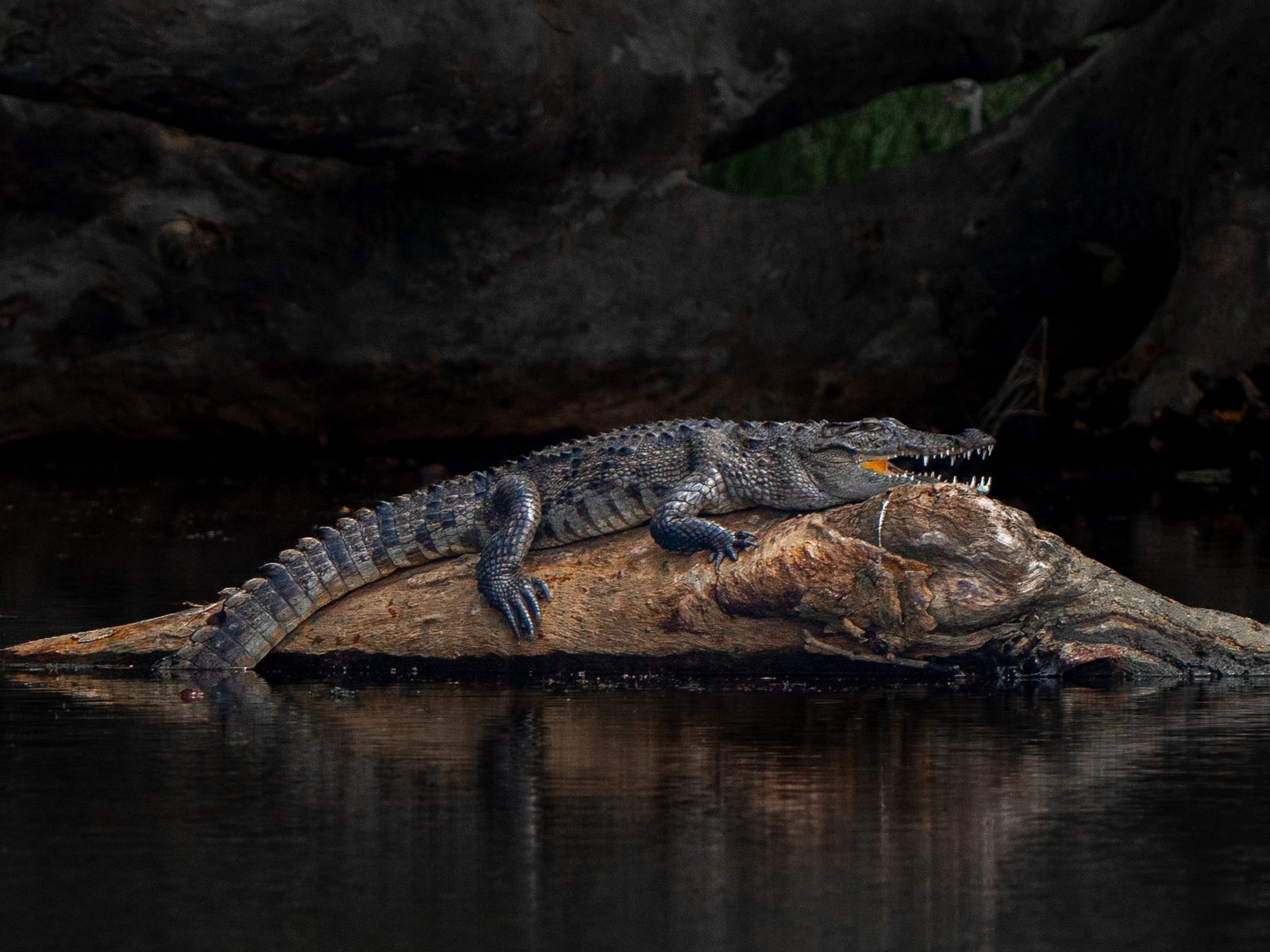


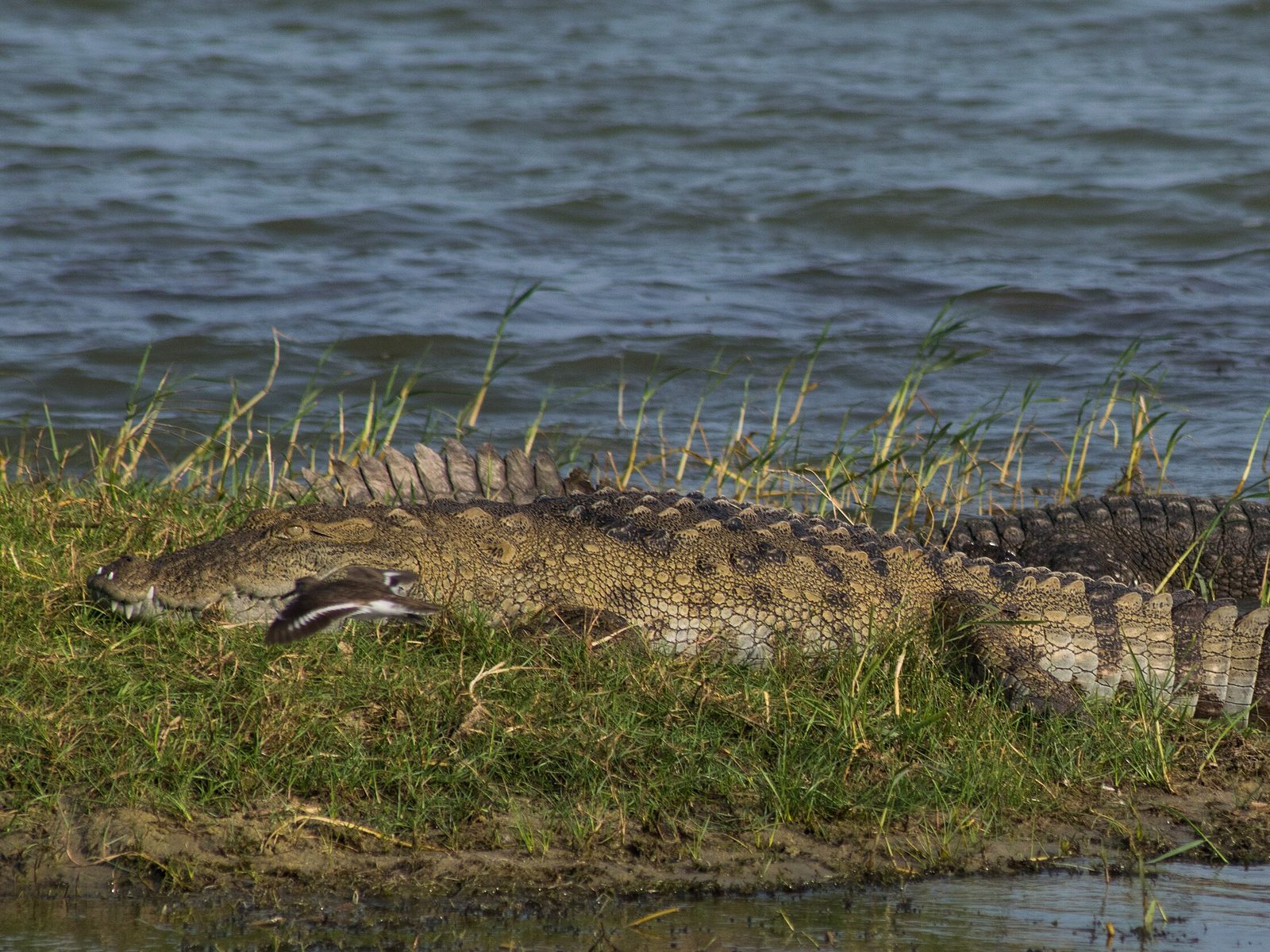
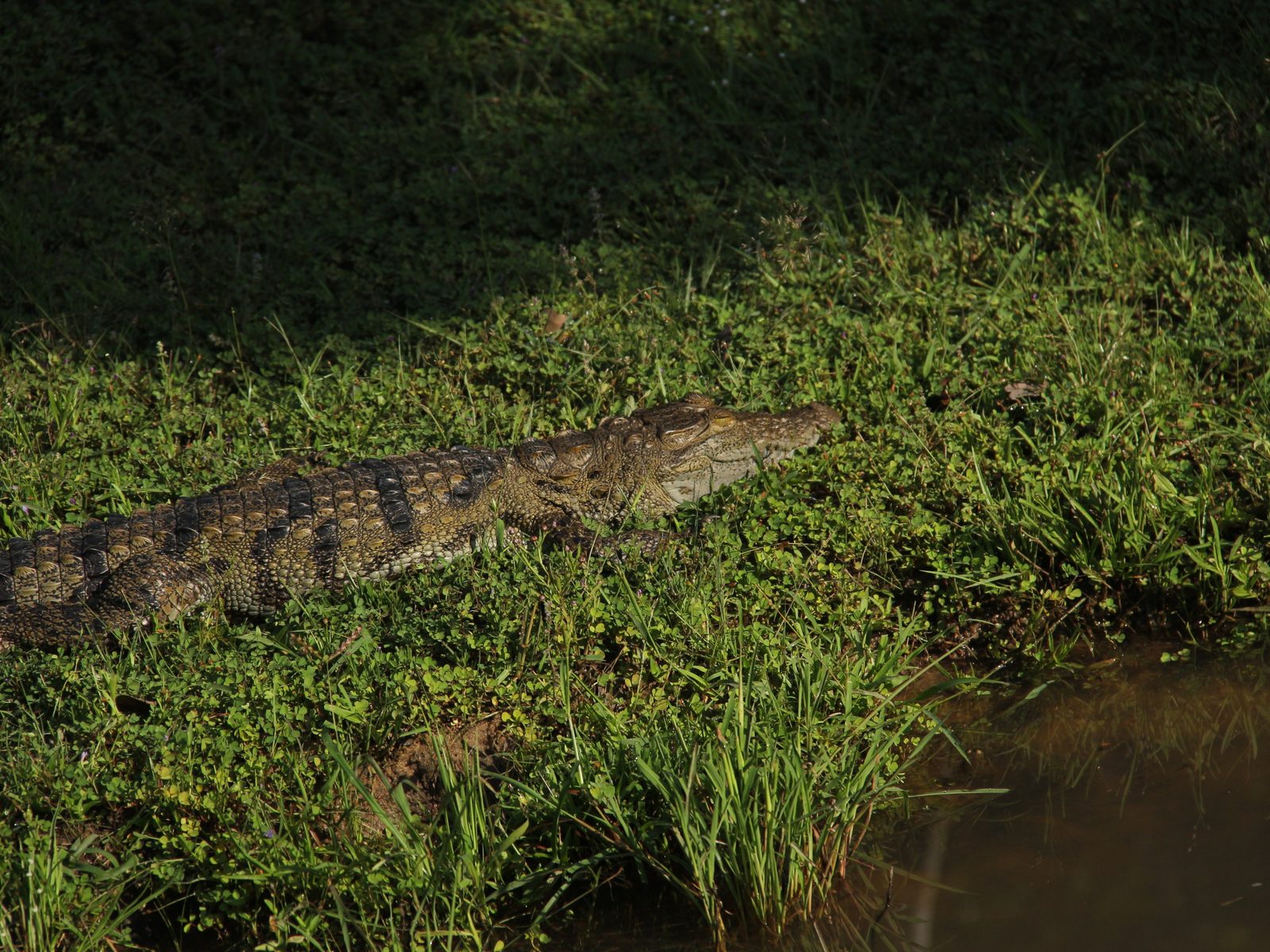
Sri Lanka has two crocodiles, and they lead very different lives. The mugger (Crocodylus palustris) is a broad-snouted freshwater crocodile that lives in the ancient tanks of the dry zone. The saltwater crocodile (Crocodylus porosus) is the largest living reptile, and it works the island’s rivers, lagoons and estuaries, sometimes swimming well out to sea. Both are true crocodiles, both are protected by law, and both are far more numerous than most visitors realise.
This guide covers the two species, how to tell them apart, where they live, the parks and waterways where you can see them safely, and what Sri Lanka’s long record of crocodile attacks teaches about sharing water with a predator.
What crocodiles live in Sri Lanka?
Sri Lanka has exactly two species of crocodile, and no alligators, caimans or gharials. They are not close lookalikes once you know what to look for: the mugger is a stocky freshwater animal with the broadest snout of any living crocodile, while the saltwater crocodile is a longer, heavier predator with a narrower head and a tolerance for salt water.
The two rarely share the same stretch of water. The mugger belongs to the dry-zone lowlands, where it lives in tanks, marshes and slow rivers. The saltwater crocodile belongs to the coast and to the wet-zone rivers of the south and west, and to the big lagoons of the east.
| Feature | Mugger (Crocodylus palustris) | Saltwater crocodile (Crocodylus porosus) |
|---|---|---|
| Snout | Broad and blunt — the widest of any living crocodile | Longer than wide, with two ridges running back from the eyes |
| Typical adult male | 3–3.5 m, rarely 5 m | Up to about 6 m, very rarely more |
| Adult female | 2–2.5 m | 2.7–3.1 m |
| Colour | Olive, grey or brown; hatchlings pale with black spots | Olive-grey above and pale below; juveniles yellow with black stripes |
| Neck armour | Large scutes set close to the back plates | Fewer scutes, with a gap before the back plates |
| Habitat | Freshwater tanks, marshes and slow rivers | Estuaries, lagoons, rivers and the sea |
| Nest | A hole dug in sand or earth | A mound of vegetation and mud |
| IUCN Red List | Vulnerable | Least Concern |
| CITES | Appendix I | Appendix I |
How do you tell a mugger from a saltwater crocodile?
Look at the head first. The mugger’s snout is broad, blunt and almost rectangular, set in a heavy, rounded jaw. The saltwater crocodile’s snout is longer than it is wide and carries two raised ridges that run from the eyes towards the nose. From a safari jeep, that head shape is usually the quickest clue.
Then judge the size. A big male mugger is usually 3 to 3.5 metres and only rarely reaches 5 metres. A male saltwater crocodile is a different order of animal: 5 to 6 metres is a large adult, and the species is the largest living reptile on earth. Females of both species are much smaller.
Look at the neck and back. The saltwater crocodile has fewer, smaller plates on its neck and a visible gap between the neck shield and the armoured back. The mugger’s neck carries large scutes that sit close to the back plates, giving it a heavier, more continuous suit of armour.
Habitat usually settles it. A crocodile in a dry-zone tank, a village reservoir or a slow freshwater river is almost certainly a mugger. A crocodile in an estuary, a mangrove lagoon or the sea is almost certainly a saltwater crocodile. The two overlap in a few coastal areas, and the wet-zone rivers can hold both, so identification is never quite as simple as location alone.
The nests are different too. Muggers dig a hole in sand or earth and cover the eggs. Saltwater crocodiles build a mound of vegetation and mud. You are unlikely to see either on a normal safari, but the difference explains why the two species favour different shorelines.
The mugger: Sri Lanka’s tank crocodile
The mugger is known in Sinhala as hela kimbula or ala kimbula, and in Tamil as kulathi or chenganni muthalai. Sri Lankans also call it the tank crocodile, and the name is exact: the island’s man-made reservoirs are its main habitat. Most of Sri Lanka’s roughly 12,000 tanks were built between the fifth century BC and the fourteenth century AD, and the mugger moved into them and never left.
What does a mugger look like?
It is a medium-sized, thick-set crocodile with a broad, heavy head and the widest snout of any living species. Adults are dark olive, grey or brown; hatchlings are pale olive with black spots and bars. The legs are strong and the animal can walk with its body lifted clear of the ground, a gait usually called the “high walk”, which lets it move between tanks when one dries out. It also digs burrows up to several metres into a bank, where the temperature stays between about 19 and 29 °C — a refuge from both drought and heat.
Where do muggers live in Sri Lanka?
Muggers are a lowland dry-zone species, mostly below 100 metres and rarely above 400. They live in tanks, marshes, canals and slow rivers, and they also enter hyper-saline estuaries in some coastal areas. The strongholds are the protected areas: Yala, Wilpattu, Bundala, Maduru Oya, Gal Oya and Kumana, with important populations also at Chundikulam, Panama and Yodhawewa. The Jaffna peninsula still holds a healthy mugger population. Outside the parks, almost every large tank in the dry zone is potential habitat.
How many muggers are there?
The numbers depend on the survey. A 1977 estimate put the national population at about 3,000. An island-wide survey between 2015 and 2017 counted about 7,500 muggers in 1,673 water bodies, with the highest totals in the Eastern Province (1,868) and the Southern Province (1,480). The two figures are not directly comparable, and some researchers still regard the species as declining outside protected areas. What is clear is that the mugger is widespread, that the parks hold the densest populations, and that unprotected tanks are where the losses happen.
Are muggers endangered?
Globally, yes: the IUCN Red List has classed the mugger as Vulnerable since 1982, and it is on CITES Appendix I, which bans international commercial trade. In Sri Lanka the picture is mixed. Populations inside Yala and Wilpattu look secure, but the species is exposed to habitat loss, drowning in gillnets, retaliatory killing and the collection of eggs. Some Sri Lankan researchers have argued that the national population meets the criteria for Endangered even while the global listing remains Vulnerable.
The saltwater crocodile: the river and lagoon giant
The saltwater crocodile is geta kimbula in Sinhala, a name that refers to the knobbly texture of its skin; it is also called minikana kimbula, “the man-eater”. In Tamil it is semmukhan, the copper-coloured crocodile. It is the largest living reptile, and the only crocodile that regularly crosses open ocean. Salt glands under the tongue let it shed excess salt, which is why it can spend days or weeks in salt water and turn up on coasts far from any river.
How big does a saltwater crocodile get?
Adult females are usually 2.7 to 3.1 metres. Males keep growing for much longer and can reach 6 metres or more; the largest authenticated specimen from Sri Lanka was a suspected man-eater killed in the Eastern Province at exactly 6 metres. Nineteenth-century reports of 6.7-metre animals are not verifiable, and the largest reliably measured crocodile anywhere was about 6.3 metres. Even so, a 5-metre animal is a formidable predator, and the species has the strongest bite force measured in any living animal.
Where do saltwater crocodiles live in Sri Lanka?
This is primarily a wet-zone and coastal species. The strongholds are the rivers and estuaries of the south and west — the Nilwala at Matara, the Bentota, the Bolgoda, the Kelani and the Maha Oya — and the lagoons of the east coast, especially around Batticaloa. They have been recorded in Yala and Bundala, and in Colombo Port, and are occasionally seen in the sea off Matara, Beruwala, Bentota, Induruwa, Balapitiya and Dehiwala. A crocodile offshore is not necessarily lost: it may be moving between river systems.
How many saltwater crocodiles are there?
A five-year survey between 2008 and 2012 recorded 778 sightings at 262 of 400 sites and estimated more than 2,000 non-hatchling saltwater crocodiles in the country, with the population growing at roughly 5% a year since 1978. Sightings were concentrated in the wet-zone waterways: the Nilwala basin accounted for about 18%, the Bolgoda River and lake for about 20%, the Bentota and Meegama basins for about 13%, and the Dutch-Hamilton canals and Ja-Ela River for about 13%. Most of the non-hatchling animals seen were juveniles, and large adults were scarce — a sign that big crocodiles are still being removed.
Is the saltwater crocodile endangered?
Not globally. The IUCN Red List has classed it as Least Concern since 1996, and it is protected in Australia, Indonesia and elsewhere. In Sri Lanka it is fully protected and listed on CITES Appendix I, which bans commercial trade. The local threats are habitat loss, sand mining, boat traffic, entanglement in fishing nets and deliberate killing after conflicts. The scarcity of large adults is the clearest sign that protection on paper is not yet protection in practice.
How do crocodiles live?
Both species are ectotherms: their body temperature follows the environment, and they manage it by basking in the sun, gaping their jaws to cool down, retreating to shade and, in the mugger’s case, digging burrows. That is why the best time to see a crocodile is usually the first warm hours after sunrise, when animals haul out to raise their temperature, and again in the late afternoon.
Nesting and eggs
The two species nest in different ways. A female mugger digs a hole 35 to 56 centimetres deep, usually within a few metres of the water, and lays 8 to 46 eggs between February and June; in Sri Lanka the eggs hatch around August and September. A female saltwater crocodile builds a mound nest of vegetation and mud, lays 40 to 60 eggs (occasionally up to 90), and guards them for roughly 80 to 90 days. In both species the temperature of the nest determines the sex of the hatchlings — a warmer nest produces more males up to a point, and then more females. Females — and, in the mugger, males too — may stay near the young for months, which is unusual for a reptile.
What do they eat?
Crocodiles are ambush predators, not chasers. They take fish, snakes, turtles, birds, crustaceans and mammals, and they scavenge carrion. A mugger will eat almost anything it can drown, from a monitor lizard to a deer; a large saltwater crocodile can take wild boar, buffalo calves, dogs and, occasionally, people. They hunt by waiting at the water’s edge or just below the surface, then exploding upwards. On land they can move fast for a short distance, but they tire quickly.
Why they matter
Both species are apex predators, and both shape the wetlands they live in. Mugger burrows stay cool and wet through the dry season and are used by frogs, freshwater turtles and insects as refuges. As top predators they sit at the top of the food web, and a tank with a healthy crocodile population is usually a tank with a functioning ecosystem.
Where can you see crocodiles in Sri Lanka?
The safest and most reliable way to see a wild crocodile is from a jeep or a boat with a licensed guide. Do not walk up to a tank or riverbank on your own, and never enter the water for a closer look. These are the places where sightings are most consistent.
- Yala National Park: the classic crocodile park. The tanks and lagoons of Block 1 hold one of the densest mugger populations in the country — an earlier survey put 500 to 600 adults and sub-adults in Block 1 alone, with more than 100 in Katagamuwa tank. Saltwater crocodiles have also been recorded in the park and its lagoons, though some may be animals moved there by wildlife officers. Best in the dry season, roughly February to June.
- Kumana National Park: mangrove-fringed lagoons in the south-east, with muggers in numbers and a great deal of birdlife. The dry season, February to June, concentrates animals around the remaining water.
- Bundala National Park: a Ramsar wetland of coastal lagoons near Hambantota, with saltwater crocodiles in the brackish water and muggers in the freshwater tanks. Good year-round; the driest months and the bird season (roughly November to March) are the most rewarding.
- Wilpattu National Park: the villus — shallow, sand-rimmed lakes — are perfect mugger habitat, and the park is one of the two most important crocodile areas in the country. Best from February to September.
- Gal Oya National Park: a boat safari on the Senanayake Samudraya reservoir is one of the quietest ways to see muggers on the shore, along with elephants and a great many birds. Good year-round, best in the morning; see the Gal Oya boat safari.
- Maduru Oya National Park: a large reservoir and dry-zone forest with a healthy mugger population, far less visited than Yala. Best in the dry season.
- Muthurajawela Wetlands: the marsh and lagoon north of Colombo, within easy reach of Negombo, with saltwater crocodiles and boat trips through the mangroves. Early morning is best.
- Bentota and Madu Ganga: two wet-zone waterways where saltwater crocodiles are regularly seen on boat safaris, usually in the early morning. The Bentota river safari is the easiest introduction.
- Nilwala River, Matara: one of the island’s most important saltwater crocodile rivers — and its worst record of attacks. See it from a boat with a local guide; do not swim, wade or wash at the edge.
- Trincomalee Crocodile Lake: a reservoir near Nedunkerni, in the east, known for its muggers and much quieter than the national parks. Year-round.
- Panama Lagoon: near Arugam Bay, a mangrove lagoon in the heart of mugger country; best in the east-coast dry season, roughly May to September.
Timing matters as much as place. The dry season — roughly December to April in the south and west, and June to September in the north and east — lowers water levels and concentrates crocodiles on the remaining banks. Early morning, from about 6 to 9 am, is the best window; late afternoon is second best. In the wet season the animals disperse and are harder to find.
For the practical side — when to go, what to take and how a crocodile safari works — see our guide to crocodile watching in Sri Lanka. For the rest of the island’s wildlife, start with wildlife and the national parks.
Crocodiles and people: the real risk
Sri Lanka records a high number of crocodile attacks for an island of its size, and the reason is not that the island has more crocodiles than anywhere else. It is that a large rural population uses crocodile water every day: bathing, washing clothes and utensils, fishing, collecting plants and driving cattle through tanks and rivers. Crocodiles learn those routines, and a routine is exactly what an ambush predator needs.
How dangerous are Sri Lanka’s crocodiles?
Between 2015 and 2024, the crocattack.org database recorded 91 crocodile attacks in Sri Lanka, 66 of them fatal. The mugger was responsible for 57 attacks and 41 deaths; the saltwater crocodile for 34 attacks and 25 deaths. That ordering surprises many visitors, who assume the giant saltwater crocodile must be the greater danger. In Sri Lanka the mugger is the bigger problem because it lives in the tanks people use every day.
An earlier island-wide survey, from 2008 to 2010, recorded 150 attacks and 50 deaths; the author personally investigated 131 of them, of which 31 were fatal. Of those 131 cases, 45% happened in tanks, 35% in small rivers and 17% in large rivers. More than half took place while people were bathing, and 83% of the victims were male. Three-quarters were dragged into the water. In 90% of the interviews, the victim had known crocodiles were present — the risk was underestimated, not unknown.
Why attacks happen
The common thread is what researchers call the “three SAMEs”: the same people, at the same place, at the same time, doing the same thing. A crocodile that watches a family wash clothes at the same ford every morning does not see a random encounter; it sees a predictable prey source. That is why attacks cluster at particular tanks, fords and river bends, and why they are most frequent in the early morning, late evening and at night.
Five regions account for a large share of the conflict: Weerawila–Hambantota–Tissamaharama, Kumana–Panama–Lahugala, Bibila–Nilgala–Ampara, Udawalawa–Thanamalwila–Lunugamvehera, and Anuradhapura–Kurunegala–Dambulla. The Nilwala River at Matara is the best-known saltwater hotspot, and Batticaloa Lagoon is another. A 2010–2024 analysis found that 40% of incidents happened in suburban areas and 40% in urban areas — this is no longer only a rural problem, because people are moving into crocodile habitat as much as crocodiles are moving into theirs.
How to stay safe around crocodiles
- Do not swim, wade or paddle in tanks, rivers, lagoons or estuaries where crocodiles live — including calm-looking water and the shallow edge.
- Avoid the water at dawn, dusk and night, when crocodiles are most active and hardest to see.
- Do not wash clothes, dishes or yourself at the water’s edge. Use a crocodile-excluding enclosure where one exists, or a tap or well away from the bank.
- Keep back from the waterline where warning signs are posted, and keep children and dogs away from the bank.
- Never feed or bait a crocodile, and do not throw fish scraps or food into the water.
- Camp only at designated sites, and pitch tents well away from the water.
- On a safari, stay in the vehicle or boat. Keep arms and legs inside, and follow the guide’s instructions.
- If you see a crocodile, stop, stay calm and back away. Tell your guide or the park office. If a crocodile charges, run away from the water in a straight line — it can sprint but tires quickly. If one grabs you, fight back and aim for the eyes and snout.
None of this is a reason to avoid Sri Lanka’s wetlands. It is a reason to treat them with the same respect you would give any predator’s territory — and to book a guide who does.
Conservation: what is being done
Crocodiles have been legally protected in Sri Lanka since 1938. Today both species are protected under the Fauna and Flora Protection Ordinance and listed on CITES Appendix I, which bans international commercial trade in them or their parts. The Department of Wildlife Conservation manages the protected areas; the difficulty is that many crocodile tanks lie outside those areas and fall under the Irrigation Department, where enforcement is weaker.
The threats are familiar and mostly man-made: wetlands drained and filled, mangroves cleared for prawn farms, sand mined from riverbeds, roads and railways built through habitat, gillnets set across channels, crocodiles killed in retaliation after an attack, eggs collected for food, and pollution. Climate change adds a new layer, with longer droughts and more intense floods both affecting nesting success.
There are practical successes too. In the Nilwala valley, families and village councils have built crocodile-excluding enclosures — simple timber, palm and metal structures that let people bathe and wash without entering open water — and warning signs have reduced attacks. Researchers argue that the long-term answer is not translocation or removal but giving communities alternative water sources, teaching the “three SAMEs” lesson, and making sure that the economic value of living crocodiles outweighs the value of a dead one.
For visitors, the contribution is simple. Choose licensed guides and operators who keep their distance and never bait an animal. Do not buy crocodile leather, meat or other products. Do not feed crocodiles, and do not ask a boatman to go closer for a photograph. Report an injured or problem crocodile to the park office or the Department of Wildlife Conservation. And when you post a photograph, leave out the exact location of a nesting bank.
Frequently asked questions
How many species of crocodile are there in Sri Lanka?
Two: the mugger (Crocodylus palustris) and the saltwater or estuarine crocodile (Crocodylus porosus). There are no alligators, caimans or gharials on the island.
Which is more dangerous, the mugger or the saltwater crocodile?
The mugger accounts for more recorded attacks in Sri Lanka — 57 of the 91 logged between 2015 and 2024, 41 of them fatal — because people use dry-zone tanks for bathing, washing and fishing. The saltwater crocodile is much larger but lives in rivers and lagoons where fewer people routinely enter the water.
Can I swim in the sea or in a river in Sri Lanka?
Do not swim in rivers, lagoons, estuaries or tanks where crocodiles live. Saltwater crocodiles also occur in coastal water near river mouths, so a quiet beach is not automatically safe. Swim at patrolled beaches, and stay out of the water at dawn and dusk.
Where is the best place to see crocodiles in Sri Lanka?
Yala, Kumana, Bundala, Wilpattu, Gal Oya and Maduru Oya national parks, and the wetlands at Muthurajawela, Bentota and Madu Ganga. A guided jeep or boat safari keeps you at a safe distance and knows where the resident animals bask.
Are crocodiles protected in Sri Lanka?
Yes. Both species are protected under the Fauna and Flora Protection Ordinance and listed on CITES Appendix I. Killing, capturing or trading them is illegal.
How big do Sri Lankan crocodiles get?
Male muggers usually reach 3 to 3.5 metres and rarely 5; the largest known were 5.63 metres, taken in Sri Lanka. Saltwater crocodiles are the largest living reptiles, with males reaching 6 metres or more; the largest authentic Sri Lankan specimen was 6 metres.
Do crocodiles live in the hill country?
No. Muggers are a lowland dry-zone species, mostly below 100 metres, and saltwater crocodiles keep to the coast and coastal rivers. The tea country is too high and too cool for both.
What should I do if I see a crocodile?
Stop, stay well back from the water and move away calmly. Never approach, feed or throw stones. Tell your guide or the park office, and warn anyone else nearby.
Photographs: mugger crocodiles at Gal Oya by Charles J. Sharp; at Wilpattu by Shaluka Herath; at Kumana by Arepticous; at Bundala by Nipuna Gamage — CC BY-SA 4.0. Saltwater crocodile at Bundala by A.Savin — Free Art License. All via Wikimedia Commons; images cropped and resized for this page.
Verder lezen
2 pagina's over nauw verwante onderwerpen.


