


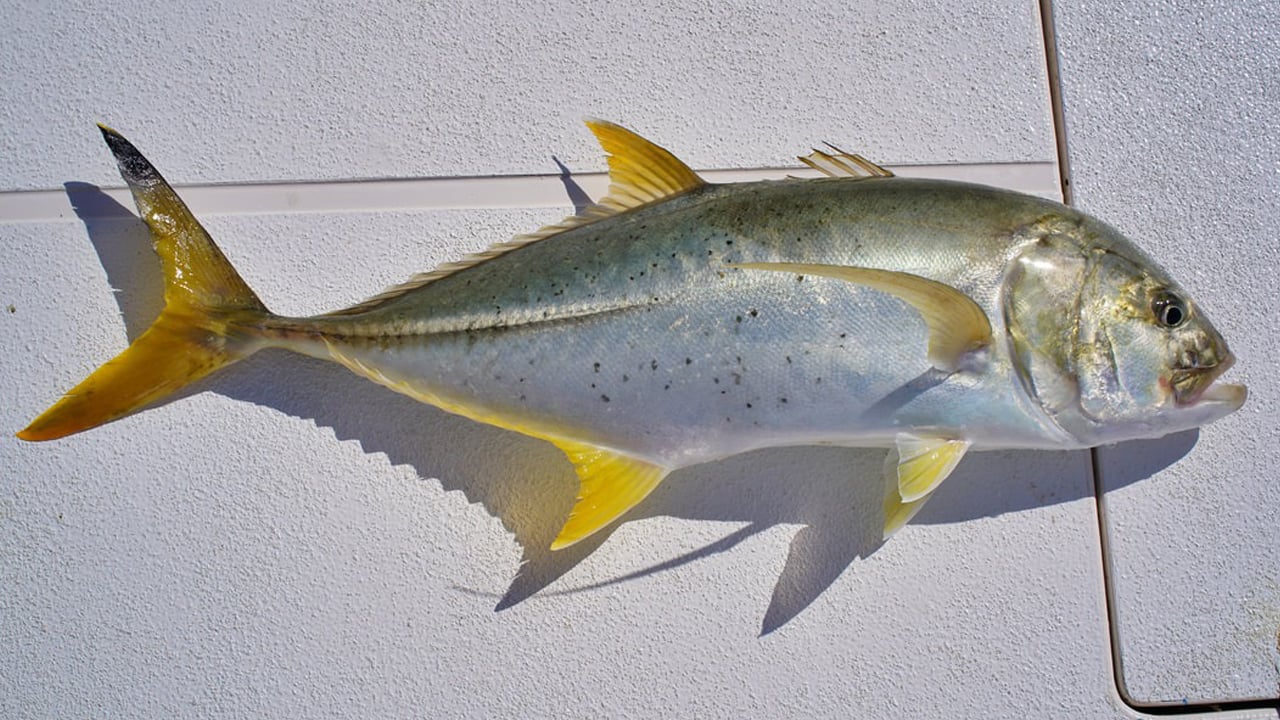
The yellowfin trevally (Caranx ignobilis) is one of the more recognisable predatory fish in the Indo-Pacific, identifiable by its yellow-tinted fins set against a streamlined silver body. Found across a broad arc of warm coastal water stretching from the Red Sea and East Africa through the Indian Ocean to the central Pacific, it is both an ecologically significant species and a prized target for anglers who appreciate its raw power on the line.
What does the yellowfin trevally look like?
The body is laterally compressed and torpedo-shaped — built for speed rather than endurance. The fins, particularly the dorsal and caudal fins, carry a distinctive yellow or yellow-green tinge that deepens in larger, older individuals. The flanks are silvery with occasional greenish reflections, and a black spot is typically present near the upper edge of the gill cover. This combination makes it relatively easy to tell apart from other large trevally species in the same waters.
Adults typically reach around 60–80 cm in length, though specimens approaching 1 metre and weighing close to 9 kg have been recorded. Most fish encountered in recreational or artisanal fisheries are considerably smaller.
Where does the yellowfin trevally live?
This species favours shallow to moderately deep coastal habitats: coral reefs, rocky headlands, sandy lagoons, and the open water just beyond reef edges. It is especially common around offshore seamounts and island groups where upwellings concentrate baitfish. In Sri Lanka, yellowfin trevally are encountered along the continental shelf and around the island's numerous reef systems, particularly in areas with strong tidal movement that concentrates prey.
Juvenile fish tend to occupy sheltered inshore areas — mangrove fringes, estuaries, and calm bays — before moving to more exposed reef environments as they mature. Adults are largely demersal to pelagic, moving between reef structure and open water depending on prey availability and time of day.
How does the yellowfin trevally hunt and feed?
Yellowfin trevally are active, opportunistic predators with a diet that shifts according to what is locally abundant. Smaller fish make up the bulk of their diet, supplemented by crustaceans and cephalopods such as squid. Rather than ambushing prey from cover, they are pursuit hunters — using burst speed and, frequently, coordinated group behaviour to drive baitfish into tight balls near the surface or against reef structures.
This schooling behaviour during feeding is one of the reasons the species is so visually dramatic to observe underwater or from the surface. Large aggregations can create visible surface disturbance as they force smaller fish into the air while feeding.
Why is the yellowfin trevally important to anglers?
Among sport fishers, Caranx ignobilis has a strong reputation for its initial run and sustained fighting ability relative to its size. It is regularly targeted on light to medium tackle using lures, poppers, and live bait. The species' tendency to school means that when one fish is located, others are typically nearby — making for productive sessions when conditions align.
It is also taken in commercial and artisanal fisheries across its range, valued for its firm, white flesh. In Sri Lanka, it is sold in local fish markets and used in a variety of preparations from simple grilled preparations to richly spiced curries.
What is the conservation status of the yellowfin trevally?
The yellowfin trevally is currently assessed as Least Concern on the IUCN Red List, reflecting a wide distribution and a population that has not shown dramatic overall decline. That said, like many coastal predatory fish, it faces localised pressure from intensive fishing, habitat degradation around reef systems, and the broader effects of climate change on coral ecosystems.
Responsible harvest practices — releasing undersized fish, observing local size and bag limits, and avoiding spawning aggregations — are practical steps that recreational anglers can take to help maintain healthy local populations. The species plays a genuine structural role in reef food webs: as a mid-to-upper predator, it helps regulate the populations of smaller fish and invertebrates below it in the food chain.
How does the yellowfin trevally fit into Sri Lanka's marine environment?
Sri Lanka sits at the intersection of the Bay of Bengal and the Indian Ocean, giving it access to a rich diversity of pelagic and reef-associated species. The seasonal monsoon cycle drives upwellings that replenish nutrients in coastal waters, supporting the baitfish populations that trevally and other predators depend upon. The southwest coast and the waters around the island's southern tip are particularly productive for larger pelagic species during the inter-monsoon and northeast monsoon seasons.
For visitors interested in marine wildlife, the yellowfin trevally is one of several large, visually impressive fish that can be observed on reef dives or encountered during fishing excursions — sitting alongside species such as giant trevally, barracuda, and various grouper in the island's reef communities.
