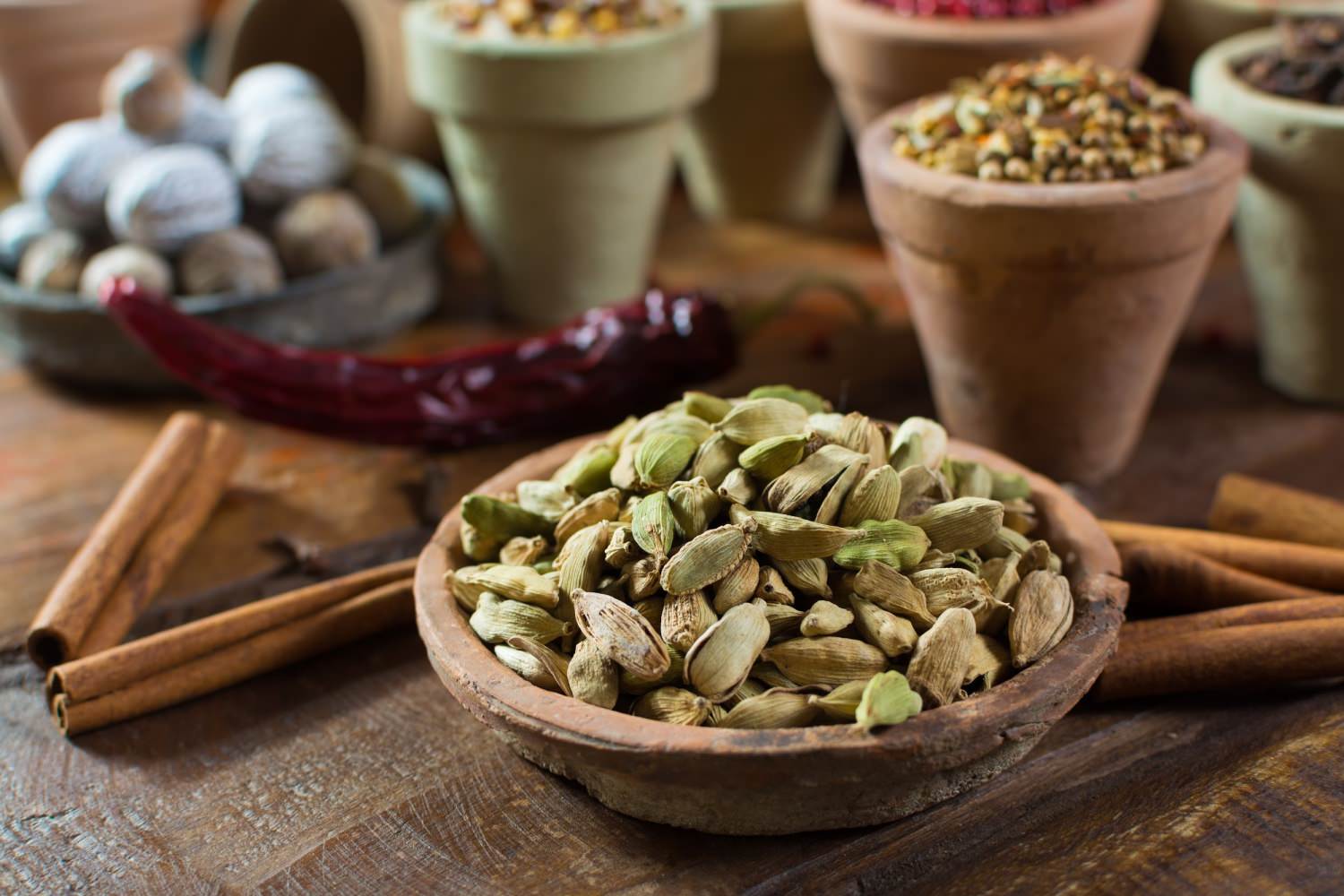
Cardamom ranks among the world's most expensive spices, trailing only saffron and vanilla, yet a small quantity goes a surprisingly long way. Native to the forests of South Asia, it has travelled through centuries of trade to become indispensable in kitchens from Colombo to Copenhagen. Sri Lanka's highland estates — particularly those in the Kandy and Ella regions — produce cardamom renowned for its bold aroma and clean, sweet-spicy finish.
What Are the Different Kinds of Cardamom?
Not all cardamom is the same. Each variety has a distinct flavour profile and works best in different culinary contexts.
- Green cardamom — The most widely used type. Its flavour is herbal, citrusy, and gently sweet. It works equally well in sweet dishes (rice puddings, pastries, chai) and savoury ones (curries, biryanis, spiced rice).
- Black cardamom — Larger pods with a stronger, smoky, menthol-like character. It suits slow-cooked savoury dishes — braises, lentil dals, and robust meat curries — and is rarely used in desserts.
- White cardamom — Essentially green cardamom that has been bleached. The process mutes its flavour considerably, so it tends to be used when colour matters more than potency, particularly in some European baking traditions.
Ceylon cardamom, grown in Sri Lanka's misty highlands near places like Ella, is typically the green variety. Its terroir — cool temperatures, high humidity, and rich soil — gives it a particularly fragrant, complex aroma that commands a premium on the international spice market.
How Do You Cook with Cardamom?
Cardamom is sold in three forms — whole pods, loose seeds, and ground powder — and the form you choose affects the intensity of flavour in the finished dish.
Whole pods deliver the boldest, most aromatic result. Before adding them to a curry base or braising liquid, dry-toast the pods in a pan over medium heat for 60–90 seconds, or until they become fragrant and begin to colour very slightly. Always remove whole pods before serving; they are not meant to be eaten.
Seeds (extracted from cracked pods) can be ground fresh using a mortar and pestle or an electric spice grinder. Freshly ground cardamom is noticeably more vivid than any pre-ground product. Add it gradually — cardamom can quickly overwhelm other ingredients if measured carelessly.
Ground cardamom powder is the most convenient option and is well suited to baked goods where even distribution through the batter or dough matters. Because its volatile oils begin to dissipate soon after grinding, store it in an airtight container away from direct light and heat, and replace it within six months.
What Dishes Use Cardamom?
Cardamom's versatility is one reason for its enduring global popularity. It pairs naturally with poultry, lamb, lentils, citrus fruits, rice, and other warm spices such as cinnamon, nutmeg, and Ceylon black pepper.
- South Asian cooking: Green cardamom is a core component of garam masala and goes into biryanis, kormas, chai masala, and kheer. Black cardamom features in North Indian and Sri Lankan meat curries and dals.
- Middle Eastern and North African cooking: Ground cardamom is stirred into Arabic coffee (qahwa), spiced rice dishes, and slow-cooked lamb. In some Gulf countries, it appears in nearly every savoury course.
- Scandinavian baking: Ground cardamom is a defining flavour in Swedish cardamom buns (kardemummabullar), Finnish pulla bread, and Norwegian julekake. The spice arrived in northern Europe via Viking trade routes more than a thousand years ago.
- Beverages: Cardamom elevates masala chai, Turkish coffee, and a growing range of specialty teas. The combination of cardamom and Ceylon tea — particularly black tea from the Uva or Dimbula regions — is a classic pairing.
- Sweets and pastries: Rice puddings, shortbreads, baklava, and ice creams benefit from a measured pinch of ground green cardamom.
What Are the Health Benefits of Cardamom?
Cardamom belongs to the Zingiberaceae family, making it a botanical cousin of ginger and turmeric — two plants long used in both South Asian cooking and traditional medicine. In Ayurvedic practice, cardamom is considered a digestive aid: it is believed to ease bloating, combat nausea, and settle the stomach after heavy meals. Some people chew whole green pods after eating, much like a breath-freshening digestif.
From a nutritional standpoint, cardamom contains iron, potassium, and vitamins A and C, though the quantities consumed in cooking are modest. Research has explored its antioxidant and anti-inflammatory properties, and while results are promising, most studies to date have been small-scale. The spice's essential oils — primarily cineole and terpinyl acetate — are also used in aromatherapy for their calming, clarifying qualities.
In Sri Lanka, cardamom features in several traditional Ayurvedic compound formulas designed to support digestion and respiratory health, reflecting a pharmacological tradition that predates modern research by centuries.
How Is Cardamom Used Beyond the Kitchen?
Cardamom's applications extend well beyond food and drink. Its essential oil is used in the fragrance and cosmetics industry, where its warm, slightly floral character makes it a natural pairing with rose — a combination that appears in luxury bath and body products formulated in Sri Lanka. The husk left after seeds are removed also finds use: cardamom husk can be brewed into a lighter, more delicate infusion or processed for essential oil extraction.
In Sri Lanka's Sinhalese herbal tradition, cardamom is sometimes combined with other spices and botanicals to create warming tisanes consumed during cold or flu season. Its role in the country's spice economy is substantial — Sri Lankan highland cardamom is exported widely to the Middle East, Europe, and North America.
What Can You Substitute for Cardamom?
Cardamom is difficult to replicate precisely, because its flavour — simultaneously sweet, citrusy, spicy, and herbal — is fairly unique. In a practical pinch, a blend of ground cinnamon, nutmeg, ginger, and cloves can approximate its warmth in baked goods, though the citrus-herbal note will be missing.
One substitution rule worth knowing: green cardamom can stand in for black, but the reverse does not hold. Black cardamom's smokiness would overpower any recipe designed around green's lighter character. When a recipe specifies green, use green.
How Should You Store Cardamom?
Whole pods retain their flavour longest — typically up to three years if kept in an airtight container in a cool, dark cupboard. Seeds, once removed from the pod, begin to lose potency faster. Ground cardamom should ideally be used within six months of opening. Buying whole pods and grinding as needed gives the most consistent flavour results over time.
Related reading
3 pages on closely related subjects.