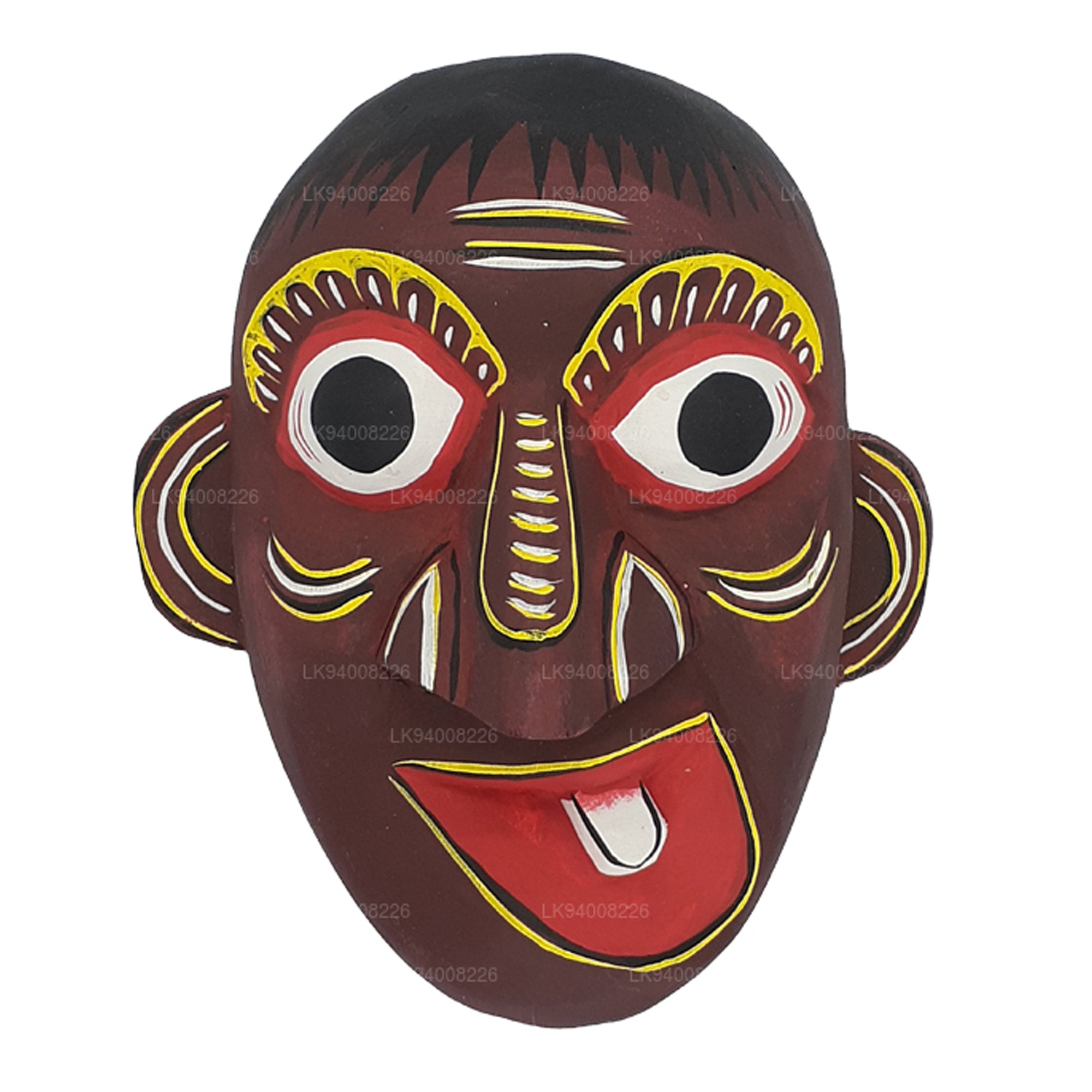
Among the low-country masks of Sri Lanka, the Surambavalliya mask occupies a category of its own. While most traditional masks are worn on the face and move only as the dancer moves, the Surambavalliya introduces a mechanical ingenuity rarely seen in South Asian mask traditions: puppet-like elements whose movement is controlled by threads attached to the dancer's own hands. The result is a performance object that is simultaneously a mask, a marionette, and a piece of narrative theatre.
What does the Surambavalliya mask look like?
The mask depicts a central female figure at its upper portion, holding two lighted torches — one in each hand. Flanking her on either side are two additional female figures, also rendered in carved and painted detail. The craftsmanship follows the conventions of the low-country mask-making tradition, using lightweight kaduru wood, vivid natural pigments, and bold facial expressions that remain legible from a distance during outdoor performances.
What sets this mask apart physically is a series of thin threads fixed at the face of the central figure and near the elbow joints of the carved arms. When the threads are pulled, the two torches held by the central female figure rise upward — mimicking the gesture of throwing a torch skyward and catching it. No other category of low-country mask in Sri Lanka employs this kind of articulated, thread-driven mechanism.
How does the Surambavalliya mask work in performance?
The dancer wears the mask in the conventional manner, but the performance dynamic is fundamentally different from standard mask dance. The threads running from the carved arms of the mask are connected to the dancer's own hands. As the dancer performs, every natural movement of the hands causes the puppet elements within the mask to move in turn — the carved female figure appears to raise and lower the torches in a rhythmic, lively motion.
This synchronisation between dancer and mask is central to the Surambavalliya tradition. The dancer does not simply embody a character; they also animate the character depicted on the mask above them, creating a layered performance in which two figures — the dancer and the carved woman — move together as one.
Verses traditionally sung during the Surambavalliya performance describe exactly this gesture: taking a torch in both hands, throwing it skyward, and catching it again, all while the assembled audience watches the dance unfold on stage. The poetry and the movement are designed to complement each other precisely.
Where does the Surambavalliya mask fit within Sri Lankan mask traditions?
Sri Lanka's low-country mask tradition is centred primarily around three categories: Kolam masks, used in comic narrative theatre; Raksha masks, used in ritual processions and exorcism ceremonies; and Sanniya masks, associated with healing rituals related to the eighteen demons of disease. The Surambavalliya does not fit neatly into any of these three groups. It represents a less common, specialised strand of the tradition in which the performative object itself carries narrative mechanisms.
The geographical heartland of Sri Lankan mask-making is the Southern Province, particularly the area around Ambalangoda, where families have passed down the craft across generations. Masks from this region are recognised both as functional performance objects and as significant examples of intangible cultural heritage.
Travellers with an interest in this tradition can explore mask museums and workshops around Ambalangoda, where the full range of low-country mask types — including rarer forms such as the Surambavalliya — are documented and demonstrated. The Esala Perahera Festival in Kandy, though rooted in a different regional tradition, offers useful context for understanding how costumed performance and ritual dance function across Sri Lankan cultural life.
What makes the Surambavalliya mask significant from a craft perspective?
The integration of puppet mechanics into a wearable mask represents a creative problem-solving that has no direct parallel in the documented low-country canon. Most mask traditions rely entirely on the human body — the dancer's face, posture, and movement — to communicate character. The Surambavalliya adds a mechanical layer, extending the performer's expressive range beyond the body itself.
This also has implications for how the mask is made. The carver must engineer the arms and torch-holding hands so that the thread mechanism moves fluidly and reliably under performance conditions — outdoors, in heat, with an audience present. The tolerances involved are precise. A mask that binds or jerks will disrupt the performance at exactly the moment when the torch-raising gesture is meant to delight the crowd.
For collectors and students of South Asian performance arts, the Surambavalliya is a reminder that Sri Lanka's mask tradition encompasses considerable internal variety, ranging from straightforward face coverings to complex articulated objects that blur the line between mask, puppet, and prop.
Can visitors see or acquire traditional Sri Lankan masks?
Authentic low-country masks are available through established craft producers in the Southern Province, as well as through curated cultural product retailers. Quality varies considerably: masks made for the tourist market are often painted with synthetic paints over mass-produced blanks, while traditionally crafted masks use hand-carved kaduru wood and mineral-based pigments applied according to conventional colour schemes specific to each mask type.
When selecting a mask, look for clean tool marks in the carving, consistent painting within the traditional colour conventions for that mask type, and provenance information linking the piece to a named workshop or artisan lineage. Reputable sellers will be able to identify which category of mask they are selling and explain its ritual or performative context.
Related reading
5 pages on closely related subjects.