


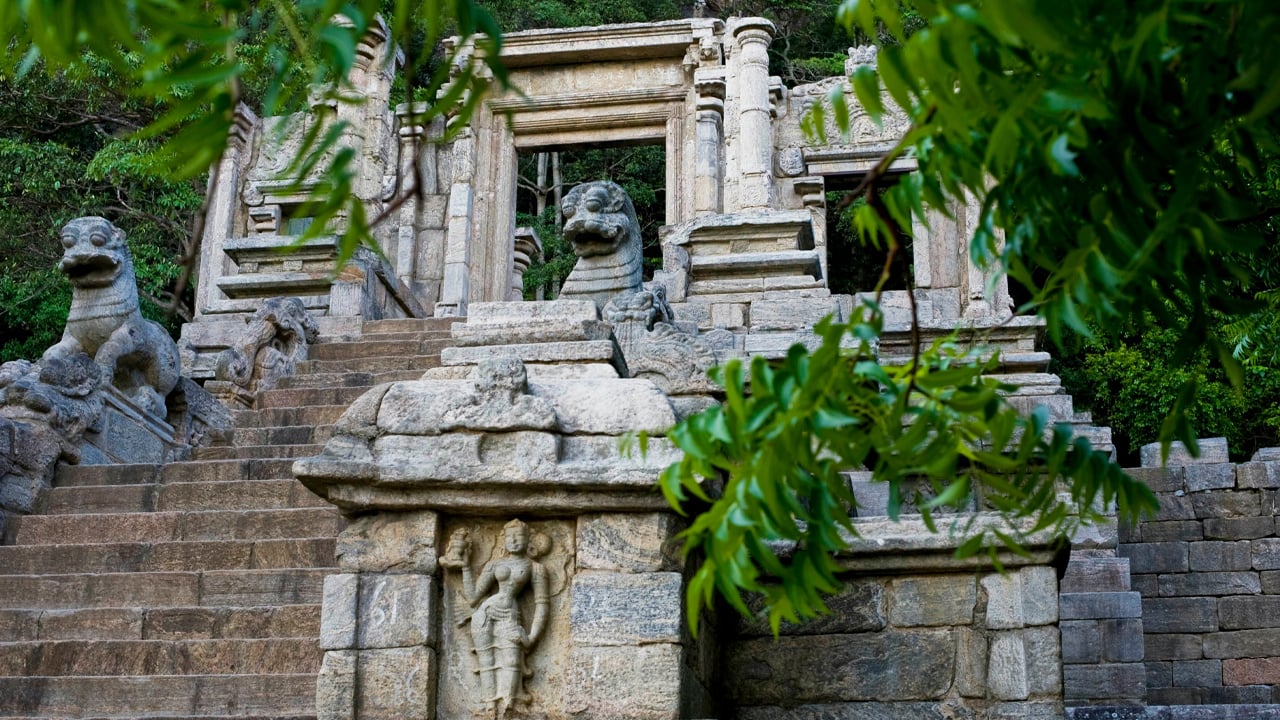

Rambodagalla Temple — formally known as Rambadagalla Monaragala Viharaya — sits among low granite hills and coconut groves in the Kurunegala District of Sri Lanka's North Western Province. It is one of the island's more quietly impressive Buddhist sites, largely unknown to mainstream tourism yet deeply significant to the communities that have maintained it for centuries. The temple's defining feature is a colossal seated granite Buddha, but the surrounding monastic landscape and hilltop shrines give it a breadth that rewards a unhurried visit.
What makes Rambodagalla Temple significant?
The central object of veneration is a seated Buddha statue carved in the Dhyana Mudra — the meditative pose — rising to approximately 67 feet. Sculpted by the late Indian master craftsman Muthiah Sthapathi, who was renowned for large-scale temple stonework across South and Southeast Asia, the figure is widely considered one of the tallest granite Buddha statues in Sri Lanka. The scale of the carving, achieved without modern quarrying techniques in the finished form, underlines both the devotional ambition and the technical skill behind the project.
Beyond the main statue, the site has roots in a much older monastic tradition. Ancient cave shelters on the rock face bear drip-ledges characteristic of early Buddhist hermitages, suggesting that monks sought refuge and practised here from the first centuries of the common era — a period when rock-cave monasteries were widespread across the dry and intermediate zones of Sri Lanka. This layered history, from early cave-dwelling monks to a twentieth-century colossal granite icon, makes Rambodagalla a place where different eras of Sri Lankan Buddhist practice can be read in a single landscape.
What can visitors see and do at Rambodagalla?
The main precinct is compact but considered. Pilgrims arrive in the early morning to make offerings of lotus blossoms and light oil lamps, and the smell of incense drifts steadily through the stone corridors. Visitors who are not pilgrims are welcome to observe these rituals respectfully, and the atmosphere is markedly less crowded than at more commercialised sites.
- The giant granite Buddha: The seated figure dominates the central courtyard. Walk the circumambulatory path around the statue's plinth to appreciate the quality of the stonework at close range.
- Ancient cave shrines: Steps cut into the rock face lead to older cave temples with painted interiors and smaller Buddha images in various stupa-flanked niches.
- Hilltop viewpoint: A short climb above the main temple rewards visitors with panoramic views over paddy fields, coconut groves, and the low ridges of the Kurunegala countryside — an orientation point for understanding the rural landscape that surrounds the site.
- Dhamma school: A functioning Dhamma School operates on the temple grounds, reflecting the temple's continuing role in the local religious community rather than purely as a heritage site.
Early morning and late afternoon are the most atmospheric times. Midday heat in the Kurunegala lowlands can be intense, particularly between April and September.
When is the best time to visit Rambodagalla Temple?
The temple is accessible throughout the year. The North Western Province generally receives its heaviest rainfall during the northeastern monsoon (October to January), but short tropical showers rarely disrupt a morning visit. The period from February to April and again from June to September tends to offer drier, more comfortable conditions. Visiting on a Poya (full moon) day — particularly the Vesak and Poson Poya days — brings additional religious ceremonies and lantern displays, adding cultural depth to the experience. On ordinary days the grounds are calm and uncrowded.
How do I get to Rambodagalla Temple from Colombo or Kandy?
Rambodagalla lies in the Kurunegala District, accessible from both Colombo and Kandy within roughly two to three hours by road depending on traffic. The most practical approach is by private vehicle, as public bus services to the immediate vicinity are limited. From Colombo, the A10 highway towards Kurunegala is the main route. From Kandy, the road passes through the cultural heartland of the island, offering a useful introduction to the rural character of the region before arriving at the temple.
Hiring a private driver for the day allows visitors to combine Rambodagalla with other sites in the Kurunegala District without relying on infrequent local transport. The temple is sometimes included in broader cultural itineraries that also take in the cave temples at Dambulla or the ancient capital of Polonnaruwa, both of which lie within a reasonable driving radius.
How does Rambodagalla fit into a Sri Lanka cultural itinerary?
Rambodagalla works well as a half-day excursion from Kurunegala town or as a stop on a longer north-central cultural circuit. Travellers covering the Cultural Triangle — Sigiriya, Dambulla, and Polonnaruwa — can route through Kurunegala without significant detour. Alternatively, those staying near Kandy and looking for a less-visited complement to the Kandy city tour will find Rambodagalla a genuinely different register: rural, quiet, and architecturally of a different scale from the urban temples of the hill capital.
The drive to the temple itself is part of the reward. The road passes through a landscape of scattered hamlets, paddy fields, and dense stands of coconut palms — a cross-section of the agricultural interior that many visitors who stick to the coast or the main heritage corridor never see.
What should visitors know before going?
- Dress code: As at all Buddhist temples in Sri Lanka, shoulders and knees must be covered. Lightweight cotton clothing that covers the limbs is practical given the climate.
- Footwear: Remove shoes before entering the shrine rooms and before climbing onto any terrace adjacent to the main statue.
- Photography: Photography of the statue and grounds is generally permitted, but always seek acknowledgement from the resident monks before photographing religious ceremonies or worshippers.
- Facilities: The temple is a working religious site in a rural area. Facilities are basic. Carry drinking water, particularly in the warmer months.
- Admission: There is no fixed entrance fee for pilgrims or visitors; donations to the temple's upkeep are customary and appreciated.
Is Rambodagalla Temple suitable for meditation retreats?
The site's quietude and forested hillside setting make it naturally appealing for those interested in contemplative practice. While Rambodagalla is not formally established as a retreat centre open to foreign practitioners in the way that some monasteries are, individual visitors are free to sit quietly in the designated areas and the atmosphere is genuinely conducive to reflection. Those seeking structured meditation in a temple environment in Sri Lanka should enquire through a reliable local organiser, as arrangements depend on the resident monastic community and change seasonally.
Nearby places
11 places within about 25 km, nearest first.
- Hiripitiya City4 km
- Ganewatta Medicinal Plant Garden5 km
- Walakumbura Railway Station5 km
- Ibbagamuwa City5 km
- Rideekanda5 km
- Nathagane6 km
- Undugoda City6 km
- Arankele Monastery7 km
- Dolukanda7 km
- Melsiripura11 km
- Na Uyana Monastery13 km
Related reading
3 pages on closely related subjects.

