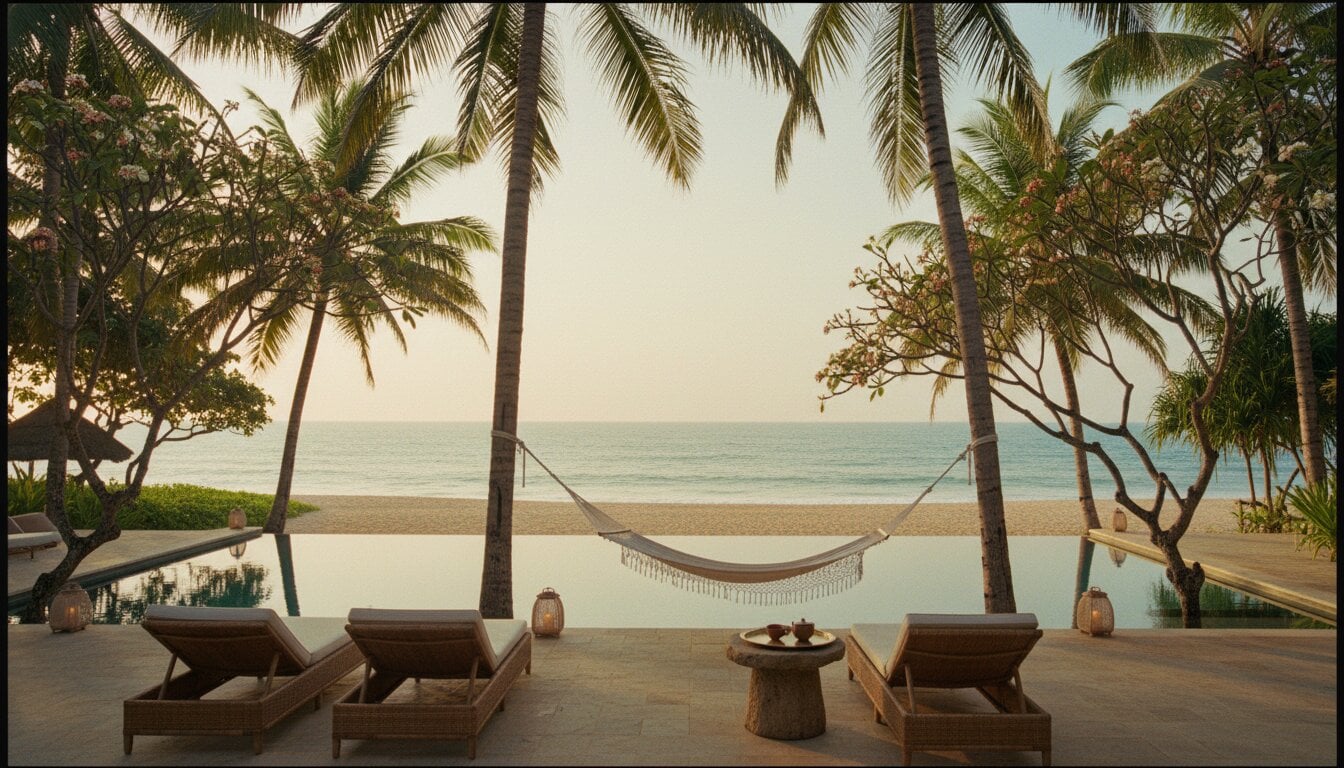
Okanda Murugan Devalaya stands at one of the most evocative junctions in Sri Lanka — the point where the dense Kumana-Panama jungle path meets the Indian Ocean shoreline. It is a place of deep religious significance and quiet natural drama, drawing Hindu pilgrims, Buddhist devotees, and curious travellers in roughly equal measure. Few shrines on the island carry the same weight of legend, archaeological interest, and coastal atmosphere combined in a single location.
What is the legend behind Okanda Murugan Devalaya?
According to Shaiva tradition, Okanda is the spot where God Skanda — known in Sri Lanka as Murugan or Kataragama Deviyo — first arrived on the island, sailing across the sea in a golden boat. That boat, the story holds, was transformed into a rock, which still stands on Okanda beach. Locals and pilgrims call it Ran Oru Gala, meaning the Golden Boat Rock, and it remains a touchstone of the shrine's identity. Seeing this formation at dawn, when the rock catches low light against the surf, gives the legend a certain visual logic that is hard to dismiss.
The temple's precise origin is not recorded in any surviving historical document, and archaeologists have not settled on a founding date. What has been noted, however, is that the ruins of an ancient monastery lie in the surrounding jungle, suggesting the site was considered sacred well before the present structure was built. The nearby ancient harbour of Okanda would have added practical importance: seafarers departing or arriving at this coast frequently sought the shrine's blessing, a tradition that may explain why its influence reached across religious boundaries so early in its history.
Why do pilgrims from different faiths visit this temple?
Okanda is one of a handful of shrines in Sri Lanka where the lines between Hinduism and Buddhism have blurred comfortably over centuries. The deity venerated here — Lord Skanda or Murugan — is also recognised in the Sinhala Buddhist tradition as the protector god Kataragama Deviyo, worshipped widely regardless of ethnicity or sect. This religious convergence means the site draws Tamils, Sinhalese, and Sri Lankan Moors, and has done so for generations. Pilgrims en route to the great Kataragama festival will often stop here, treating Okanda as a devotional waypoint on a longer sacred journey.
The atmosphere during the annual pada yatra — the barefoot pilgrimage that passes through this coast — is particularly charged. Thousands of pilgrims walk hundreds of kilometres from the north of the island, moving through jungle and beach, and Okanda marks one of the key overnight camps on that route. Outside of pilgrimage season the shrine is calm, tended by a handful of resident priests, and surrounded by the sounds of the adjacent Kumana National Park.
Where exactly is Okanda Devalaya, and how do you get there?
The temple sits on the southeastern coast of Sri Lanka, roughly 17 kilometres from the well-known Okanda surf point, along the coastal track that connects Panama with the entrance to Kumana National Park. The road approaching from Panama is partly unsealed and can be challenging in a regular saloon car; a four-wheel-drive or a high-clearance vehicle is advisable, particularly during or just after the monsoon season. The closest town with reliable accommodation and supplies is Arugam Bay, which lies approximately 30 kilometres to the north.
From Colombo, the most practical route runs via Potuvil, passing through Monaragala and Siyambalanduwa — a drive of roughly five to six hours depending on traffic and road conditions. Travellers combining the shrine visit with a safari in crocodile watching or wildlife viewing in the adjacent Kumana wetlands will find the logistics align well: the national park entrance is a short distance beyond the devalaya on the same track.
What is there to see around Okanda?
The shrine itself is modest in scale — a small but carefully maintained kovil in the coastal scrub — yet the surrounding environment amplifies its appeal considerably. Okanda beach is largely undeveloped, and the Ran Oru Gala rock formation sits in the shallows where the temple compound meets the sand. At low tide it is possible to walk close to the rock. The beach also has a reputation among experienced surfers, with the break roughly 17 kilometres away forming part of the wider Arugam Bay surfing corridor.
The jungle between Okanda and Kumana holds peacocks, spotted deer, grey langur monkeys, and — for the fortunate — leopards and sloth bears that range through the coastal forest. Birdwatchers will find the wetlands immediately north of the park entrance among the richest waterbird habitat in Sri Lanka, particularly between May and August. Combining a temple visit with an early-morning game drive makes an unhurried full day from Arugam Bay.
When is the best time to visit Okanda Murugan Devalaya?
The shrine is accessible year-round, but the experience differs markedly by season. The driest, most accessible months on the east coast run from around May through September, which coincidentally coincides with both the Kumana park's peak wildlife season and the annual Hindu pilgrimage period. If attending the pilgrimage or festival activities is a priority, visiting between June and July — when the Esala season is in full swing further southwest at Kataragama — brings the most ceremonial activity.
Between October and January the northeastern monsoon can make the coastal track muddy and occasionally impassable. The shrine remains open and attended, but the journey from Panama requires more careful planning. March and April offer a transitional window that is often underrated: visitor numbers are low, the scrub forest is relatively green, and the road is usually dry.
Is there any archaeological significance to the site?
The evidence of an ancient monastery near the devalaya suggests this stretch of coast was an active religious and possibly commercial zone during Sri Lanka's classical period. Okanda's natural harbour, sheltered from the southwest swell, would have served coastal traders moving between the island's south and the eastern ports. Several rock inscriptions have been identified in the broader Kumana-Panama area dating to the early centuries of the Common Era, indicating a literate, organised Buddhist community in the vicinity. The physical proximity of a Hindu shrine and Buddhist monastic ruins at Okanda reflects a pattern seen at other major pilgrimage sites — Polonnaruwa being perhaps the most studied example — where different traditions built on and around each other over time.
Tips for visiting respectfully and practically
- Dress modestly. Both shoulders and legs should be covered when entering the shrine precinct, regardless of the heat.
- Remove footwear before stepping onto the temple grounds.
- Photography inside the inner sanctum is generally not permitted; ask the temple attendant before raising a camera anywhere within the compound.
- Carry sufficient water and snacks. There are no established food stalls at the shrine, and the nearest reliable facilities are back toward Panama or Arugam Bay.
- Start the drive from Arugam Bay early in the morning to allow time for both the shrine visit and a drive through the Kumana zone before the midday heat.
- Pilgrimage season brings large crowds and reduced road access for private vehicles; coordinate with a local guide or driver who knows the track conditions.
Nearby places
8 places within about 25 km, nearest first.
- Kumana City4 km
- Kumana National Park4 km
- Kudumbigala Monastery6 km
- Kebiliththa Dewalaya6 km
- kadiraweli13 km
- Sastrawela Mani Naga Pabbatha Viharaya17 km
- Panama Lake17 km
- Panama Town18 km
Related reading
2 pages on closely related subjects.