Lake Round Kurunegala — locally known as Rantalia Lake or simply Kurunegala Lake — sits at the geographic and social heart of Kurunegala town in Sri Lanka's North Western Province. Stretching around 3.68 kilometres in circumference, it is far more than a reservoir: the lake anchors the town's identity, sustains small-scale agriculture on its fringes, and gives residents and visitors a rare pocket of calm inside a busy provincial capital.
What makes Lake Round Kurunegala worth visiting?
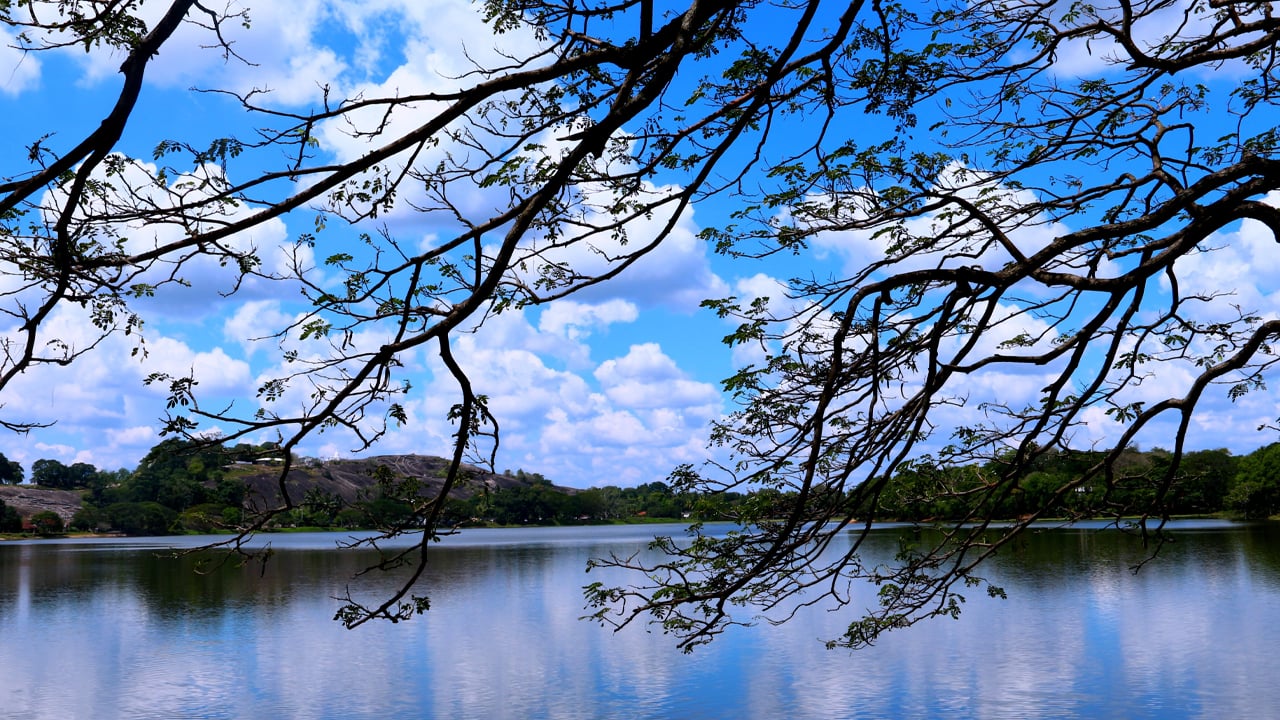
The appeal here is understated and genuine. The lake is rimmed by a well-maintained promenade fitted with walking tracks, cycle lanes, shaded seating, and evening lighting — a level of urban parkland infrastructure that is still uncommon in Sri Lankan towns of this size. Coconut palms and other mature trees line much of the waterfront, and the rocky silhouette of Ethagala (Elephant Rock), which rises directly beside the town, frames the lake's eastern horizon in a way that rewards photographers at almost any hour.
Freshwater bird life is a quiet highlight. Herons, egrets, and kingfishers are regular visitors, and the early morning hours — before traffic builds — offer the kind of stillness that wildlife-watchers appreciate. The lake also reflects light in ways that make sunrise and sunset noticeably photogenic, which explains why wedding photographers frequently use the promenade as a backdrop.
What can you do at Lake Round Kurunegala?
- Walking and cycling: The full promenade circuit is manageable on foot in under an hour and is flat enough for all fitness levels. Bicycle hire is available informally near the lakeside.
- Birdwatching: Early mornings yield the widest variety of waterbirds. Bring binoculars if you have them — the far bank is harder to observe with the naked eye.
- Lakeside dining: Several small restaurants and street-food stalls operate along the approach roads, offering Sri Lankan rice-and-curry as well as short eats. Eating with a lake view is a simple pleasure that locals take for granted but visitors consistently enjoy.
- Photography: The combination of water, rock escarpment, and colonial-era town buildings nearby creates compositional variety that goes beyond a single postcard shot.
- Relaxed people-watching: The promenade is a genuine cross-section of Kurunegala life — schoolchildren, retirees, couples, and cricket-playing teenagers all share the space, particularly in the late afternoon.
When is the best time to visit Lake Round Kurunegala?
The lake is accessible year-round, but the experience varies by time of day rather than season. Early mornings between roughly 6 and 8 a.m. offer cooler temperatures, active birdlife, and soft light on the water — conditions that photographers and walkers both seek. Late afternoons from around 4 p.m. to sunset are the most sociable, when locals arrive for their evening circuit and the promenade takes on an unhurried festival atmosphere.
Kurunegala sits in the dry zone and receives the bulk of its rainfall during the northeast monsoon (roughly October to January). Even during wetter months, morning visits are typically dry, and the greenery around the lake looks its best shortly after the rains have freshened the vegetation.
How do I get to Lake Round Kurunegala from Colombo?
Kurunegala is approximately 95 kilometres northeast of Colombo along the A10 highway, making it around a 2-hour drive depending on traffic. The town is also well connected by rail: trains on the Colombo–Badulla main line stop at Kurunegala station, which is within comfortable walking distance of the lake. From Kandy, the drive takes roughly an hour via the A10, and from Dambulla it is around 40 kilometres south. Private transfers arranged through Lakpura can be combined with visits to Wilpattu National Park, which lies around 70 kilometres to the northwest, making Kurunegala a logical midpoint stop on a North Western circuit.
Is Lake Round Kurunegala suitable for children and older travellers?
Yes, on both counts. The promenade surface is paved, level, and well-lit, making it accessible for pushchairs and those with limited mobility. There are no entrance fees or ticketing queues. The open green spaces give children room to move, and the lack of heavy traffic along the waterfront walking path means families can relax without constant vigilance. It is the kind of stop that works well as a mid-afternoon break during a longer itinerary rather than a half-day standalone excursion.
What else is there to see near Kurunegala?
Kurunegala served as one of the medieval capitals of Sri Lanka, and the surrounding region holds genuine historical depth. Ethagala Rock, visible from the lake, has a small temple near its summit accessible by a short but steep climb. The ancient irrigation tanks of the North Western Province — part of Sri Lanka's extraordinary hydraulic civilisation — can be explored on day trips. Heading north, Wilpattu National Park is the country's largest national park and famous for its leopard sightings around natural lakes called villus. Heading east, the Cultural Triangle sites of Polonnaruwa are within a comfortable two-hour drive.
For travellers building a North-to-South itinerary, Kurunegala also acts as a useful staging point before crossing into the hill country. A Kandy city tour fits naturally the following day.
Practical information for visitors
| Detail | Information |
|---|---|
| Entry fee | None (public park) |
| Best visiting hours | 6–8 a.m. or 4–6 p.m. |
| Distance from Colombo | Around 95 km via A10 highway |
| Distance from Kandy | Around 50 km via A10 |
| Distance from Dambulla | Around 40 km via A6/A10 |
| Facilities | Paved promenade, cycle lanes, seating, lighting, nearby restaurants |
| Accessibility | Flat, paved surface; suitable for wheelchairs and pushchairs |
How does Lake Round fit into a wider Sri Lanka itinerary?
Most international travellers pass through or near Kurunegala at some point during a Sri Lanka circuit, but few stop deliberately. That is changing as the promenade development has given the lakeside a more polished feel. Treating Kurunegala as a brief stop — an hour by the water, a short-eat lunch at a local bakery, a look at Ethagala from the promenade — adds a layer of authentic urban Sri Lankan life that pure resort itineraries miss. The town is not a destination in the same sense as Sigiriya or Galle, but it rewards the traveller who takes a few minutes to step away from the highway and walk beside the water.
Nearby places
10 places within about 25 km, nearest first.
- Ethagalaunder 1 km
- Kurunegala Cityunder 1 km
- Kurunegala Railway Stationunder 1 km
- Kurunegala Districtunder 1 km
- Bathalegoda Lake, Kurunagale1 km
- Kadigamuwa9 km
- Pada Yatra10 km
- Ridi Viharaya Stupa10 km
- Kadigamuwa12 km
- Alawwa14 km
Related reading
5 pages on closely related subjects.