Jamuna Tank is a man-made reservoir near Padiyathalawa in Sri Lanka's Eastern Province, quietly anchoring the agricultural rhythms of the surrounding dry zone communities. Unlike the grand ancient tanks of Polonnaruwa, Jamuna is a working, community-scale reservoir — less celebrated but no less significant to the families who depend on it for paddy cultivation and daily life.
What is Jamuna Tank and why does it matter?
Jamuna Tank belongs to a tradition of small-scale hydraulic engineering that has shaped Sri Lanka's dry zone for more than two millennia. Constructed to collect monsoon runoff and release it gradually through a network of sluices and canals, the tank supports paddy fields that would otherwise be unviable in a landscape receiving irregular rainfall. It is not a showpiece — it is infrastructure, quietly feeding the region season after season.
Beyond agriculture, the tank supplies water for domestic use and livestock, functioning as the hydrological heart of several nearby villages. This dual role — irrigation and domestic supply — is characteristic of the anicut-and-tank systems scattered across Sri Lanka's North Central and Eastern Provinces.
What wildlife can you see at Jamuna Tank?
The reservoir and its fringing woodland attract a reliable mix of waterbirds and dry zone species. Painted storks, open-billed storks, little cormorants, and purple herons are commonly sighted along the margins, particularly in the cooler months when water levels are higher and fish are concentrated. Spot-billed pelicans occasionally appear in small groups.
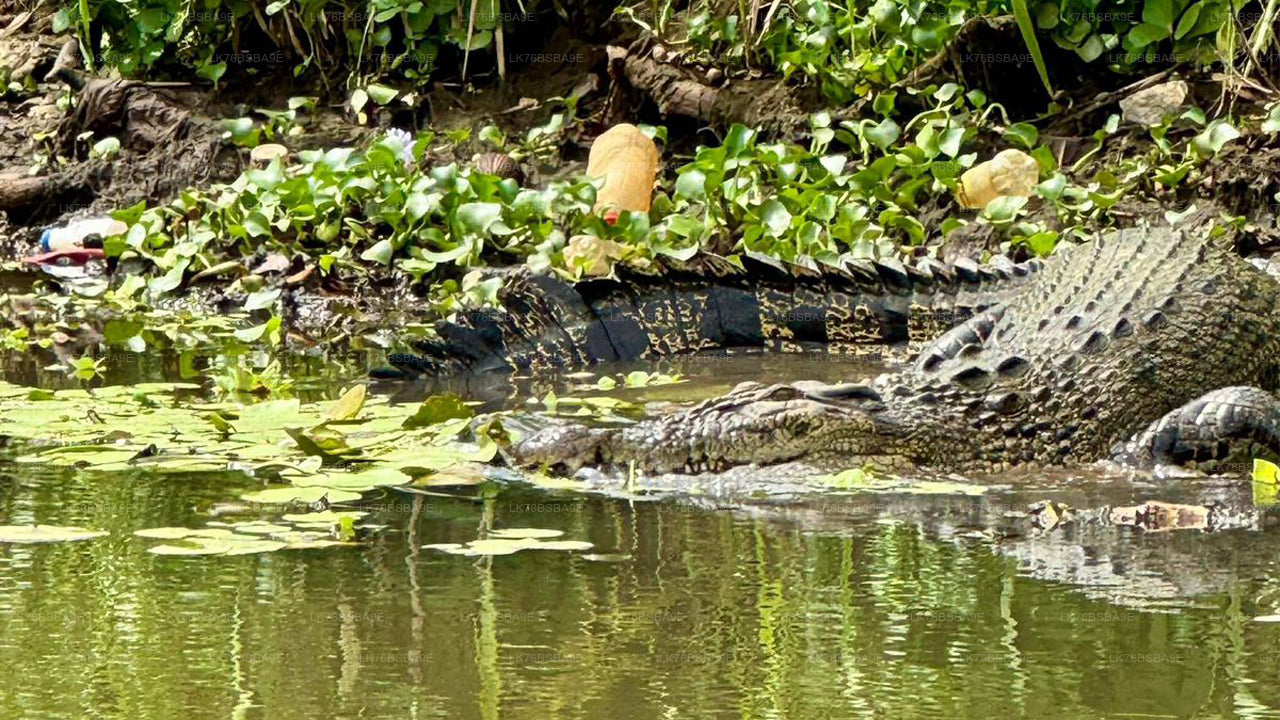
The scrub forest surrounding the tank provides cover for dry zone mammals including spotted deer, wild boar, and occasional elephants moving along traditional corridors in the Eastern Province. Crocodiles are sometimes reported in larger tanks of this region — visitors should maintain a sensible distance from the water's edge. The ecosystem is at its most active during the early morning hours and in the hour before dusk.
When is the best time to visit Jamuna Tank?
The Eastern Province operates on a different rainfall pattern to the wet southwest coast. Its primary rainy season runs from October to January, driven by the northeast monsoon. The period from May to September — when the inter-monsoon and southwest monsoon bring drier conditions to the east — is typically the most comfortable time to visit. Water levels remain steady from residual storage, farming activity is in full swing, and wildlife congregates reliably around the tank.
Early mornings from June through August are particularly rewarding for birdwatching, with clear skies and low wind. Avoid visiting immediately after heavy rains, when access tracks around the tank can become waterlogged.
How do I get to Jamuna Tank from Colombo?
Padiyathalawa, the closest town, lies roughly 230 km east of Colombo by road. The most practical route follows the A26 highway through Kandy and Mahiyanganaya before reaching Padiyathalawa. The drive takes around five to six hours depending on traffic through the hill country. There is no direct train or bus service to Jamuna Tank itself; a private vehicle is strongly recommended for the final approach to the reservoir.
Arugam Bay and Ampara are feasible base towns for travellers who want to combine a visit to Jamuna Tank with broader exploration of the Eastern Province. Both are accessible within an hour or two of Padiyathalawa.
What should visitors know before going?
- There are no visitor facilities — no ticket booth, café, or signage. Bring water, food, and sun protection.
- The area around the tank is actively farmed; be respectful of crops, irrigation channels, and working farmers.
- A four-wheel-drive vehicle is advisable if you intend to reach the tank bund directly, especially between October and January.
- Sunrise visits yield the best birdwatching and the most photogenic light across the water.
- Mobile network coverage can be patchy in this part of the Eastern Province; download offline maps before you leave the main road.
How does Jamuna Tank fit into Sri Lanka's irrigation heritage?
Sri Lanka's ancient kings invested extraordinary resources in water storage, constructing thousands of tanks — known as wewa in Sinhala — across the dry zone. Many fell into disrepair after the collapse of the Anuradhapura and Polonnaruwa kingdoms and were only rehabilitated during the colonial period and after independence. Jamuna Tank represents that ongoing tradition of restoration and communal stewardship.
The tank also reflects a sophisticated understanding of water catchment that predates modern hydrology. A cascade of smaller tanks feeds into larger ones, forming chains that maximise the capture of every rain event. Jamuna is one node in that chain — modest on its own, but part of a system that has sustained human settlement in a challenging climate for generations. For travellers interested in Sri Lanka's paddy farming culture, seeing a working tank in its agricultural context adds a dimension that no heritage museum can replicate.
Is Jamuna Tank suitable for a day trip?
Most visitors combine Jamuna Tank with other destinations in the Eastern Province rather than treating it as a standalone attraction. It works well as a quiet stop on a route between Mahiyanganaya and Arugam Bay, or as an early-morning detour for birdwatchers based in Padiyathalawa. Allow around one to two hours at the tank itself. The surrounding countryside — typical dry zone landscape of scrub, termite mounds, and open paddy — rewards a slow walk along the bund if conditions allow.
Nearby places
7 places within about 25 km, nearest first.
- Narangala12 km
- Dunhinda Falls14 km
- Badulla14 km
- Badulla Accommodations14 km
- Badulla District14 km
- Muthiyanganaya14 km
- Welekade Dutch Fort14 km
Related reading
3 pages on closely related subjects.