

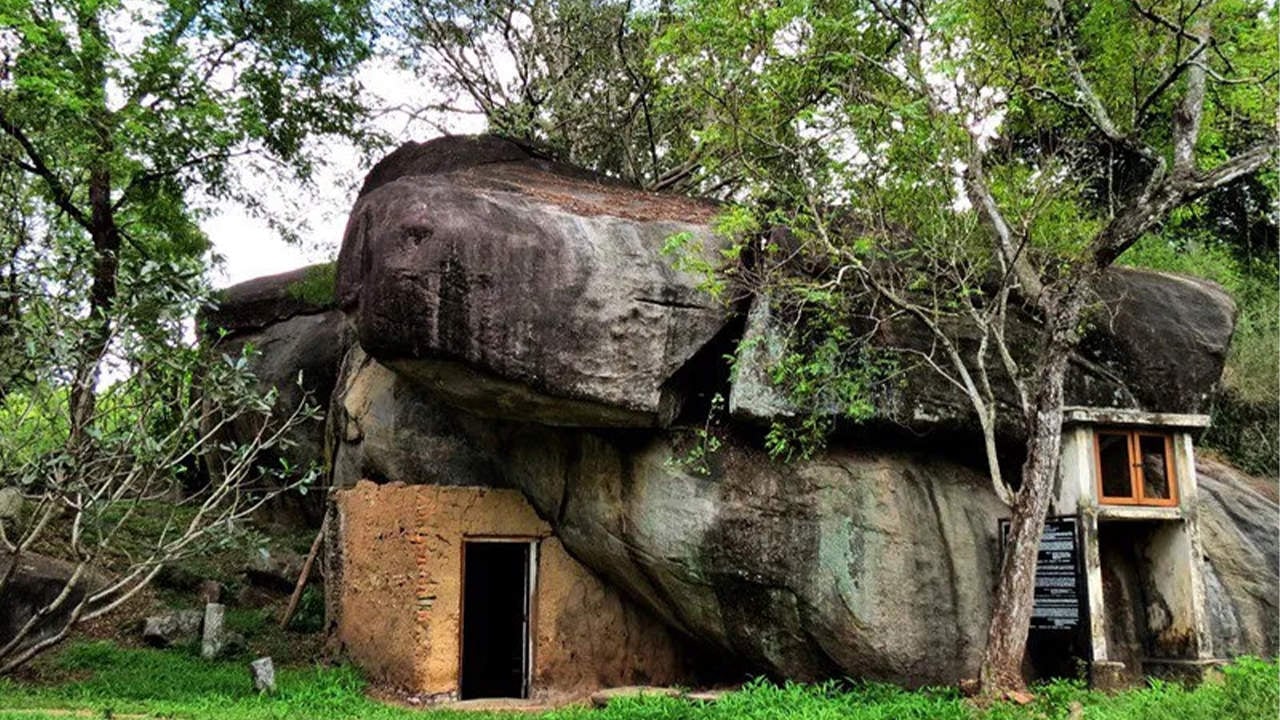
Hidden among granite boulders in the Kotmale Canal Colony of Ampara District, the cave temple known as Gonagolla Punchi Sigiriya — literally "Little Sigiriya of Gonagolla" — preserves a remarkable set of ancient frescoes that bear a striking resemblance to the celebrated paintings at Sigiriya: The Ancient Rock Fortress. Off the beaten path and rarely crowded, this site offers an unusually intimate encounter with Sri Lanka's earliest artistic traditions.
What makes Gonagolla Punchi Sigiriya significant?
The cave temple earned its popular name because the paintings found here echo, in style and composition, the famous maidens of Sigiriya — one of the most recognised works of ancient South Asian art. That two geographically separate sites share such a closely related artistic vocabulary suggests the existence of a broader painting tradition in early Sri Lankan society, one that extended well beyond the royal court.
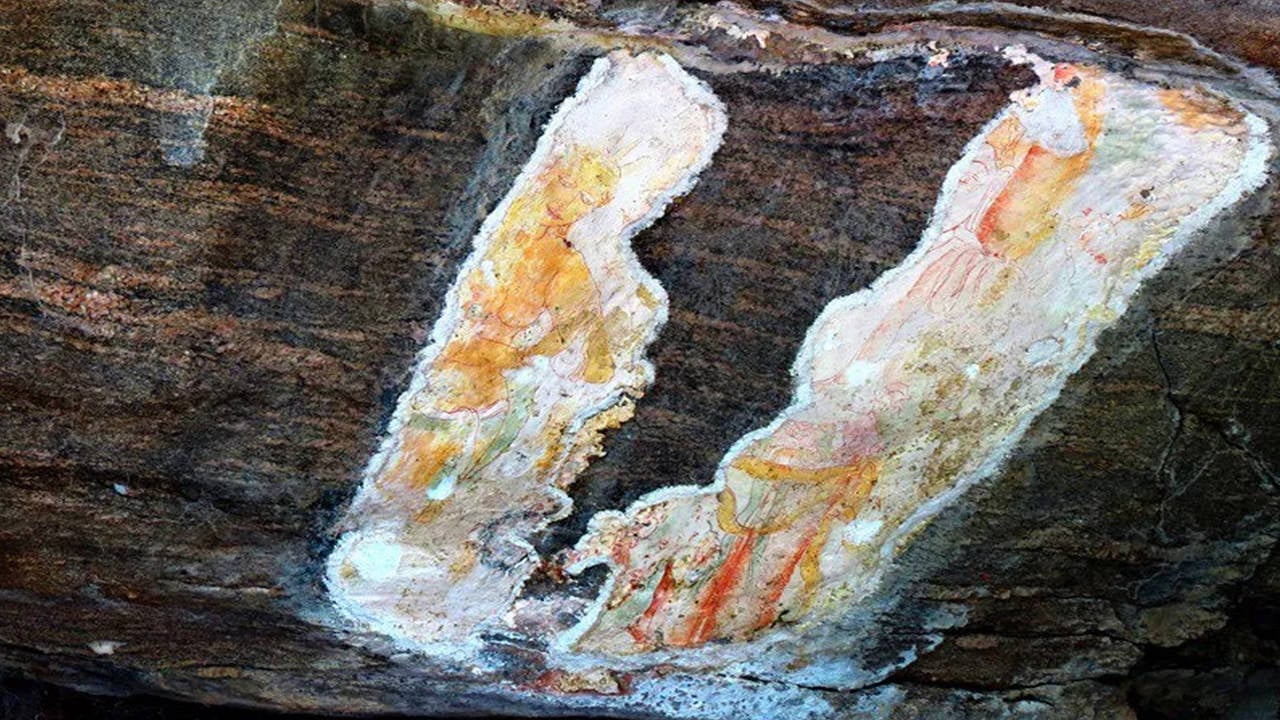
What survives today is precious: two figures painted in a palette of red, yellow, green, and white. A female dancer, curved and graceful with downcast eyes, clasps her hands in a gesture of reverence toward a male figure standing beside her. The quality of the remaining pigment, given the centuries of exposure, is remarkable. Rock inscriptions at the site date the frescoes to around the 3rd century CE, making them among the oldest surviving paintings on the island.
What can you see at the Gonagolla cave temple?
The site contains several distinct elements, spread across a cluster of rock outcrops and surrounding grounds:
- Two cave chambers with frescoes — one retains the two surviving painted figures; the second originally held additional images that have not survived.
- Rock inscriptions — two further caves contain Brahmi-script inscriptions belonging to the 3rd–4th and 4th–5th centuries CE respectively, attesting to continuous monastic use of the site over several hundred years.
- Ancient stupa remains — the foundations of an early stupa can be traced among the boulders, indicating that this was once an active place of Buddhist worship rather than purely an artistic commission.
- Watadage remnants — partial remains of a circular relic shrine (watadage) hint at the architectural ambition of the original complex.
- Monolithic stone pillars — massive cut-stone columns, now scattered, suggest the site once included a substantial building, possibly a prayer hall or assembly chamber.
Together, these elements confirm that Gonagolla was not a minor hermitage but a functioning monastic centre of some importance during the early centuries of the Common Era.
How do I get to Gonagolla Punchi Sigiriya?
The site lies in the Wewagampattuwa Divisional Secretariat Division of Ampara District, in Sri Lanka's Eastern Province. The Kotmale Colony — the immediate locality — sits roughly 3 miles east of Kohombana Junction along the Ampara–Gonagolla Road. The final approach involves unpaved tracks, so a four-wheel-drive or high-clearance vehicle is advisable, particularly during or shortly after the rainy seasons (October–January in this region).
The nearest significant town is Ampara, from which the site can typically be reached in under an hour by road. Public transport connections to the colony are infrequent, so hiring a private vehicle or arranging a guided excursion is the most practical option for most visitors. The nearest major heritage destination is Polonnaruwa, which lies to the northwest and can be combined into a broader cultural itinerary through the North Central and Eastern provinces.
When is the best time to visit Gonagolla Punchi Sigiriya?
The Eastern Province experiences its main dry spell roughly between May and September, when the inter-monsoon and the southwest monsoon bring relatively settled weather to this side of the island. Visiting during these months keeps the access tracks passable and reduces the risk of humidity that can temporarily obscure the pigments. Early morning visits are preferable: the light angle through the cave openings is more favourable for viewing the frescoes, and the heat is considerably more manageable.
The northeast monsoon (October to January) brings heavy rain to the Eastern Province, which can make the unpaved colony roads difficult to navigate and may temporarily close the site to casual visitors. If you are planning a trip that includes Gonagolla alongside other Ampara-area attractions, the May–August window offers the most reliable conditions.
How does Gonagolla compare to Sigiriya's frescoes?
The paintings at Sigiriya, created under the patronage of King Kashyapa I in the late 5th century CE, are among the most studied works in South Asian art history. The Gonagolla frescoes predate them by roughly two centuries, which makes the stylistic parallels all the more striking. Both share the same convention of depicting female figures with rounded forms, a three-quarter profile, and careful attention to jewellery and headdress.
Scholars have suggested that a shared school of itinerant painters — or at least a shared set of artistic conventions passed between monastic centres — accounts for the similarities. Unlike Sigiriya, where the frescoes are displayed in a well-managed UNESCO World Heritage Site context, Gonagolla remains a working village temple with minimal interpretive infrastructure. That informality is part of its appeal: visitors engage with the paintings in something close to their original context.
Is Gonagolla Punchi Sigiriya protected?
The site falls under the jurisdiction of the Central Cultural Fund and the Department of Archaeology of Sri Lanka, which have recorded and documented the inscriptions and paintings. Physical conservation work has been limited, which is why the number of surviving fresco panels is small. Visitors are asked not to touch the painted surfaces and to follow any guidance from the resident caretaker or monk. Flash photography directed at the paintings is generally discouraged, as repeated light exposure accelerates pigment degradation.
What else is worth visiting in the Ampara area?
Ampara District rewards travellers who are willing to explore beyond the headline sites. The district borders the Eastern Province coast, where Pigeon Island offers some of the clearest reef snorkelling in Sri Lanka. Inland, the Gal Oya reservoir system supports a unique boat-based wildlife experience where herds of elephants have been observed swimming between islands. The broader region also holds several other early monastic sites and irrigation tanks built during the Anuradhapura and Polonnaruwa periods, making it a coherent destination for anyone with a serious interest in ancient Sri Lankan history.