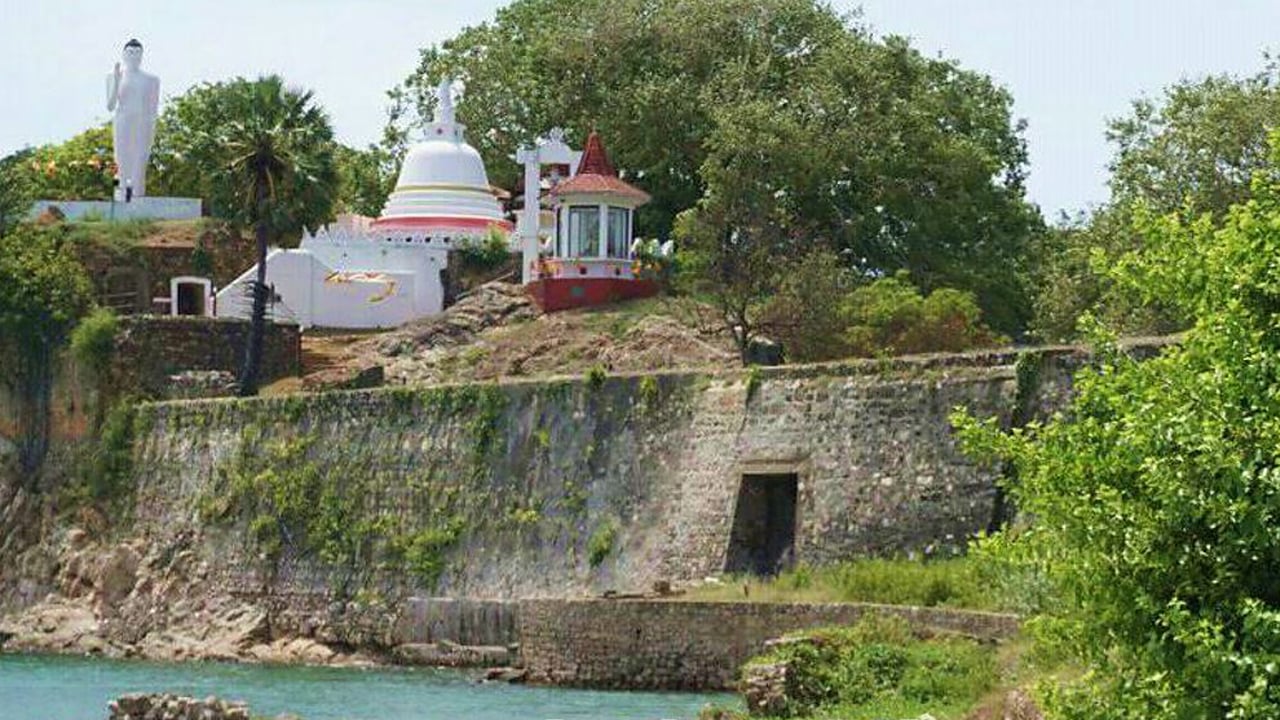

Gokanna Vihara is one of Sri Lanka's oldest Buddhist sites, quietly occupying a corner of Fort Frederick on the Swami Rock peninsula in Trincomalee. Though modest in scale today, the temple carries a history stretching back nearly two millennia — intertwined with royal chronicles, Portuguese conquest, and the coexistence of Buddhist and Hindu traditions on the same sacred headland.
What is the history of Gokanna Vihara?
The name Gokanna comes from the ancient designation for Trincomalee itself. According to the Mahavamsa, the great Pali chronicle of Sri Lankan history, the temple was founded by King Mahasen, who reigned from around 275 to 301 AD. The chronicle records that Mahasen ordered the demolition of a Shiva temple on Swami Rock and erected the Buddhist vihara in its place — a decision that reflects the shifting religious politics of early medieval Sri Lanka.
The temple was later expanded during the reign of King Agbo V, who added a preaching hall (dharma sala) to the existing structure, indicating the site remained an active centre of Buddhist learning and practice well into the middle period of the Anuradhapura kingdom.
A Tamil rock inscription discovered near the main entrance of Fort Frederick records a different chapter: that the Hindu temple which had stood on this site was subsequently destroyed by the Portuguese during their occupation of the eastern coast. That temple — the celebrated Koneswaram Kovil — was rebuilt in 1963 and now stands prominently on Swami Rock, drawing pilgrims from across Sri Lanka and the Tamil diaspora.
In correspondence from the Government Agent of Trincomalee dated 8 October 1964, it was noted that the sacred Bodhi tree in front of the Koneswaram Kovil had been destroyed. More recently, underwater surveys by divers in the sea around Swami Rock have recovered submerged Buddhist and Hindu sculptures, suggesting that earlier structures may have partially collapsed into the ocean over centuries — a possibility consistent with the dramatic cliff-edge geography of the site.
Where exactly is Gokanna Vihara located?
The temple sits within the grounds of Fort Frederick, a colonial-era fortification in central Trincomalee. The fort itself was built on a promontory that juts into the sea, and entry to the compound — which is still partly administered as a military zone — is via a well-marked gate. Gokanna Vihara stands close to the fort entrance, making it accessible without a lengthy walk inside the compound. The sacred Koneswaram Kovil, which occupies the same rocky headland, is a short walk further into the fort grounds.
Trincomalee is located on Sri Lanka's northeastern coast and is reachable by road from Colombo in around five to six hours, or by rail via Polonnaruwa, which itself is a significant stop on the ancient city circuit.
What can visitors see at Gokanna Vihara today?
The present-day vihara is a working Buddhist temple set within the historic fort perimeter. Visitors will typically find a stupa, shrine rooms, and the atmospheric remains of a site that has been both worshipped and contested over two thousand years. The proximity of the Buddhist vihara to the Hindu Koneswaram Kovil within the same fort enclosure makes this one of the few places in Sri Lanka where the layered religious history of the island is visible in a single, compact area.
The cliffs of Swami Rock — sometimes called Lover's Leap in older colonial-era accounts — offer dramatic views over the natural harbour and the Bay of Bengal. The combined religious and scenic significance of the location makes it a meaningful stop for travellers interested in Sri Lanka's early Buddhist period and its intersections with Shaivite Hindu traditions.
What is the significance of Swami Rock to both Buddhists and Hindus?
Few places in Sri Lanka illustrate the island's religious pluralism as clearly as Swami Rock. The chronicle tradition credits the headland with Buddhist royal patronage from the third century AD, while Tamil epigraphic and oral traditions identify the same site as an ancient seat of Shaivite worship associated with Koneswaram — one of the five great Shiva temples of the island. The Portuguese demolition of the Hindu kovil and its subsequent rebuilding in the twentieth century are events that remain part of living memory for Trincomalee's Tamil community. Today, Buddhist monks and Hindu pilgrims visit the same rocky outcrop, often on the same day.
When is the best time to visit Trincomalee and Gokanna Vihara?
Trincomalee lies on the eastern coast of Sri Lanka, which means its dry season runs roughly from May to September — the opposite of the southwestern coast. This period brings calm seas and clear skies, making it ideal not only for visiting Gokanna Vihara and Fort Frederick but also for exploring nearby Pigeon Island, known for its coral reefs and blacktip reef sharks.
| Month | Weather in Trincomalee | Suitability |
|---|---|---|
| May – September | Dry, warm, low humidity | Ideal |
| October – November | Northeast monsoon onset | Moderate |
| December – April | Wetter; occasional heavy rain | Less suitable |
How do I get to Fort Frederick and Gokanna Vihara from Colombo?
The most comfortable option is a private vehicle, which takes approximately five to six hours along the A6 highway via Habarana. Alternatively, trains from Colombo Fort station serve Trincomalee with a journey time of around seven to nine hours, depending on the service. From Trincomalee town, Fort Frederick is reachable on foot or by three-wheeler in a few minutes. Entry to the fort is generally free; visitors may need to show identification at the gate.
What else is worth seeing near Gokanna Vihara?
- Koneswaram Kovil — the rebuilt Hindu temple on the same headland, a major pilgrimage site with sweeping coastal views.
- Pigeon Island National Park — a short boat ride from Trincomalee's beach, offering some of the best shallow-water snorkelling in the country.
- Trincomalee Harbour — one of the finest natural deep-water harbours in Asia, with a seafront worth walking at dusk.
- Marble Beach — a clean, relatively quiet stretch of sand within easy reach of the town.
- Kanniya Hot Wells — a set of natural hot springs a short drive inland, with both historical and local religious significance.
For travellers combining the eastern coast with the ancient cities, Trincomalee pairs well with Polonnaruwa, Sigiriya, and the broader Cultural Triangle, which can be covered in a well-planned circuit of five to seven days.
Nearby places
11 places within about 25 km, nearest first.
- Fort Fredrickunder 1 km
- Koneswaram Templeunder 1 km
- Lover's Leap in Trincomaleeunder 1 km
- Pathirakali Amman Templeunder 1 km
- Trincomalee Deer Parkunder 1 km
- Sri Lanka Navy Museumunder 1 km
- Trincomalee Cityunder 1 km
- Trincomalee Harbourunder 1 km
- Trincomalee Seaportunder 1 km
- Koddiyar Bay1 km
- Trincomale Port Cruise Terminal1 km