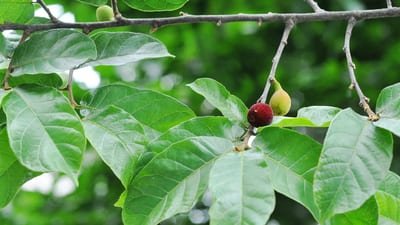
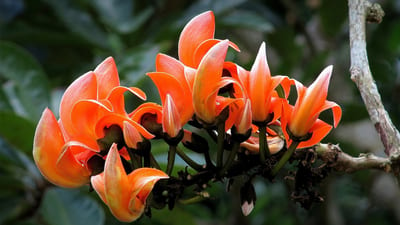
Ficus tinctoria ssp. parasitica, commonly known as the dye fig, is a woody plant belonging to the fig family, Moraceae. It is recorded as native to Sri Lanka and has no known edible parts.
What does the dye fig look like?
As a member of the genus Ficus, this subspecies shares the broad family traits of figs: a woody habit, milky latex in its stems and leaves, and the distinctive enclosed inflorescence known as a syconium, which later develops into the small fig-like fruit. Many species in this genus begin life as epiphytes or hemi-epiphytes, taking root on other trees or on rock surfaces before developing an independent root system, a growth habit consistent with the name parasitica given to this subspecies.
Where does Ficus tinctoria ssp. parasitica grow?
The species is native to Sri Lanka. Ficus tinctoria as a whole has a wide native distribution across tropical and subtropical Asia and the Pacific, and its presence in Sri Lanka fits this broader pattern of a widespread, adaptable fig species.
What is its conservation and native status?
In Sri Lanka, Ficus tinctoria ssp. parasitica is classified as a native species, meaning it occurs naturally in the island's flora rather than having been introduced by human activity.
Can any part of it be eaten?
No edible parts are recorded for this subspecies. It should not be regarded as a food plant.
Recorded facts
| Attribute | Detail |
|---|---|
| Scientific name | Ficus tinctoria ssp. parasitica |
| Family | Moraceae |
| English name | Dye fig |
| Status in Sri Lanka | Native |
| Edible parts | None |
Other species in this genus
16 more, sharing the same genus.
- Ficus amplissima
- Ficus arnottiana
- Ficus benghalensis var. benghalensis
- Ficus benghalensis var. krishnae
- Ficus benjamina var.benjamina
- Ficus callosa %
- Ficus deltoidea var. lutescens %
- Ficus drupacea var. pubescens
- Ficus exasperata
- Ficus fergusoni
- Ficus heterophylla
- Ficus hispida
- Ficus microcarpa
- Ficus mollis
- Ficus nervosa var. nervosa
- Ficus religiosa