Tucked within the historic city of Kandy, Ehelepola Walawwa stands as one of the most evocative survivals of the Kandyan aristocratic era. A walawwa was traditionally the manor of a high-ranking noble or provincial administrator, and this one belonged to one of the most consequential — and ultimately tragic — figures of 19th-century Sri Lankan history: Ehelepola Nilame, Adigar (chief minister) to King Sri Wickrama Rajasinghe. The building and the man are inseparable; understanding one means understanding the other.
Who was Ehelepola Nilame, and why does the Walawwa matter?
Ehelepola Nilame served as one of the most powerful officials in the final years of the Kandyan Kingdom, holding the title of First Adigar — roughly equivalent to a prime minister. His relationship with King Sri Wickrama Rajasinghe deteriorated sharply amid the pressures of British colonial encroachment and bitter internal court rivalries. When Ehelepola defected and collaborated with the British in the early 19th century, the king's retribution fell not on him but on his family, who were subjected to punishments that shocked Kandyan society and later influenced British public sympathy toward annexation.
The Convention of 1815, which formally ceded the Kandyan Kingdom to the British Crown, ended an independent monarchy that had resisted foreign rule for centuries. Ehelepola's Walawwa thus occupies a charged place in that story — a physical remnant of a world that was about to disappear forever.
What makes Kandyan architecture distinctive at Ehelepola Walawwa?
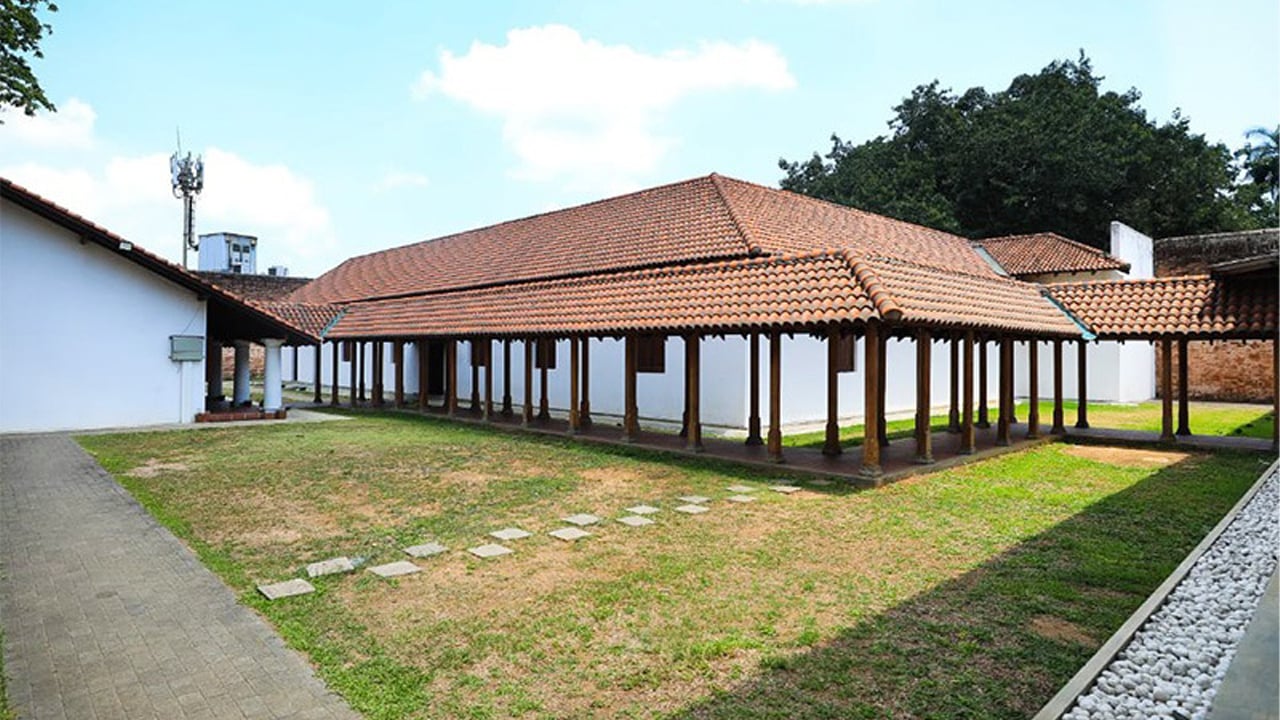
Kandyan-style manor houses follow a recognisable grammar of design shaped by climate, social hierarchy, and the skills of local craftspeople. Ehelepola Walawwa demonstrates several defining characteristics:
- High-pitched tiled roofs — steeply angled to shed the heavy monsoon rains and allow heat to rise away from living spaces.
- Ornate timber carvings — door frames, lintels, and column brackets are worked with floral and geometric motifs that required considerable artisanal expertise.
- Spacious verandahs — semi-open transitional spaces that mediate between the tropical exterior and the cooler interior, also serving as spaces for receiving visitors of lower rank.
- Inner courtyards — providing natural light and ventilation deep into the plan, a practical response to the warm, humid climate of the Kandyan hills.
- Integrated landscaping — shaded garden areas that would have been used for both household production and leisure.
Taken together, these elements illustrate how Kandyan nobles balanced display and practicality — projecting status through craftsmanship while designing for comfort in a tropical environment. Architectural historians regard surviving walawwas as primary evidence for pre-colonial elite domestic life, since few written records describe interior arrangements in any detail.
How does Ehelepola Walawwa compare with other surviving walawwas in Sri Lanka?
Sri Lanka retains a modest number of walawwas in varying states of preservation. Some, such as those in the southern and Sabaragamuwa provinces, have been converted into boutique guesthouses or cultural centres. Ehelepola Walawwa is notable because of its location in Kandy itself — the seat of the last independent kingdom — and because its owner played a documented, historically decisive role rather than serving as a generic provincial administrator. This direct connection to a named historical episode gives the building a narrative weight that purely architectural survivors may lack.
Visitors who have explored Kandy's broader heritage landscape — particularly the Esala Perahera festival grounds and the Temple of the Sacred Tooth Relic — often find that a visit to Ehelepola Walawwa adds a more intimate, human-scale counterpoint to those grand ceremonial sites. If you are planning a broader city itinerary, the Kandy City Tour offered by Lakpura can incorporate heritage stops of this kind within a structured half-day or full-day programme.
What can visitors see and experience at Ehelepola Walawwa today?
The Walawwa is primarily appreciated as an architectural and historical monument rather than a museum with formal exhibits. Visitors can observe the exterior massing and roof profile, examine the carved woodwork on doors and verandah columns, and gain a sense of the spatial organisation typical of elite Kandyan residences. The inner courtyard, where it remains accessible, reveals how the building turns inward for privacy — consistent with the social customs of Kandyan nobility, which maintained strict protocols about who could enter which spaces.
The surrounding neighbourhood also repays attention. Kandy's heritage zone contains several buildings from the late Kandyan and early colonial periods in close proximity, making a short walking circuit a rewarding exercise for anyone interested in how the city's urban fabric evolved across the 19th century.
When is the best time to visit Ehelepola Walawwa?
Kandy is accessible year-round, but the most comfortable visiting conditions are generally between January and April, when the city's inter-monsoonal period brings drier, cooler days. The southwest monsoon (May to September) brings heavier rainfall to the hill country, while October and November see the northeast monsoon's influence. Morning visits tend to be quieter and cooler than afternoon arrivals, particularly important if you are walking between multiple heritage sites in the city.
If your visit coincides with late July or August, the Esala Perahera Festival transforms Kandy into one of South Asia's most spectacular ceremonial events — though accommodation books out well in advance and the city is significantly busier than usual.
How do I get to Ehelepola Walawwa from Colombo?
Kandy lies roughly 115 kilometres northeast of Colombo, typically around three hours by road depending on traffic — the A1 highway corridor through Kadugannawa is the main route. The Colombo–Badulla train line stops at Kandy station, and the journey through the hill country is widely regarded as one of the more scenic rail experiences on the island. Tuk-tuks and metered taxis operate within Kandy itself; the city's compact heritage zone makes most major sites walkable once you are in the centre.
Why is preserving Ehelepola Walawwa important for Sri Lanka's heritage?
Tangible heritage from the Kandyan period is under ongoing pressure from urban development, neglect, and the conversion of historic properties for commercial use. Walawwas in particular are vulnerable because they are privately held in many cases — meaning their fate depends on the resources and priorities of individual families or institutions. Ehelepola Walawwa's continued presence in Kandy's built environment offers researchers, architects, and visitors a rare opportunity to encounter a surviving example of aristocratic Kandyan domestic architecture that is directly connected to documented historical events.
Sri Lanka's Department of Archaeology and the Central Cultural Fund have pursued preservation initiatives for heritage structures in the Kandyan region, though the practical pace of conservation work varies. Visitors who take time to engage seriously with sites like Ehelepola Walawwa — rather than treating them as incidental backdrop — contribute to making the case for their continued protection.
Nearby places
1 places within about 25 km, nearest first.
- Maha Wahalkadaunder 1 km
Related reading
3 pages on closely related subjects.