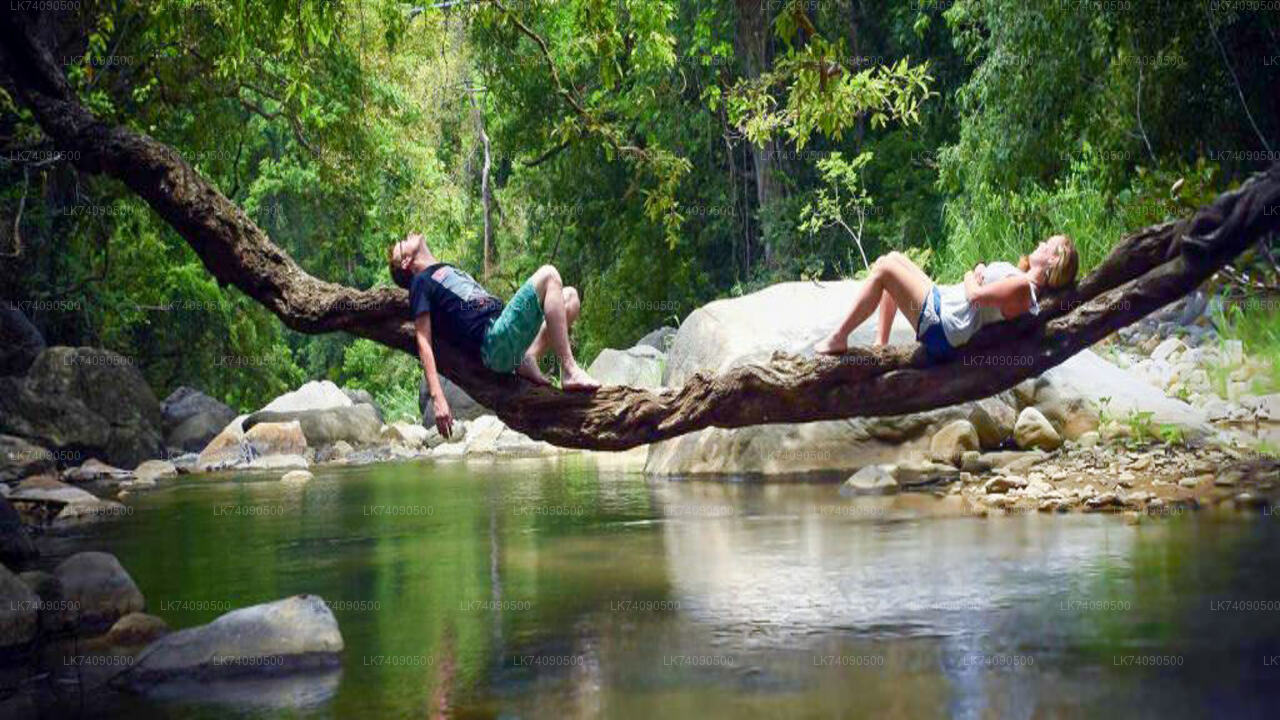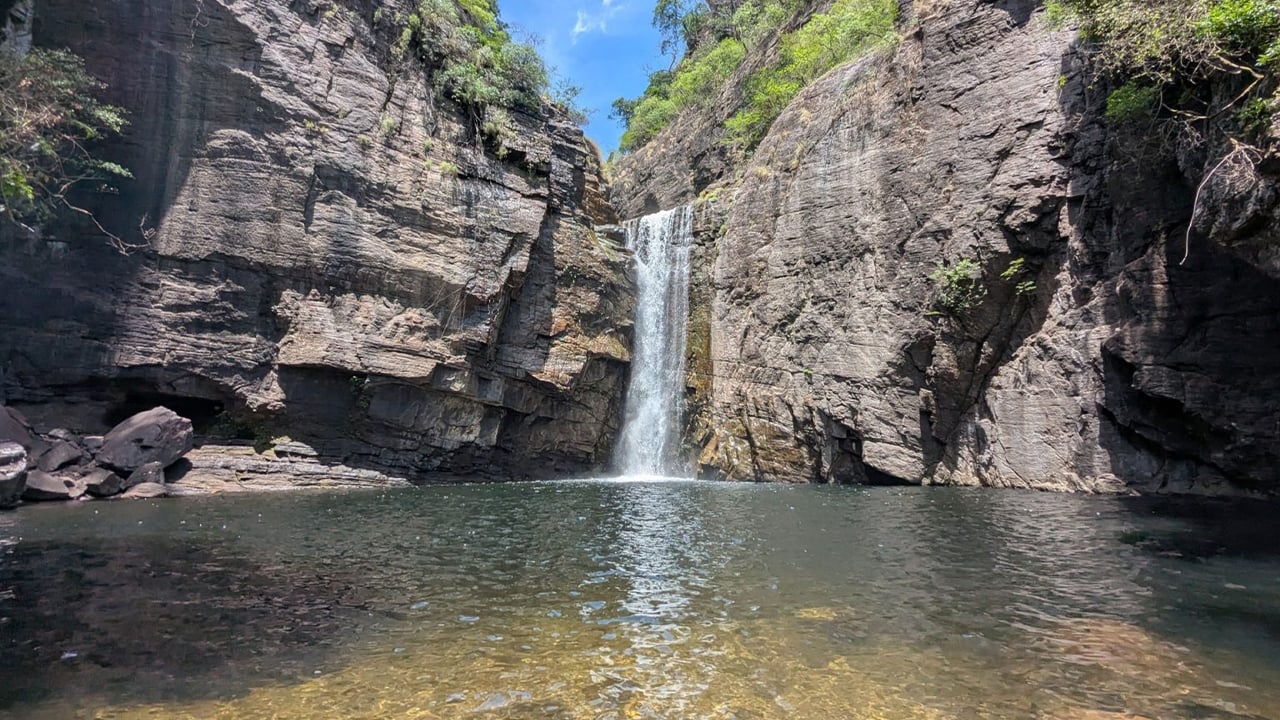

Dumbara Ella Falls drops roughly 30 metres over a tiered rock face deep inside the Knuckles Mountain Range, one of Sri Lanka's two UNESCO-listed natural World Heritage Sites. Fed by the Dumbara River, the fall collects in a clear natural pool before continuing its journey through a landscape of montane forest, terraced paddy land, and mist-wrapped ridgelines. It is not a landmark you stumble upon by accident — reaching it requires a deliberate choice to leave the main road — and that effort is precisely what keeps the site uncrowded and ecologically intact.
What makes Dumbara Ella Falls worth visiting?
Unlike many Sri Lankan waterfalls that are viewable from a roadside platform, Dumbara Ella rewards closer exploration. The cascade splits across several rock shelves before converging at the base pool, so the visual character changes depending on where you stand. During and just after the monsoon the volume increases dramatically; in drier months the flow narrows but the surrounding forest remains lush. Photographers tend to visit between December and February when the air is clearest and a soft mist clings to the canopy above the falls.
The immediate environment supports a range of flora found in Sri Lanka's intermediate and upper wet zones — tree ferns, epiphytic orchids, mosses, and endemic Knuckles species that draw botanists as well as casual walkers. Birdwatchers regularly spot endemics such as the Sri Lanka blue magpie and the yellow-eared bulbul along the trails leading to the falls.
How do I get to Dumbara Ella Falls from Kandy?
Kandy is the most practical base. The falls lie within the Knuckles Conservation Forest, and the most common approach is via Matale or through the Riverston road, depending on which trailhead you choose. By private vehicle the drive from Kandy takes roughly one and a half to two hours; road conditions in the range can be unpredictable after heavy rain, so a four-wheel-drive or high-clearance vehicle is advisable. A Kandy city tour pairs well with an early-morning departure toward the Knuckles the following day, letting you acclimatise to the region's altitude and pace before the hike.
There is no scheduled public bus that drops passengers at the trailhead; the most reliable option is a private transfer or a guided trekking day trip that handles logistics, permits, and trail navigation.
What is the best time of year to visit?
The Knuckles Range sits between two monsoon systems, which means some rainfall is possible in most months. As a general guide:
- December to March — dry and clear; good visibility across the ridges; the falls flow steadily without being dangerously high.
- April to May — the first inter-monsoon brings heavy showers; trails can become slippery and streams swell quickly.
- June to September — the south-west monsoon largely misses the northern Knuckles but can still bring afternoon rain; mornings are typically clear.
- October to November — the north-east monsoon reaches the range; waterfalls are at their most dramatic but access trails are muddiest.
The safest and most comfortable months are December through March, though the falls have genuine appeal year-round for travellers who don't mind some rain.
What trails lead to the falls?
Several designated trails cross the Knuckles Conservation Forest, and Dumbara Ella lies within a sector accessible via community-managed buffer zones. Guides licensed by the Department of Wildlife Conservation or the Central Province Forest Department are required for most routes into the core zone. A typical trek to the falls and back covers around 6 to 10 kilometres depending on the chosen trailhead, with moderate elevation gain through secondary montane forest.
Along the way the trail passes through areas of cloud forest — a rare habitat in Sri Lanka defined by persistent low cloud, high humidity, and an understorey dominated by mosses and liverworts. This ecosystem is fragile; staying on marked paths and carrying out all waste is both a legal requirement inside the conservation area and straightforward common sense.
What wildlife can I expect to see?
The Knuckles Range holds one of the highest concentrations of endemic species per square kilometre in South Asia. Around Dumbara Ella you can reasonably expect to encounter:
- Sri Lanka leopard (rarely seen but present; pugmarks are occasionally spotted on muddy trail sections)
- Purple-faced langur and toque macaque in the forest canopy
- Sri Lanka junglefowl foraging near the stream edge
- Several endemic skink and gecko species on rock faces near the falls
- A variety of dragonflies and damselflies at the base pool, including species found nowhere else on Earth
For anyone combining nature sites in the highlands, Horton Plains National Park is a logical addition — it protects a different high-altitude ecosystem roughly two hours south and hosts the endemic sambar deer and the endangered Sri Lanka whistling thrush.
Are there facilities at the falls?
Dumbara Ella is a backcountry site with no permanent infrastructure. There are no toilets, food vendors, or first-aid posts at or near the base pool. Visitors should carry sufficient water, snacks, a basic first-aid kit, and a fully charged phone. Mobile signal is intermittent throughout the range. Hiring a local guide — available through community lodges in villages such as Pitawala or Meemure — significantly reduces the risk of getting lost and directly supports the households closest to the conservation area.
Can I swim in the pool at Dumbara Ella?
Swimming is possible in calm conditions when the water level is moderate, but the pool's depth and current change significantly after rain. After any period of heavy rainfall, the base pool can fill quickly and an undertow can develop near the base of the main cascade. Exercise caution, avoid the pool if the river upstream appears flooded, and never swim alone. Children should be supervised closely on the wet rocks surrounding the pool, which can be extremely slippery.
What else can I combine with a Dumbara Ella visit?
The Knuckles landscape is rich enough to fill several days. The Makandawa Rainforest lies on the western fringe of the range and offers canopy walks and guided nature trails at a gentler gradient — a good option for families or less experienced hikers. The paddy terraces of Meemure village, reachable by jeep track, give a glimpse of highland agricultural life that has changed little in generations. Further afield, the Sinharaja Forest Reserve — Sri Lanka's other UNESCO-listed rainforest — makes a compelling multi-day extension for serious nature travellers, combining the country's two most biodiverse forest systems in one trip.
Nearby places
13 places within about 25 km, nearest first.
- Lakegala2 km
- Nitro Cave4 km
- Alakola Falls6 km
- Campbell's Lane Forest Reserve6 km
- Rathna Ella Falls6 km
- Sembuwatta Lake6 km
- Kaluwa Watuna Ella6 km
- Corbet’s Gap6 km
- Randenigala Dam9 km
- Seetha Kotuwa9 km
- Pitawala Pathana (Mini World's End)9 km
- Sera Ella Falls11 km
- Riverston Peak17 km