


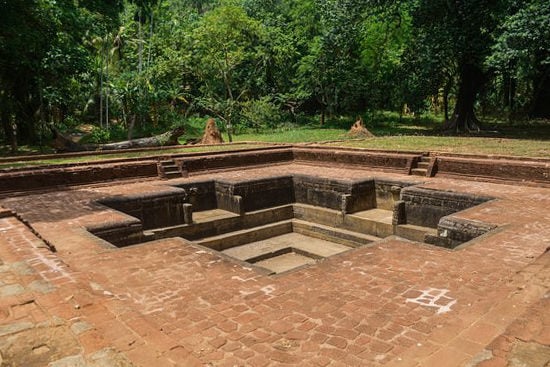
Few engineering achievements in the ancient world match the quiet ingenuity of Sri Lanka's hydraulic civilisation. For more than 1,500 years, the island's engineers designed, refined, and maintained a system of reservoirs and canals that turned the arid dry zone into productive rice-growing land. At the heart of that system sat a deceptively simple device: the Bisokotuwa, a vertical sluice tower that controlled the release of water from large earthen reservoirs with remarkable precision.
What is a Bisokotuwa?
The word combines Sinhala roots meaning “queen's chamber” or “royal chamber” — a name that reflects the esteem in which these structures were held. In engineering terms, a Bisokotuwa is a vertical intake tower built inside or just upstream of an earthen dam embankment. It allowed the operators of a reservoir to draw water from a chosen depth rather than simply releasing water from the base of the dam, where pressure — and destructive energy — would be at its greatest.
The tower was typically constructed from granite or fired brick and seated on a conduit laid horizontally through the base of the embankment. Openings at different heights on the tower corresponded to different water levels in the reservoir. By blocking or opening these apertures, the irrigation overseers could regulate flow with a degree of control that prevented erosion of the earthworks downstream.
How did the Bisokotuwa evolve from earlier sluice designs?
The Bisokotuwa did not appear fully formed. Its predecessor was the Keta Sorowwa — a stack of funnel-shaped chute units made from fired clay, placed one atop another to reach the water surface of a reservoir. Each unit was essentially a tapered collar; together they formed a tower whose uppermost opening sat at the current water level. A clay conduit ran from the base of the stack through the embankment and into the distribution canal.
The operating principle exploited a fundamental property of fluid mechanics: water pressure at the surface of a reservoir is far lower than at depth. By drawing water from the top of the column rather than the bottom, the Keta Sorowwa kept outlet velocities manageable and spared the clay conduit from the full hydrostatic force of the stored water. As the reservoir emptied and the level dropped, workers removed the highest chute unit manually, re-exposing the next opening and maintaining discharge.
Over successive generations, builders replaced the clay stacks with permanent stone towers — the Bisokotuwa — and refined the conduit design. The result was a structure that could be built once and operated indefinitely, requiring only the management of sluice boards or stone plugs rather than the physical removal of clay collars.
Why was controlled water release so critical?
An earthen embankment is stable only so long as water seeps through it slowly and evenly. A sudden, uncontrolled release of stored water generates turbulence powerful enough to scour the toe of the dam, undercut the embankment, and trigger a catastrophic breach. In densely settled river valleys, such a failure could destroy entire villages and agricultural communities built alongside the reservoir.
The Bisokotuwa addressed this danger by dissipating potential energy before the water ever reached the earthen sections of the dam. Water entered the tower at a low-pressure point near the surface, descended within the shaft, and entered the base conduit at a velocity the canal network could safely accommodate. The energy was released gradually rather than explosively — an elegant solution arrived at through centuries of empirical observation rather than formal hydraulic theory.
Where can Bisokotuwa structures still be seen today?
Surviving examples are found throughout the ancient irrigation heartland of Sri Lanka's North Central Province. The reservoirs of Polonnaruwa — including the Parakrama Samudra complex — preserve some of the most studied examples, where archaeological excavation has revealed intact stone towers and their associated conduit systems. Scholars regard these structures as primary evidence for the sophistication of Sinhalese hydraulic engineering during the Anuradhapura and Polonnaruwa kingdoms.
Smaller, less-excavated examples exist at many minor tanks scattered across the dry zone, some still in agricultural use today. Their continued function after more than a millennium is a testament to the quality of the original construction.
How does the Bisokotuwa relate to modern spillway engineering?
The conceptual line from the Keta Sorowwa to the Bisokotuwa continues into contemporary hydraulic engineering. The Morning Glory spillway — a circular, funnel-shaped overflow structure now used in reservoirs worldwide — operates on an identical principle: draw excess water from near the surface, where energy is lowest, and convey it through a shaft to a downstream outlet. The Bomburu Ella reservoir near Horton Plains National Park in the Nuwara Eliya hills is equipped with a Morning Glory spill, its silhouette recognisably descended from those ancient clay chutes.
Modern engineers encountering the Bisokotuwa for the first time frequently note that, given the materials and tools available to its builders, the design choices were close to optimal. The geometry of the tower, the placement of apertures, and the gradient of the conduit all reflect an understanding of hydraulic behaviour that took Western engineering centuries more to formalise.
What broader cultural significance does the Bisokotuwa carry?
The Bisokotuwa was not simply infrastructure; it was the linchpin of a water-management culture that shaped Sri Lankan society, economy, and governance for over a millennium. The construction and upkeep of large tanks required coordinated labour, centralised administration, and a body of specialist knowledge passed across generations. State patronage drove continuous improvement, and the prosperity generated by irrigated rice cultivation funded the temple complexes, dagobas, and royal capitals that survive as UNESCO heritage sites today.
Rice cultivation itself — still central to Sri Lankan identity — would have been impossible at its historical scale without these devices. The paddy field landscapes that visitors see across the dry zone are, in a very real sense, the living legacy of the engineers who first stacked clay chutes inside an earthen bund and watched water flow safely into a canal.
Understanding the Bisokotuwa is, therefore, a way of understanding Sri Lanka: a society that turned a difficult semi-arid environment into one of the ancient world's most productive agricultural civilisations, and did so through patient, cumulative ingenuity rather than dramatic conquest.