Rising to 2,259 metres (7,411 feet) above sea level, Bambarakanda Peak is one of the more rewarding highland summits in Sri Lanka's central mountains. Located in the Badulla District of Uva Province, the peak sits within a landscape shaped by cloud forest, steep escarpments, and the headwaters of rivers that feed the lowland plains far below. It is best known as the high ground above Bambarakanda Falls — at around 220 metres, the tallest waterfall in Sri Lanka — though the peak itself offers its own reasons to make the journey.
What makes Bambarakanda Peak worth visiting?
The peak occupies a corner of the central highlands where the terrain drops away sharply, giving the summit exceptional long-range views. On a clear morning, the panorama extends across rolling tea country, forested ridges, and — on the best days — to distant summits including Sri Pada (Adam's Peak) to the west and Hakgala to the north. Below the treeline, mist frequently pools in the valleys, creating the layered visual effect that makes this part of Uva Province so distinctive.
The surrounding forests are part of a broader highland ecosystem that includes montane wet evergreen and cloud forest communities. Several plant species here are endemic to Sri Lanka, and the birdlife is notably rich — highland species such as the Sri Lanka white-eye, dull-blue flycatcher, and yellow-eared bulbul have been recorded in the area.
How difficult is the hike to Bambarakanda Peak?
The trail is considered moderately challenging. The ascent involves a sustained climb through dense forest with some steep sections near the upper ridge. Fit hikers without technical climbing experience can complete it, but the terrain warrants proper footwear — trail shoes or light hiking boots with grip are strongly recommended. The path can become slippery after rain, which is frequent in this part of the highlands.
Hiring a local guide is advisable. The trail is not consistently well-marked throughout, and sections of the route pass through dense vegetation where the path can be ambiguous. A guide also adds value by identifying birds and endemic plants along the way. Start early — ideally before 6 a.m. — to maximise the chance of clear summit views before cloud builds up through the morning.
When is the best time to visit Bambarakanda Peak?
The highland zone around Bambarakanda receives rainfall from both monsoon systems, so there is no completely dry season. The period from January to April, when the northeast monsoon has eased and the southwest monsoon has not yet arrived in force, tends to offer the clearest mornings and the most settled hiking conditions. August and September can also be reasonable. Avoid visiting during the height of the southwest monsoon (May to July) if summit views are a priority — the peak is frequently socked in cloud during those months, and trail conditions deteriorate.
Temperatures at this elevation are cool year-round, typically between 12°C and 20°C during the day, and dropping further at night. Carry a light layer regardless of the season.
How do I get to Bambarakanda Peak from Colombo or Ella?
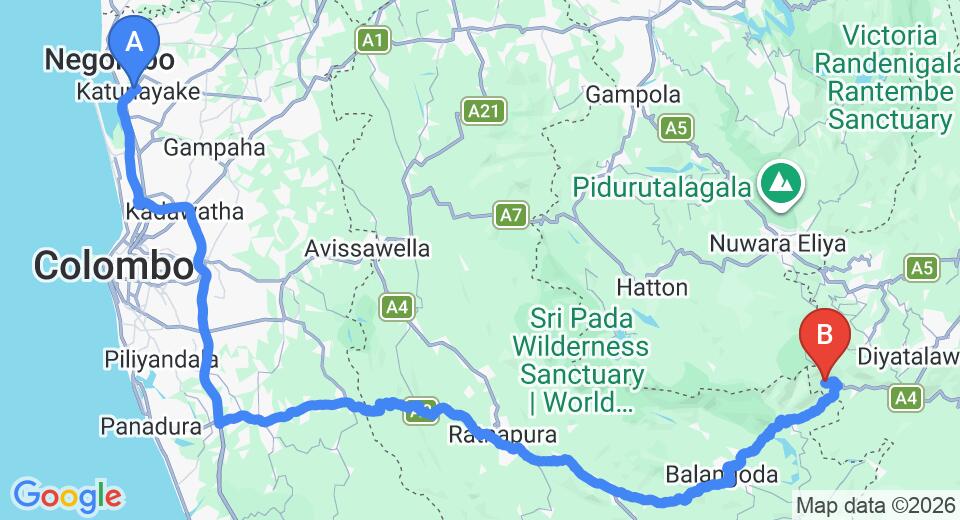
The peak is most conveniently approached from the small settlement of Bambarakanda, which sits off the Beragala–Haputale road in Badulla District. From Colombo, the drive is roughly five to six hours via the expressway to Ratnapura and then through the highlands. From Ella, the journey is considerably shorter — around one to one-and-a-half hours by road — making Ella a practical base for the hike.
There is no direct public transport to the trailhead, so most visitors arrange a private vehicle. The road to Bambarakanda village is navigable by a standard car in dry conditions, though a higher-clearance vehicle is more comfortable on the final approach.
What can I see near Bambarakanda Peak?
The single most-visited attraction in the immediate area is Bambarakanda Falls itself, located roughly 5 kilometres from the peak. The waterfall cascades in a near-vertical drop of around 220 metres down a basalt face and is at its most impressive during and shortly after the rainy season, when the flow is heaviest. A viewing platform near the base provides a clear sightline to the full height of the falls.
Beyond the falls, the broader Uva highlands contain several other points of interest within reasonable driving distance. Horton Plains National Park — home to World's End, a sheer escarpment dropping nearly 900 metres — is around an hour to the northwest. The cool-climate town of Haputale and the tea estates of the Dambatenne range lie to the south and east, offering a different perspective on the highland landscape.
| Detail | Information |
|---|---|
| Elevation | 2,259 m (7,411 ft) |
| District / Province | Badulla / Uva |
| Nearest waterfall | Bambarakanda Falls (~220 m drop) |
| Nearest town base | Haputale or Ella |
| Best hiking months | January–April, August–September |
| Hike difficulty | Moderate |
| Guide recommended | Yes |
What flora and fauna should I expect on the trail?
The forests on the approach to Bambarakanda Peak include montane species typical of Sri Lanka's wet central highlands. Rhododendron arboreum — the tree rhododendron, which produces deep-red flowers — appears at higher elevations alongside species of Syzygium, Calophyllum, and a dense understorey of ferns and mosses. Orchids are present but not always conspicuous outside flowering season.
Mammals in the area include purple-faced langurs, which are frequently seen in the forest canopy, as well as sambar deer and wild boar at lower elevations. Sri Lanka leopard sightings are occasionally reported but rare. The birdwatching is genuinely rewarding — the highland endemic assemblage is well-represented, and early morning on the trail is the most productive time.
Is Bambarakanda Peak suitable for overnight camping?
Camping in the immediate area is possible but requires advance planning. There are no formal campsite facilities at the trailhead, and any overnight stay in designated forest reserve areas typically requires a permit from the Forest Department. Some small guesthouses operate in and around Bambarakanda village and in nearby Haputale, which is a more practical base for those combining the peak with other highland destinations. Confirm accommodation availability before travel, as options are limited compared to more-visited highland towns.
Nearby places
9 places within about 25 km, nearest first.
- Bambarakanda Ellaunder 1 km
- Hunugalagala Limestone Cave2 km
- Haldummulla2 km
- Bambarakanda Falls4 km
- Haputale Railway Station7 km
- Haputale City7 km
- Haputale St. Andrews Church7 km
- Beragala7 km
- Kalupahana Village9 km
Related reading
8 pages on closely related subjects.