

About this experience
This private day tour travels north from Colombo to Negombo, a coastal city with a layered colonial past and a fishing tradition that has shaped its streets, waterways, and churches for centuries. Over the course of six hours, a small group — or a single traveller — moves through four distinct landmarks at their own pace, accompanied by an English-speaking chauffeur guide in an air-conditioned vehicle. The itinerary takes in a working fish market, a fort gateway inscribed with a colonial date, one of the largest Catholic churches in Sri Lanka, and a canal built by a British official at the turn of the nineteenth century.
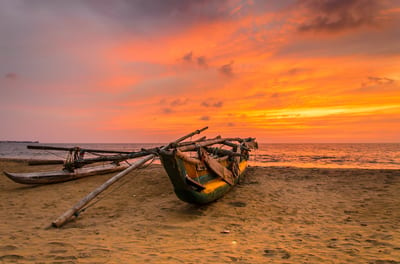
Negombo sits roughly thirty-five kilometres north of Colombo on the island's west coast, and the drive there sets the scene: the city skyline gives way to lagoon flats, fishing settlements, and the open Indian Ocean glittering to the west. The first stop is the Negombo Fish Market — known locally as Lellama — where ocean-going boats land deep-water catches and lagoon craft return with prawns and crabs. The traditional outrigger canoes called oruvas, with their painted hulls and wooden outrigger poles, line the shore nearby, much as they have for generations. From the market, the tour moves to the Dutch Fort, whose stone gateway bears the inscription 1678 — a remnant of the era when Negombo passed from Portuguese to Dutch control. The fort structure today serves as a prison, but its gate and surroundings remain a visible record of the colonial period that shaped this coastline.
St. Mary's Church stands on Grand Street at the centre of Negombo, a neoclassical Roman Catholic church whose current building was begun in 1874 and completed in 1922. It is the fifth church to occupy this site — the first was established in 1544 — and it reflects the depth of Catholicism here: Negombo is sometimes called Little Rome for its more than twenty-five Catholic churches, a legacy of Portuguese settlement since 1505. Inside, the ceiling carries alabaster paintings of saints alongside depictions of the life of Christ painted by N.S. Godamanna, a local Buddhist artist, creating an unusual meeting of European and Sri Lankan artistic traditions. The final stop on the route is the Hamilton Canal, conceived by Garvin Hamilton, British Agent of Revenue and Commerce, and constructed between 1802 and 1804. The canal runs west of the older Dutch waterway, covering fourteen and a half kilometres from the Kelani River mouth at Hekitta south to the Negombo Lagoon at Pamunugama, and forms part of a broader canal network that once connected Negombo to Colombo and beyond.
The tour departs with a hotel pickup in Colombo at 08:30 and returns guests to their hotel at approximately 12:30, making it a manageable morning excursion that leaves the afternoon free. The vehicle is air-conditioned throughout, and one litre of bottled water per person is provided. Comfortable walking shoes are worth wearing, as some sites involve uneven ground. Entrance fees, meals, and drinks are not covered and are the guest's own arrangement. Photography stops along the route can be requested at locations where parking is available. The minimum age for participation is five years old.