

Tantirimale Monastery sits in the North Central Province of Sri Lanka, deep within a rocky, forested landscape that has changed little since the site was first consecrated more than two thousand years ago. For pilgrims and archaeology enthusiasts alike, the monastery offers something rare: an ancient Buddhist site that remains genuinely off the main tourist circuit, yet is historically significant enough to stand alongside the great centres of Polonnaruwa and Anuradhapura.
What is the history of Tantirimale Monastery?
Tantirimale is believed to date to the 3rd century BCE, during the reign of King Devanampiya Tissa — the same monarch who welcomed the arrival of Buddhism in Sri Lanka through the missionary Arahat Mahinda. According to tradition, the site was used as a resting place during one of Mahinda's early journeys across the island, lending it a founding-era significance that few monasteries can claim.
Early Brahmi inscriptions found at the site corroborate its ancient origins and provide some of the oldest epigraphic evidence of Buddhist monastic activity on the island. These inscriptions, carved directly into the granite outcrops, record the names of benefactors and monks — a common practice at early Sri Lankan monasteries that helps historians piece together the social fabric of the Anuradhapura Kingdom period.
The monastery continued to function and expand through successive centuries, and remnants of monastic dwellings, image houses, and stupas reflect multiple phases of construction and restoration.
What can you see at Tantirimale Monastery?
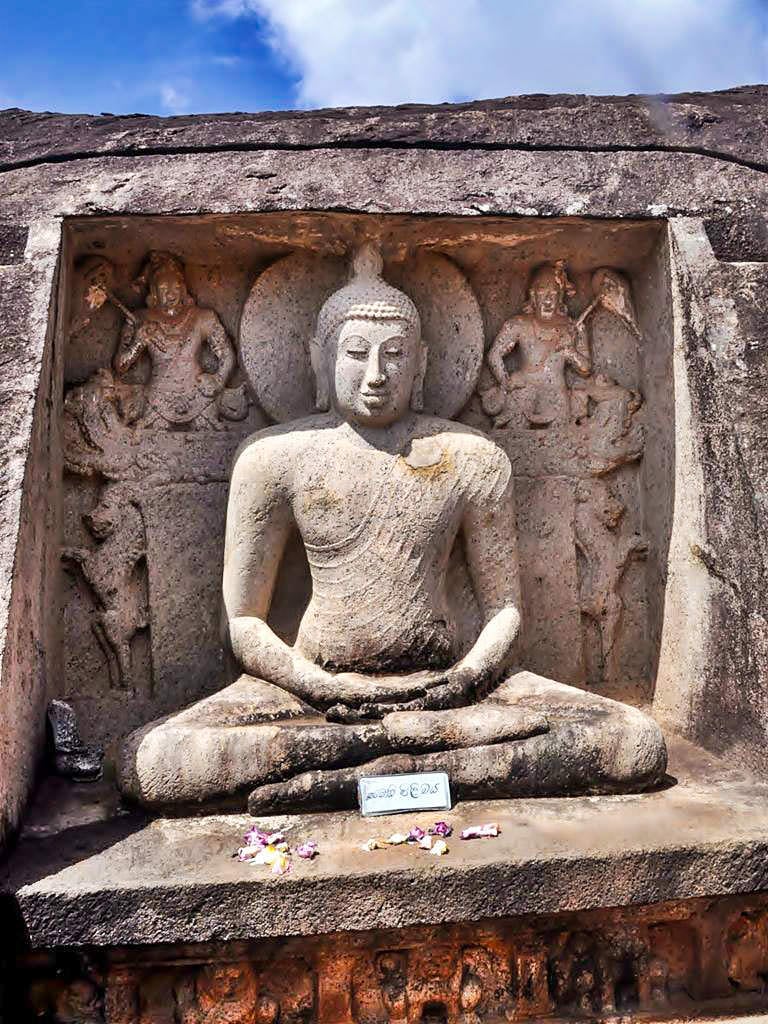
The most striking feature is a large reclining Buddha statue carved directly into a granite boulder. Rock-hewn sculpture of this kind was a characteristic art form of early Sri Lankan Buddhism, and the Tantirimale example retains considerable presence despite centuries of weathering. Traces of ancient frescoes on sheltered rock surfaces hint at a richer decorative programme that once existed here.
Several dagobas (stupas) of varying sizes dot the hilltop complex. Some have been partially restored by the Department of Archaeology; others remain in a state of picturesque ruin that underlines the site's age. Stone-cut steps, cisterns, and the foundations of monks' cells are scattered across the boulders, rewarding visitors who take time to explore carefully.
The surrounding dry-zone forest is also worth noting. The rocky outcrops are interspersed with large specimen trees and shrubs typical of Sri Lanka's northern dry zone, and wildlife — including grey langur monkeys and occasionally wild elephants — moves through the area. Tantirimale falls within a region where elephant corridors are active, so encounters are possible on the approach road.
How do I get to Tantirimale from Anuradhapura?
Tantirimale lies roughly 35 km north-west of Anuradhapura town. The access road is unpaved for a section of the route, and a four-wheel-drive or a high-clearance vehicle is advisable, particularly during or after the north-east monsoon (October to January) when the track can become muddy. Most visitors travelling independently hire a tuk-tuk or private car from Anuradhapura, though the road condition means a sturdy vehicle is preferable to a low-slung taxi.
There is no reliable scheduled public transport directly to Tantirimale, so private or chartered transport is the practical choice. The nearest town with accommodation and services is Anuradhapura, which also serves as the logical base for a day trip to the monastery.
When is the best time to visit Tantirimale?
The dry season from May to September is the most comfortable period to visit. During these months the access track is passable, the forest is open, and daytime temperatures — though warm — are manageable in the early morning. The site is particularly atmospheric around dawn, when mist settles between the boulders and the forest is quiet.
Poya (full-moon) days draw Sri Lankan pilgrims to the monastery throughout the year, and the atmosphere on these days is lively and devotional. If you are interested in observing active religious practice rather than purely archaeological exploration, timing a visit to coincide with a Poya day is worthwhile. The Esala Poya, which falls in July or August and is linked to the arrival of Buddhism in Sri Lanka, holds particular resonance at sites associated with King Devanampiya Tissa's era.
Is Tantirimale suitable for meditation retreats?
The monastery's remoteness and natural setting make it one of the quieter sacred sites in the Anuradhapura District. The resident monastic community observes traditional Theravada practice, and the rocky surroundings provide natural meditation shelters much as they did for monks in antiquity. Visitors should dress modestly, remove footwear before entering temple structures, and maintain a respectful silence within the inner precincts.
There are no formal facilities for visiting meditators in the way that some urban viharas provide, but the site's environment is genuinely conducive to contemplative visits. Those with a serious interest in forest monastery traditions in Sri Lanka may also consider exploring the broader Anuradhapura District, where several active forest hermitages maintain ancient lineages.
Practical information at a glance
| Detail | Information |
|---|---|
| Location | Anuradhapura District, North Central Province |
| Distance from Anuradhapura town | Approximately 35 km north-west |
| Access road | Partly unpaved; high-clearance vehicle recommended |
| Best season | May – September (dry season) |
| Nearest base town | Anuradhapura |
| Dress code | Modest clothing required; white is traditional for Poya visits |
| Entry fee | No fixed government entry charge (donations welcome) |
How does Tantirimale compare with other Anuradhapura-area sites?
The Sacred City of Anuradhapura is a UNESCO World Heritage Site and receives large visitor numbers daily. Tantirimale, by contrast, sees a fraction of that footfall and preserves an atmosphere of quiet authenticity that heavily visited sites inevitably lose. Archaeology enthusiasts who have already toured the main Anuradhapura monuments — the Jetavanaramaya, the Sri Maha Bodhi, and the Thuparamaya — will find Tantirimale a compelling contrast: less manicured, more evocative of the monastic forest tradition that shaped early Sri Lankan Buddhism.
The Wilpattu National Park lies to the west of Anuradhapura and can be combined with a Tantirimale visit to create a two-day itinerary that balances cultural heritage with wildlife. Similarly, the town of Tambuttegama, a short distance to the south-east, has its own minor antiquities and can serve as a waypoint en route.
Nearby places
8 places within about 25 km, nearest first.
- Thanthirimaleunder 1 km
- Konagarayankulam8 km
- Thanthirimale Raja Maha Viharaya11 km
- Puliyankulam Railway Station16 km
- Konagarayankulam16 km
- Tantirimale City17 km
- Omanthai Railway Station18 km
- Talawa Railway Station19 km