Rambukkana is a small but strategically placed town in the Kegalle District of Sabaragamuwa Province, sitting at the edge of Sri Lanka's hill country where the lowland plains begin their gradual climb toward Kandy. Governed by the Rambukkana Pradeshiya Sabha — incorporated on 7 July 1991 — the constituency covers around 128.8 square kilometres and is home to roughly 84,260 residents. For travellers, Rambukkana serves primarily as a gateway: it is one of the last stops on the main railway line before the iconic hill-country ascent begins, and its surrounding landscape of rubber estates, paddy fields, and forested ridges rewards those who pause here rather than rush through.
Where exactly is Rambukkana, and how do I get there?
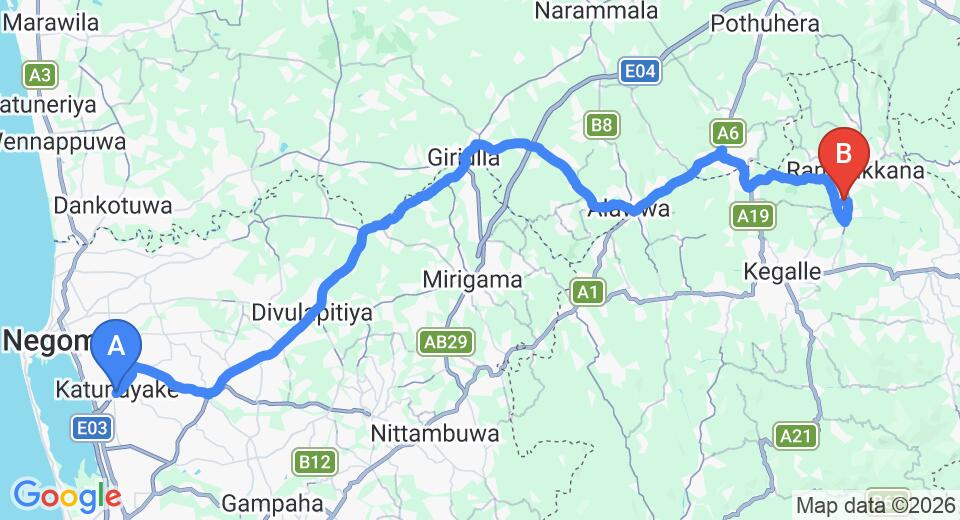
Rambukkana lies on the Colombo–Kandy railway line, roughly midway between the capital and the cultural city of Kandy. The town is accessible by train from Colombo Fort Station in around two hours on an intercity service, or slightly longer on a stopping train. By road, the A1 Colombo–Kandy highway passes through the broader Kegalle District, and Rambukkana is reachable via a short deviation from it.
For visitors who prefer door-to-door convenience, a private transfer from Colombo Bandaranaike International Airport is a practical option — the drive takes roughly two to two-and-a-half hours depending on traffic. Lakpura operates scheduled transfers directly to accommodation in and around Rambukkana.
What is the Kegalle District known for?
Kegalle District spans approximately 1,693 square kilometres and forms the northern half of Sabaragamuwa Province. According to the 2012 census, the district's population stood at around 837,000 — close to four percent of Sri Lanka's total — making it a moderately sized district by national standards. The landscape is characterised by rolling hills, tea and rubber plantations, rivers, and a handful of significant cultural and natural landmarks.
- Pinnawala Elephant Orphanage — one of Sri Lanka's most visited wildlife centres, located within the district
- Rubber cultivation — Kegalle is among Sri Lanka's main rubber-producing areas, and working estates are visible across the district
- Buduruwagala and small temples — scattered Buddhist shrines and vihara add a quiet religious character to many villages
- Makandawa Forest Reserve — a rainforest fragment near Kitulgala that draws birders and white-water rafters
The district was historically part of a former Dissavani (administrative territory) under Kandyan-era rule, giving it a layered historical significance beyond its natural assets.
What is Sabaragamuwa Province, and why does the name matter?
Sabaragamuwa Province is one of Sri Lanka's nine provinces — the first-level administrative division — and contains two districts: Kegalle and Ratnapura. The name derives from the Sabara, an ancient Indic term for hunter-gatherer communities who once inhabited the region's forests. While the province has existed geographically for centuries, its legal status as an administrative province was formalised only in 1987 under the 13th Amendment to the Constitution of Sri Lanka.
The province is ecologically significant: it shelters the western edge of the central highlands and contains portions of rainforest that form a corridor between lowland and montane ecosystems. The nearby Sinharaja Forest Reserve — a UNESCO World Heritage Site in the adjacent Ratnapura District — gives a sense of the biodiversity that defines this part of the island.
What is there to do near Rambukkana?
Rambukkana itself is a quiet market town, but its surroundings offer a range of experiences for curious travellers. The chief draw in the immediate area is the Pinnawala Elephant Orphanage, where visitors can observe Sri Lankan elephants being bathed in the Maha Oya river — a routine that takes place twice daily. The site is managed by the Department of National Zoological Gardens of Sri Lanka.
Beyond Pinnawala, the Kegalle District rewards slow travel:
- Rubber tapping — visiting a working rubber estate gives insight into an industry that shaped the region's economy for more than a century
- River bathing and picnicking along the Maha Oya, which flows through the district
- Scenic train journeys — boarding the hill-country train at Rambukkana and riding toward Kandy offers some of the most photographed rail scenery in Sri Lanka, including viaducts and forested gorges
- Kitul tapping — local kitul palm tapping is practiced in villages across Sabaragamuwa, and watching the process is a distinctive cultural encounter
When is the best time to visit Rambukkana?
Rambukkana falls within Sri Lanka's wet zone, which means it receives rainfall year-round, with peaks typically between May and July (southwest monsoon) and again in October and November. The driest and most reliably sunny months tend to be January through March, making this the most comfortable period for outdoor exploration. That said, the lush greenery sustained by regular rainfall is part of the landscape's appeal — even a rainy afternoon has a certain atmosphere among the rubber and paddy fields.
Temperatures in the area are moderate compared to coastal Sri Lanka, hovering around 25–30°C during the day, with cooler nights reflecting the altitude of the surrounding hills.
How does Rambukkana fit into a broader Sri Lanka itinerary?
Most visitors encounter Rambukkana as a transition point rather than a primary destination. It sits naturally between Colombo and Kandy on the classic Cultural Triangle circuit — a logical overnight or half-day stop for travellers who want to break the journey and visit Pinnawala. From Kandy, the broader cultural loop extends north toward Sigiriya and the Kandy city experience, or south toward the hill-country tea estates.
For travellers arriving by air at Bandaranaike International Airport, Rambukkana and the Pinnawala area can serve as a first-night destination — close enough to the airport to reach comfortably after a long flight, yet already immersed in rural Sri Lanka rather than the congestion of Colombo.
What accommodation options exist in and around Rambukkana?
The area around Rambukkana has seen a modest growth in boutique and heritage accommodation over recent years. Jetwing's Wahawa Walauwa property near Rambukkana — a converted walauwa (manor house) — offers a sense of colonial-era Sabaragamuwa in a relatively intimate setting. More rustic guesthouses and homestays are available in nearby villages, catering to travellers who prefer local immersion over resort-style amenities. Kandy, roughly 35 kilometres away, provides a much wider range of hotels for those who prefer a larger town as a base.
Nearby places
10 places within about 25 km, nearest first.