


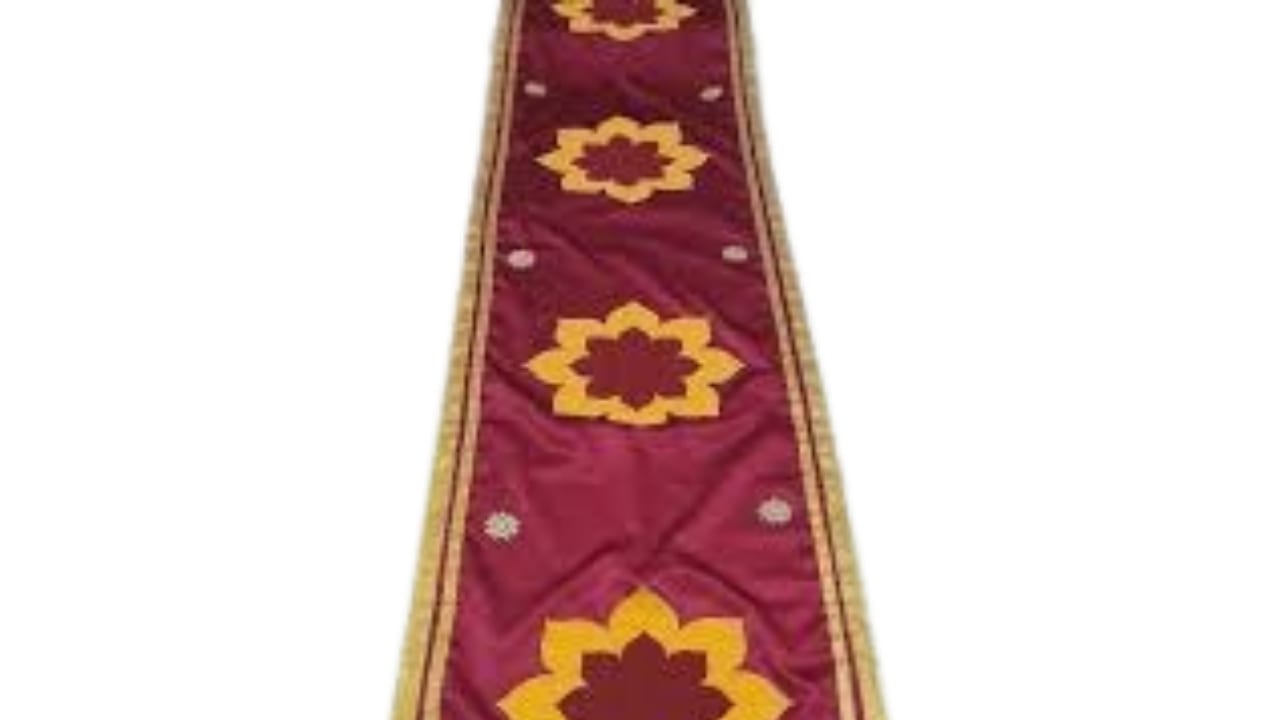

The pawada is one of the quieter but most enduring objects in Sri Lankan Buddhist practice. Placed on the floor of temples, shrine rooms, and home altars across the island, it serves as a designated, consecrated surface for kneeling, sitting, and presenting offerings during worship. Its presence is a small but deliberate act of reverence — marking out a space where everyday life gives way to spiritual attention.
What is a pawada and what does it represent in Buddhism?
In Sinhala Buddhist tradition, the pawada functions much like a prayer mat does in other religious cultures — it defines a clean, respectful boundary for devotional activity. The word itself carries connotations of humility: by lowering oneself onto the pawada before the Buddha image, the devotee expresses deference to the Triple Gem — the Buddha, the Dhamma, and the Sangha.
Beyond its practical function, the pawada is understood as a symbol of purity and mindfulness. Keeping a dedicated surface for worship reinforces the discipline of separating the sacred from the mundane, a principle woven throughout Theravada Buddhist ethics in Sri Lanka.
What materials and designs are used to make a pawada?
Traditional pawada are made from woven cloth, natural fibers, or velvet, chosen for their softness underfoot and their ability to be kept clean. Plain, muted colors — cream, white, saffron, or deep maroon — are most common, reflecting the Buddhist emphasis on simplicity over display.
Many pawada carry subtle decorative elements drawn from Buddhist iconography:
- Lotus flower — symbolizing purity and spiritual awakening arising from ordinary conditions
- Dharma Chakra (Wheel of the Law) — representing the Buddha's first teaching and the path to liberation
- Geometric border patterns — conveying balance and meditative order
Velvet pawada, often used in formal temple settings or presented as devotional gifts, tend to have more intricate embroidery while still adhering to restrained, reverential motifs. Simpler woven versions serve equally well for daily home worship.
When and how is a pawada used in Sri Lankan religious life?
The pawada appears across the full range of Buddhist observance in Sri Lanka, from quiet individual prayer to large communal ceremonies. Its contexts include:
- Daily puja — morning and evening worship at home altars and temple shrine rooms
- Poya day observances — the full-moon days that mark the Buddhist calendar, when temples fill with worshippers observing sil and participating in collective merit-making
- Pirith chanting ceremonies — where monks chant protective suttas and devotees sit attentively on pawada throughout
- Almsgiving (dāna) — occasions when lay devotees offer food and requisites to the Sangha, using the pawada to mark the respectful space between giver and receiver
- Meditation sessions — providing a stable, clean foundation for seated practice
In temple settings, large pawada may be laid along the entire length of a shrine room floor, allowing a congregation to prostrate together. In homes, a smaller pawada is typically kept folded near the family altar and unrolled only for worship, preserving its ritual cleanliness.
How does the pawada connect to broader Sri Lankan Buddhist culture?
Sri Lanka's Buddhist heritage runs deep — the island has maintained an unbroken tradition of Theravada practice for over two millennia, and everyday objects like the pawada are carriers of that continuity. The Dhamma School (Daham Pasala) system, which teaches children Buddhist values and rituals from an early age, includes instruction in the correct use of temple items, ensuring the significance of the pawada passes from generation to generation.
The pawada also appears prominently during major national religious events. At the Esala Perahera Festival in Kandy, and at countless smaller perahera processions around the country, shrines and processional routes are lined with offerings and ritual objects that include decorative pawada, reinforcing its place not just in private devotion but in public religious life.
In this sense, the pawada is more than a floor covering. It is a quiet, physical expression of a worldview — one in which attention, cleanliness, and humility are understood as the foundations of a well-lived life.
What should visitors know about the pawada when visiting Sri Lankan temples?
Travelers visiting Buddhist temples in Sri Lanka will encounter pawada in almost every shrine room. A few points of etiquette are worth knowing:
- Remove footwear before stepping onto any area covered by a pawada — this applies to visitors of all backgrounds.
- Avoid stepping over offerings or across the pawada if not participating in worship; walk around the designated ritual space.
- If invited to sit during a ceremony, sit cross-legged or kneel — pointing the soles of the feet toward a Buddha image is considered disrespectful.
- Pawada used in worship should not be handled casually by visitors; treat them with the same care you would any sacred object.
Temples such as the Iranawila Rajamaha Viharaya and the ancient monuments of Polonnaruwa provide excellent contexts in which to observe these objects in their living ritual setting, rather than simply as artifacts.
Can I purchase a pawada as a meaningful souvenir or devotional gift from Sri Lanka?
A pawada makes a thoughtful and culturally resonant gift — particularly for Buddhist practitioners, for those with Sri Lankan connections, or for anyone who appreciates handcrafted devotional objects. Quality varies considerably: mass-produced versions use synthetic fabrics, while finer pawada are made from velvet or traditionally woven cloth with hand-embroidered motifs.
When selecting a pawada, consider the size of the intended altar space, the weight of the fabric, and the clarity of the symbolic embroidery. A well-made pawada should lie flat without bunching and retain its color after washing. Lakpura offers a range of authenticated pawada — from simple woven mats to velvet pieces with lotus and Dharma Chakra designs — sourced from Sri Lankan craftspeople who understand the devotional context of the object.
Related reading
1 pages on closely related subjects.


