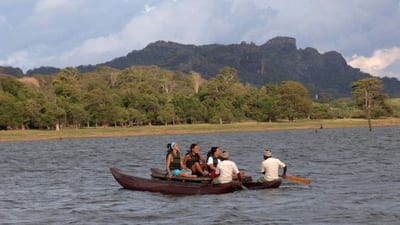
Many of the rivers flowing through our country have been named in Pali, as mentioned in our chronicles such as the Mahavamsa, and Culavamsa. Among them is the Bentota Benthara river flowing through the deep south. About 38 miles away from the Colombo-Galle-Matara highway, this river is named in Culavamsa (Part 1) as Bhimathitha. It is derived from the Pali word ‘Bhima’, which means fearful/dreadful, while ‘thitha’ means ferry/port. Legend has it that the river is said to be haunted by a demon lying in its murky depths, ready to prey upon anyone crossing. Old timers living along the banks of this river have recalled how their ancestors, before they crossed the river, invoked the blessings of the guardian deities such as Kataragama and Vishnu for a safe crossing. Close to this Bentota river lies an ancient temple named Benthara Galapatha Raja Maha Vihara. Associated with this river, this temple is also aptly named Bhimathitha Vihara.
Carvings in stone
The pathway leading to this temple goes through a stone archway off a stone doorway having two upright monolithic pillars on either side, and another two above and below. On those standing pillars are carved elaborate, Nari Latha motifs. These decorative carvings of great aesthetic value date back to the Kandyan period. These fascinating Nari Latha carvings come out of a hoary myth spun around the Rishis of the Himalayas, linked to a fabulous climbing creeper named Nari Latha, which when it blossoms, takes the shape of an enticing damsel. These clusters of flowers are said to have even mesmerised the Rishis, disturbing their meditation. The stone door frame and its standing pillars had been originally installed at the Bentota Udakotuwa Raja Maha Vihara in the Kali Devale. In later years, it was brought to the Galapatha temple.
Rare archaeological find
Surpassing them all is a unique archaeological object – Galperanaya (stone water filter), made out of some quality of stone having porous properties to absorb the water filled into it. It is oval in shape, like a basin, having its mouth at the top. Its depth is about 18 inches. There are two small arm-like appendages attached on its left and right hand sides. There are also two oval stone pillars with circular rings lightly carved on them. The Galperanaya is kept under the two arm-like appendages serving as pedestals. The Incumbent of the temple, After about 15-20 minutes, I noticed the outer surface of this stone vessel gradually getting damp. Thereafter drops trickled down into the small basin kept under it. I examined the underside, but there were no incisions made for the water to filter down. Ven. Bentota Assaji disclosed that Dr. Roland de Silva, as Director–General of the Department of Archaeology had visited this temple and been quite amazed to see this marvellous piece. Ven. Assaji said that this Galperanaya was kept exclusively in the Pilimage (image house) to be used for sprinkling ‘pen’ (water) on the flowers offered to the Buddha. He was of the opinion that its age cannot be determined, but it had been kept at this temple from
附近地点
约 25 公里范围内的 15 个地点,由近及远。
- Paramotoring不到 1 公里
- 本托塔市不到 1 公里
- 本托塔海龟孵化场不到 1 公里
- Gamini National School Grounds (VCCN)不到 1 公里
- Bentota River不到 1 公里
- Bentota Railway Station不到 1 公里
- Diyakawa Water Sports Centre不到 1 公里
- Aluthgama 火车站不到 1 公里
- Bentota Beach不到 1 公里
- 阿卢加马市不到 1 公里
- Bentota River Airport不到 1 公里
- Bentara River2 公里
- The Brief Garden, Bentota2 公里
- Cinnamon Island3 公里
- 卢努甘加庄园4 公里