

Wickramasinghe's Bronzeback (Dendrelaphis wickramasinghei) is one of Sri Lanka's quietly remarkable endemics — a slender, tree-dwelling snake that spends most of its life threading through the canopy of the island's wet-zone rainforests. Non-venomous and largely harmless to humans, it is nonetheless an important part of the forest ecosystem and a rewarding sighting for wildlife enthusiasts exploring southern Sri Lanka.
What is the scientific classification of Wickramasinghe's Bronzeback?
The species belongs to the family Colubridae and the genus Dendrelaphis, a group of agile, fast-moving arboreal snakes distributed across South and Southeast Asia. Dendrelaphis wickramasinghei was named in honour of Dr. A. Wickramasinghe, a Sri Lankan herpetologist whose fieldwork helped bring the island's lesser-known reptile fauna to scientific attention. The species is endemic to Sri Lanka, meaning it is found nowhere else on Earth.
| Attribute | Detail |
|---|---|
| Scientific name | Dendrelaphis wickramasinghei |
| Family | Colubridae |
| Venomous? | No |
| Endemic to Sri Lanka? | Yes |
| Typical length | Around 1 metre (3.3 ft) |
| Habitat zone | Wet-zone tropical rainforest |
What does Wickramasinghe's Bronzeback look like?
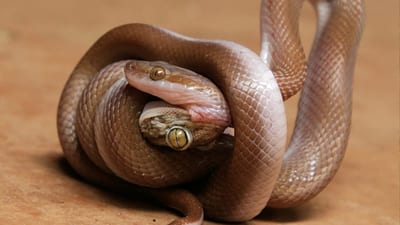
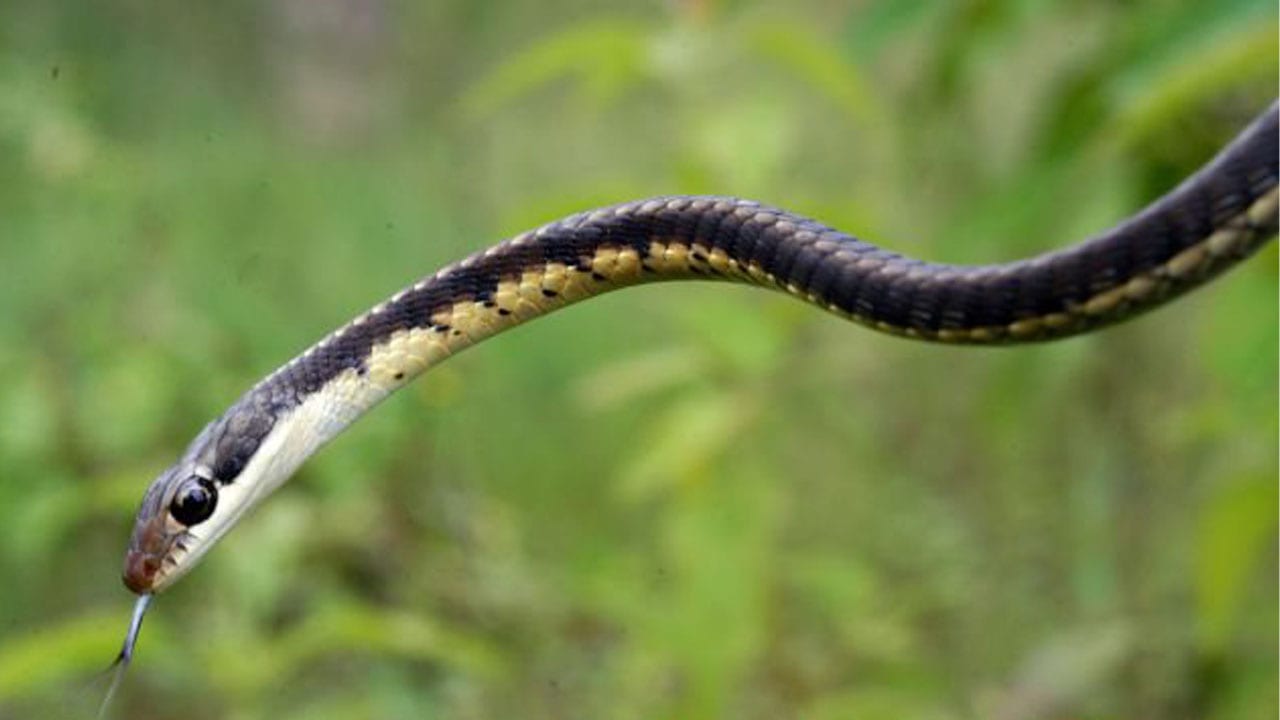
The species has the hallmark Dendrelaphis silhouette: a long, lean body, smooth scales, and a slightly flattened, narrow head that is distinctly set off from the neck. Adults typically measure around 1 metre in length, though individuals may vary. The dorsal surface is a warm bronze to olive-green, giving the snake its common name and blending seamlessly with sun-dappled bark and foliage. The underside is considerably paler — often pale yellow or cream — creating a counter-shading effect that is common among canopy-dwelling reptiles.
The eyes are notably large relative to the head, an adaptation that enhances depth perception in the broken light of the forest interior. When threatened, like other bronzebacks, it may laterally compress its body to reveal brighter interstitial skin between the scales — a display that makes it appear larger and more conspicuous.
Where in Sri Lanka is Wickramasinghe's Bronzeback found?
The species is confined to the wet-zone forests of central and southern Sri Lanka. Key areas where it has been recorded include the Sinharaja Forest Reserve and adjoining rainforest patches. Sinharaja, a UNESCO World Heritage Site and one of Asia's last substantial lowland tropical rainforests, provides the combination of high canopy cover, humidity, and prey availability that this snake requires.
The species is not typically found in drier zones or heavily disturbed habitats. Its distribution appears broadly tied to areas receiving high annual rainfall and retaining intact or near-intact forest structure. Isolated populations may persist in forest fragments across the Sabaragamuwa and Southern provinces, though detailed range maps remain limited by the relative scarcity of survey data.
What habitat does Wickramasinghe's Bronzeback prefer?
This is a specialist of tropical rainforest — dense, multi-layered vegetation with a closed canopy, high humidity, and abundant microhabitats. It is most often encountered among the mid-storey branches, particularly in areas close to streams, moist ravines, and forest edges where prey is plentiful. Although primarily arboreal, the snake will descend to the forest floor when hunting or during the breeding season.
- Closed-canopy wet-zone rainforest
- Forest interiors near streams and ravines
- Secondary growth adjacent to primary forest
- Rarely: disturbed or fragmented forest patches
The species is sensitive to habitat loss. Large-scale deforestation across Sri Lanka's wet zone has reduced suitable territory, making intact reserves such as Makandawa Rainforest increasingly important refugia for forest-dependent endemics.
What does Wickramasinghe's Bronzeback eat?
Like other members of its genus, this bronzeback is a diurnal (daytime-active) hunter that relies heavily on speed and visual acuity to catch prey. Its diet consists primarily of small lizards and frogs, though it is also known to take small birds and other vertebrates when the opportunity arises. It does not use constriction or venom to subdue prey; instead it seizes and swallows prey alive, relying on its grip and agility.
The large eyes are well suited to tracking fast-moving prey through vegetation. Hunting typically takes place in the morning and mid-afternoon, when lizard activity peaks in the canopy and understorey.
How does Wickramasinghe's Bronzeback behave in the wild?
This species is fast, alert, and — from a human perspective — elusive. Encounters in the field are brief: the snake typically retreats rapidly into dense vegetation at the first sign of disturbance. It poses no danger to people and will not strike unless directly handled or cornered.
As with most bronzebacks, it is a solitary animal outside the breeding season. Little is published on its reproductive biology specifically, but other Dendrelaphis species in the region are oviparous (egg-laying), with small clutch sizes typical of slender, specialist arboreal snakes.
Is Wickramasinghe's Bronzeback endangered?
The species is considered rare, reflecting both its naturally restricted range and ongoing pressure from habitat degradation. Because it is endemic to a relatively small area of Sri Lanka's wet zone, any significant loss of rainforest cover directly reduces viable habitat. Precise population estimates are not publicly available, and the species has received limited dedicated study compared to more conspicuous Sri Lankan endemics.
Sri Lanka as a whole is recognised as one of the world's biodiversity hotspots, and its endemic herpetofauna — which includes dozens of snake and lizard species found nowhere else — remains imperfectly surveyed. Conservation of intact wet-zone forest is the single most important factor in securing the species' long-term survival.
Where can I see Wickramasinghe's Bronzeback in Sri Lanka?
Sinharaja Forest Reserve is the most reliable starting point for anyone hoping to encounter this species. Guided forest walks within the reserve, led by experienced local naturalists, maximise the chances of spotting canopy-dwelling reptiles that casual visitors would otherwise miss entirely. Early morning excursions, when snakes are active and temperatures are moderate, tend to yield the best results.
Patience and quiet movement are essential. The bronzeback's cryptic coloration makes it genuinely difficult to spot against bark and leaves, even when a snake is stationary only a metre or two away. Binoculars are useful for scanning branches at mid-canopy height.