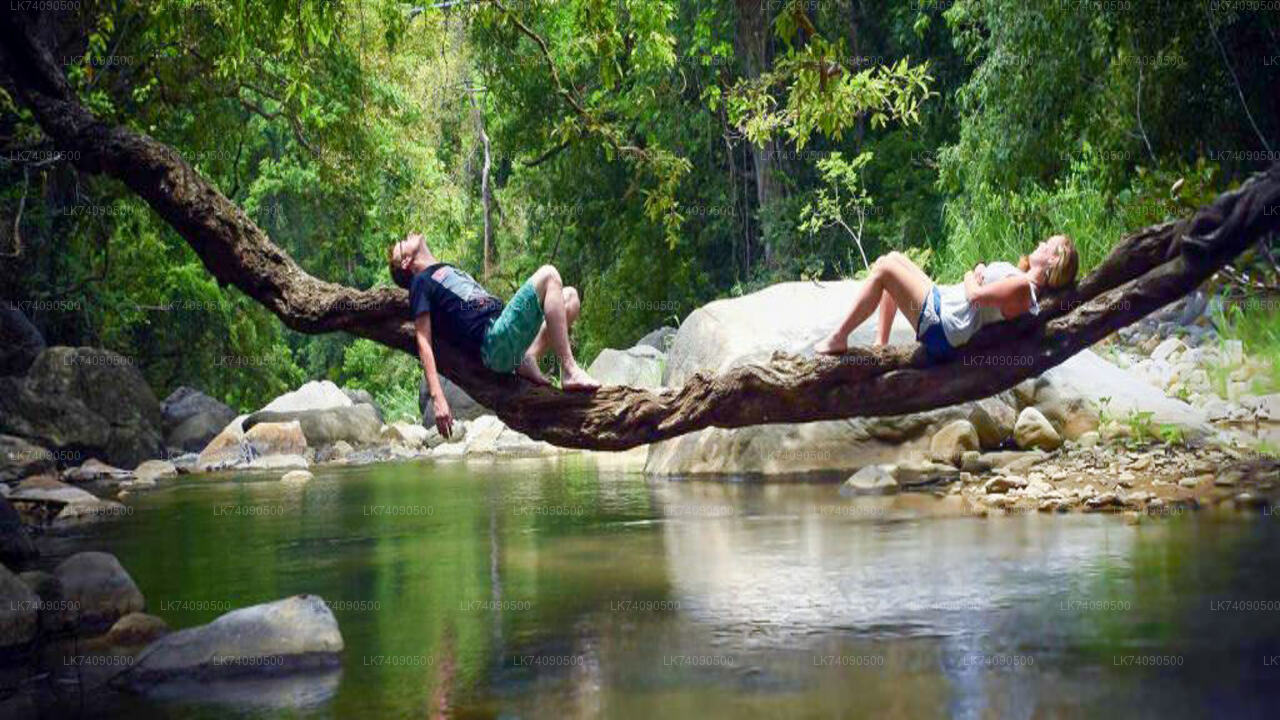
Tucked inside Thudugala village in the Dodangoda Divisional Secretariat, Kalutara District, Thudugala Ella is one of those waterfalls that rewards visitors who make the effort to find it. Standing around 8 metres (26 feet) tall, it may be modest in height compared to giants like Bambarakanda, yet the Lanka Council on Water Falls (CLWF) has ranked it among the country's most popular falls — and one visit makes clear why. The setting is layered: a colonial-era country house stands nearby in quiet ruin, a natural pool fringed with ketala plants and fern invites a swim, and a tunnel that passes under the falls and surfaces on the far side adds an unusual architectural curiosity to the natural scene.
What makes Thudugala Ella different from other Sri Lankan waterfalls?
Most waterfalls in Sri Lanka are appreciated from a viewing platform or a riverbank. Thudugala Ella offers something more interactive. A tunnel cut through the rock runs beneath the cascade and exits on the upper side, letting visitors walk through the falls themselves — a feature uncommon even among Sri Lanka's approximately 382 recorded waterfalls, where Thudugala holds the 268th rank by the CLWF classification.
The site also carries a colonial footnote. The surrounding estate was once owned by a British planter, and the remains of his country house still stand on the grounds, half-reclaimed by vegetation. The combination of natural pool, tunnel, ruins, and forest gives the location a texture that purely scenic waterfalls lack.
What wildlife can you see at Thudugala Ella?
The forest reserve bordering the waterfall supports both resident and migratory bird species. The pale-bellied flowerpecker — regarded as among the smallest birds in Sri Lanka — is regularly spotted here. The dense understorey of ketala and fern provides cover for smaller fauna, and the proximity to the Sinharaja Forest Reserve biome means the broader landscape sustains a richer biodiversity than the lowland elevation might suggest.
Birdwatchers should arrive in the early morning before day-trippers reach the pool. Light is better, birds are more active, and the fall itself is typically quieter.
How do I get to Thudugala Ella from Colombo?
The standard route begins at Katukurunda Junction on Galle Road, south of Colombo. From there, take the Matugama Road for approximately 8 km until you reach Thudugala Junction. The waterfall is a further 13 km from that junction — a total road distance that is manageable in under two hours from Colombo under normal traffic conditions.
At the approach to the waterfall, drivers will reach a junction called Ellagawa Junction, marked by a rubber plantation signboard. Take the left fork over a small bridge — this road leads to the natural waterfall and bathing pool. The right fork leads only to an artificial bathing area with no view of the falls, so the distinction matters.
| Starting point | Route | Approximate distance |
|---|---|---|
| Katukurunda Junction (Galle Road) | Matugama Road → Thudugala Junction | ~8 km |
| Thudugala Junction | Local road → Ellagawa Junction → left fork | ~13 km |
| Colombo Fort | Galle Road south to Katukurunda, then above | ~65 km total |
A private car or tuk-tuk is the most practical way to reach the falls. Public buses serve Matugama, from where onward transport requires a hired vehicle or tuk-tuk for the final stretch.
When is the best time to visit Thudugala Ella?
Kalutara District receives rainfall from both the south-west monsoon (May to September) and inter-monsoonal showers. The waterfall flows most powerfully between June and October, when the pool is deepest and the tunnel experience is most dramatic. Visiting during or just after rain also means the surrounding ferns and ketala are at their greenest.
The dry months of January to March see lower water volume but easier road conditions and more predictable weather for a day trip from Colombo. Weekday visits are generally quieter than weekends, when the natural pool draws local families from Kalutara and Colombo.
Is Thudugala Ella suitable for swimming?
The natural stream pool at the base of the falls has been a popular bathing spot for generations. The pool is fed directly by the waterfall and is typically calm enough for swimming away from the cascade itself. Visitors should exercise caution close to the falls during high-water periods, when the current can be stronger than it appears.
The artificial bathing area accessible via the right fork at Ellagawa Junction offers calmer water but no visual connection to the waterfall, making it a less interesting option for most visitors.
What else is near Thudugala Ella?
The broader Kalutara District combines inland plantation scenery with a coastline that reaches Beruwala and Kalutara town to the north. The Hakgedi Ella Waterfall is another lesser-known cascade in the region worth pairing with a visit to Thudugala if time allows. The Madu River Safari at Balapitiya, about an hour north along the coast, offers a contrasting half-day on the water through mangrove islands.
For those building a longer itinerary, Thudugala Ella fits naturally into a loop that combines the Kalutara coast, a tea estate visit further inland, and a return to Colombo via the Southern Expressway access points near Dodangoda.
Nearby places
8 places within about 25 km, nearest first.