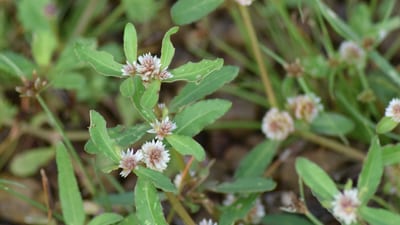
Pavetta indica, known in Sinhala as පාවට්ටා (Pavatta), is a woody shrub native to South and Southeast Asia that has been woven into Sri Lankan traditional medicine for centuries. It grows readily across the island — in home gardens, forest margins, and roadside hedges — and is one of the few plants that livestock, including goats, typically refuse to graze. That characteristic alone has made it a popular live fence for farmers, while Ayurvedic practitioners value it for a range of therapeutic applications.
What does Pavetta indica look like?
Pavetta indica is a multi-stemmed shrub that can reach 4–5 metres in height when left unpruned. Its branches tend to extend upward and outward from the central trunk, giving the plant a spreading crown. The leaves are simple, large, and a deep glossy green, shaped like an elongated arrowhead — a feature that makes the plant easy to identify in the field.
Flowers appear in axillary clusters, white and delicate, backed by small rounded green bracts. In Sri Lanka, flowering typically occurs around December. The fruiting bodies that follow each contain roughly four to five small seeds, often with surface nodules. The plant propagates easily — cuttings strike reliably in most soil types, and seed germination is straightforward, making it a low-maintenance addition to any garden.
How is Pavatta used in Ayurveda?
Sri Lankan Ayurveda uses nearly every part of the Pavatta plant — leaf, stem, root, flower, and fruit — a combination referred to in traditional texts as the panchanga (five parts). The leaves are most commonly prepared as a juice, decoction, or steam inhalant, while the panchanga decoction is used for systemic conditions. Below is an overview of the principal therapeutic applications recorded in traditional practice.
- Respiratory support: Pavatta leaf juice combined with ingredients such as ginger and honey is a long-standing Ayurvedic preparation for managing asthma and chronic cough. Steam inhalation from boiling leaves is also used to ease congestion associated with colds.
- Lung health: Inhaling steam from a pot of boiling Pavatta leaves is a traditional method for clearing the airways. This approach is considered particularly helpful during episodes of cough or seasonal respiratory illness.
- Fever management: Juice extracted from Pavatta flowers and leaves, taken with honey or a small amount of sugar, is used in traditional practice to help reduce fever.
- Anemia: A decoction of the panchanga, taken with honey, is cited in Ayurvedic literature as a supportive measure when hemoglobin levels are low, though this should complement — not replace — medical evaluation.
- Urinary tract health: Dried Pavatta leaf powder, prepared as a mild herbal tea, is used traditionally to ease discomfort associated with urinary tract irritation.
- Hemorrhoid relief: A traditional preparation involves using a pottani (cloth poultice) containing Pavatta, applied as a sitz-bath treatment to reduce hemorrhoid-related discomfort.
It is worth noting that while these uses are well-documented within the Ayurvedic tradition, anyone with a diagnosed condition should consult a qualified medical or Ayurvedic practitioner before relying on herbal preparations as a primary treatment.
What are the fertilizer benefits of Pavatta leaves?
Pavatta leaves have a notably high nitrogen content relative to many other shrub species, which is why they have long been used as green manure in Sri Lankan smallholder agriculture. Farmers cut leafy branches and dig them into soil as a natural fertilizer, improving soil structure and nutrient levels without the need for synthetic inputs. This practice fits naturally within the principles of traditional home-garden agriculture still common in rural Sri Lanka — a system that often integrates plants like Pavatta alongside staple food crops. The traditional paddy field (kumbura) system, for instance, has historically relied on organic matter cycling of exactly this kind.
How do you grow Pavetta indica?
Pavatta is one of the easier shrubs to establish in a Sri Lankan garden. It tolerates a wide range of soil conditions — from sandy coastal soils to heavier clay — and requires minimal irrigation once established. Propagation by stem cuttings is the most reliable method: a healthy cutting of around 20–30 cm, planted in moist soil with partial shade, typically roots within a few weeks. Seed propagation is also possible but slower. The plant is evergreen and grows relatively quickly, making it useful as a hedge, a green manure crop, or simply a medicinal plant kept close to the kitchen.
Because livestock generally avoid grazing it, Pavatta is particularly popular as a boundary plant on smallholder farms across the island's wet and intermediate zones.
Where does Pavetta indica grow in Sri Lanka?
The species is distributed across much of Sri Lanka, from the coastal lowlands to the lower hill country, appearing in secondary forests, village gardens, and disturbed land. It is less common at high elevations. Across the island's traditional herb gardens and Ayurvedic homesteads, Pavatta often grows alongside other medicinal species such as Pongamia pinnata, which is similarly valued in traditional medicine for its multi-purpose properties.
In the wild, Pavatta often colonises areas of disturbed forest, riverbanks, and the margins of agricultural land, contributing to ecological recovery in areas that have experienced clearance or degradation.
Is Pavetta indica the same as Adhatoda vasica (Adathoda)?
The original page text equates Pavatta with Adathoda (Adhatoda vasica), but these are distinct species. Adhatoda vasica belongs to the Acanthaceae family and is also called Malabar nut; Pavetta indica belongs to the Rubiaceae (coffee) family. Both are used in Ayurveda, and both share a common characteristic of being avoided by livestock, which may explain the colloquial conflation. If you are sourcing plant material for medicinal use, confirm the botanical identity with a qualified Ayurvedic practitioner or botanist.
How does Pavatta compare to other traditional Sri Lankan medicinal plants?
Sri Lanka has an unusually rich pharmacopoeia of native and naturalised medicinal plants, many of which remain in daily household use. Acacia chundra, for example, is another traditional species whose bark and heartwood feature in Ayurvedic formulations for a range of conditions. Pavatta stands out for its accessibility — it is easy to grow, freely available, and requires no specialist processing for most household applications. This combination of simplicity and therapeutic breadth explains its enduring place in Sri Lankan home medicine.