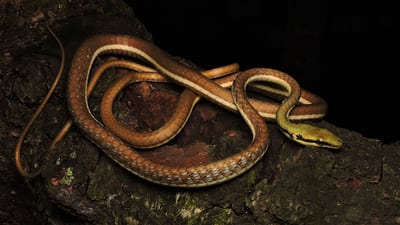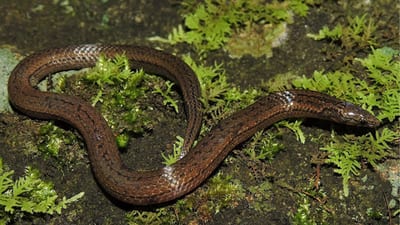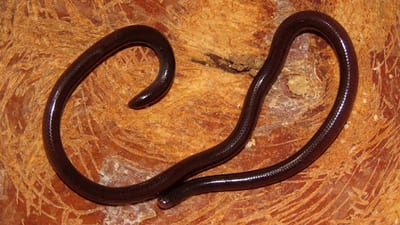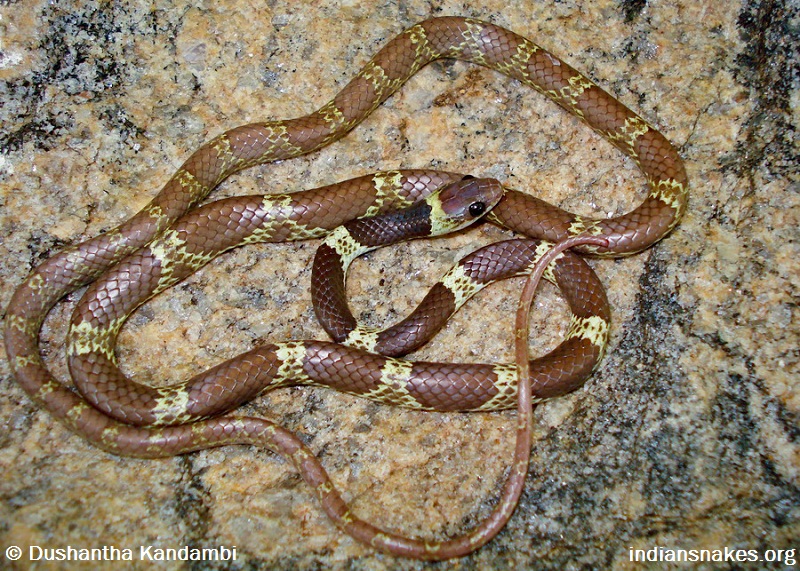


The Common Bridal Snake (Dryocalamus nympha) is a small, slender, non-venomous snake of the family Colubridae, found only in peninsular India and Sri Lanka. Its glossy dark body is crossed by clean white bands, a contrast that earned it the "bridal" name. That same pattern also makes it look a lot like the highly venomous Common Krait. Because of this, it is often feared and needlessly killed, although it is harmless to people.
What does the Common Bridal Snake look like?
Adults are small and slim, usually around half a metre long. The body is glossy black or dark chocolate-brown with a series of white or cream crossbands. The bands are clearest on the front of the body and often become narrower, broken or faded towards the tail, especially in older snakes. The head is slightly flattened and distinct from the neck, and the snout and lips are often pale. The underside is white.
Young snakes show the same banded pattern as adults, usually with sharper contrast.
How is it different from the Common Krait?
The Common Krait (Bungarus caeruleus) is one of Sri Lanka's most dangerous snakes. It is also dark with pale crossbands, and the resemblance is the bridal snake's main defence. A krait has thin white bands, often in pairs, that run across the back. It has a row of enlarged six-sided scales along the spine, and a stouter body that is somewhat triangular in cross-section. The bridal snake is slimmer, with broader single bands that start close to the head and a flatter head.
These differences are hard to judge at night or at a glance. Treat any black-and-white banded snake as a possible krait: keep your distance and let an experienced naturalist make the identification.
Where is the Common Bridal Snake found in Sri Lanka?
In Sri Lanka the species is mainly a lowland snake. It is recorded chiefly from the dry and intermediate zones, and it also turns up in villages, home gardens and town outskirts. It is a capable climber and is often found on tree trunks, rock faces, walls and the roofs of buildings, where its lizard prey lives. Dry-zone protected areas such as Wilpattu National Park and Yala National Park lie within its range, though a small night-active snake like this is rarely seen on a daytime safari.
What does it eat?
The Common Bridal Snake is a specialist hunter of lizards, mainly geckos and skinks, and it also takes lizard eggs. It hunts at night, searching cracks, crevices, bark and house walls where geckos shelter. Prey is seized and held in the jaws; the species has no venom.
How does it behave?
It is nocturnal and secretive, spending the day hidden in crevices, under bark or in roof spaces. It is not aggressive. When disturbed it usually tries to escape, and if it is cornered it may coil tightly and tuck its head under its body rather than strike. It can bite if it is handled, but the bite is harmless.
How does it reproduce?
Like most colubrids, the Common Bridal Snake lays eggs. Females lay small clutches in sheltered, humid spots such as crevices, leaf litter or rotting wood, and the young are independent from hatching.
Is the Common Bridal Snake dangerous?
No. It is non-venomous and harmless to people. The real danger comes from confusing it with a krait, in either direction. People kill harmless bridal snakes believing they are kraits. Worse, they sometimes assume a real krait is a harmless lookalike. If anyone is bitten by a banded snake that has not been identified with certainty, treat it as a medical emergency and go to hospital at once. See snake bites in Sri Lanka for what to do.
What is its conservation status?
The species is widespread across its range and is not considered threatened. Its main local pressures are habitat loss and deliberate killing by people who mistake it for a krait. In Sri Lanka, wildlife protection law covers native snakes, and learning to tell the two apart is the simplest way to protect it.
Where can I learn more about Sri Lanka's snakes?
Sri Lanka has over 100 recorded snake species, many of them found nowhere else. Our guide to the snakes of Sri Lanka and the wider herpetofauna overview are good starting points. For field identification, a photographic guide is the most reliable companion. Guided night walks with a trained naturalist give the best chance of seeing nocturnal species such as this one safely.
Photograph: Common Bridal Snake by Dushantha Kandambi (Wikimedia Commons, CC BY 3.0).
ආශ්රිත ලිපි
සමීපව සම්බන්ධ මාතෘකා පිළිබඳ පිටු 6.