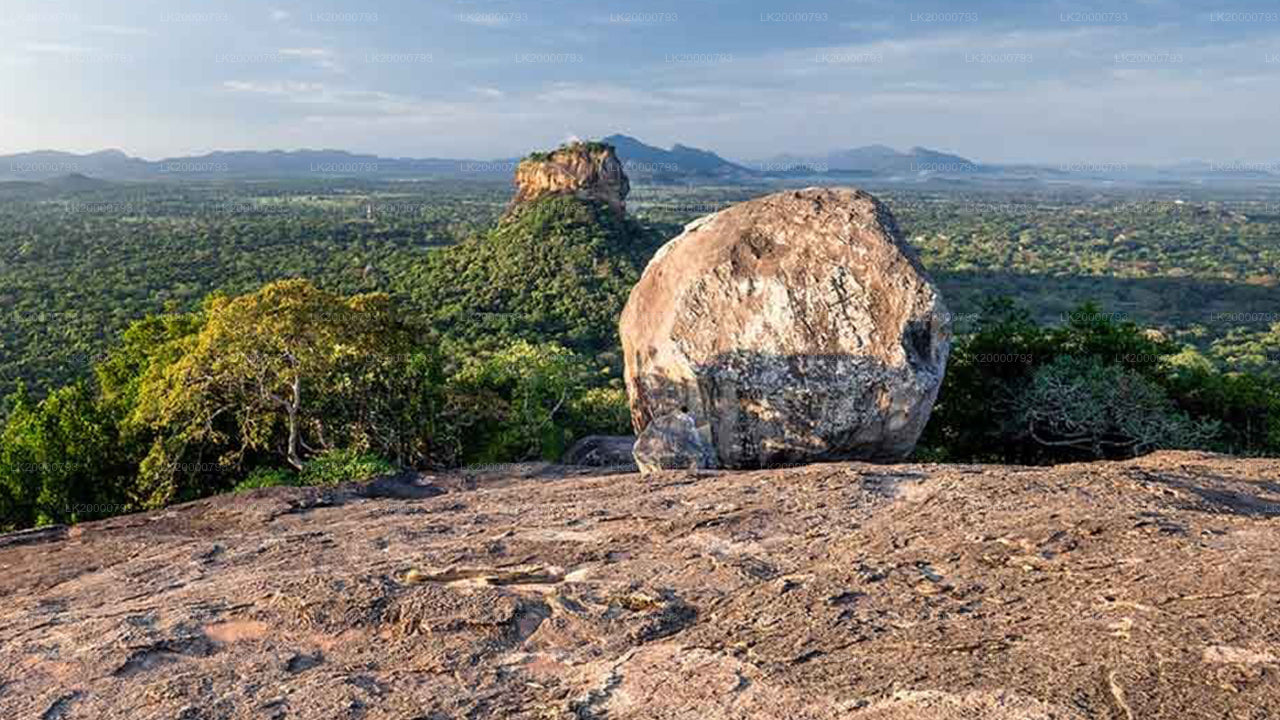
Pidurangala Rock rises from the dry-zone scrubland a short distance north of Sigiriya, offering one of the most rewarding short hikes in Sri Lanka's Cultural Triangle. The summit rewards climbers with an unobstructed view across the jungle canopy toward the iconic profile of Sigiriya Rock Fortress — a perspective that has made Pidurangala a favourite among photographers and early-morning hikers. What makes the climb doubly worthwhile is the living religious site at its base and the ancient rock shelters found partway up: this is not just a viewpoint but a place with more than two thousand years of continuous human history.
What is the history of Pidurangala?
The earliest records of Pidurangala Vihara point to the first and second centuries BC, when the site served as a forest monastery where Buddhist monks meditated in natural rock caves. The caves were adapted over time with drip-ledges — a characteristic feature of early Sri Lankan monastic rock shelters — carved to keep rain off the entrances.
The site became particularly significant during the reign of King Kashyapa (around 473–495 AD). According to the Mahavamsa chronicle, Kashyapa seized the throne by imprisoning and killing his father, King Dhatusena, then fortified Sigiriya Rock as a palace-citadel to defend against the inevitable counter-attack by his half-brother Mugalan. When Kashyapa's court displaced the monks who had been living at Sigiriya, he relocated them to Pidurangala and, as a form of restitution, commissioned improvements to the monastery there. The brick reclining Buddha visitors encounter midway up the rock dates from roughly this period, though it has been partially restored in more recent centuries.
After Mugalan eventually defeated Kashyapa and reclaimed the kingdom, Sigiriya reverted to monastic use and Pidurangala continued its quiet religious life alongside it. Today, Pidurangala Sigiri Rajamaha Viharaya — the white-painted temple at the rock's base — remains an active place of worship.
What can you see at Pidurangala Rock?
The site contains three distinct layers of interest, each at a different elevation on the rock.
- Pidurangala Sigiri Rajamaha Viharaya (base): A working Buddhist temple painted white, set among large boulders at the foot of the rock. Entrance fees are collected here and the dress code is enforced at this point.
- Reclining Buddha (midway): A large brick-and-plaster image of the reclining Buddha sits inside a partially open rock shelter roughly halfway to the summit. The image has weathered significantly but retains its presence, and the shelter itself is lined with the kind of ancient drip-ledges that mark centuries of monastic occupation.
- Summit viewpoint (top): The final approach crosses a broad, open slab of granite that requires using both hands in places. At the top, the panorama takes in Sigiriya Rock directly to the south, the surrounding forest reserve, and — on clear mornings — distant ridges toward Dambula and the dry-zone plains.
How difficult is the hike up Pidurangala?
The ascent is rated moderate. Most hikers in reasonable fitness complete the climb in around 30 to 40 minutes from the temple gate. The lower section follows a clear path through forest; the upper section becomes steeper and involves scrambling over bare rock, including one short near-vertical section where fixed ropes or iron handholds assist climbers. Descending the same route takes a similar amount of time and requires care, especially on the smooth granite slabs when wet.
The terrain is shared with wildlife. Snakes, including rock pythons and occasional venomous species, inhabit the boulder fields — watch where you place your hands and feet, particularly on the lower forested section. Monkeys are common throughout. There are no toilet facilities on the trail or at the summit, so plan accordingly before you set off.
When is the best time to visit Pidurangala?
Sunrise is consistently the most popular time. The ticket office opens at 5 am, and hikers who leave the gate around that time typically reach the summit just as the sky behind them begins to lighten — with Sigiriya Rock silhouetted against the dawn. Sunset visits are also popular; the ticket office closes at 6 pm, though visitors who are already on the rock may remain until dark.
In terms of season, the Sigiriya area lies in the dry zone and receives the most reliable weather from roughly January through to early April and again from July through September. The inter-monsoon months (October–November) bring heavier afternoon showers that can make the upper granite slabs slippery. Mornings are the cooler part of the day year-round in this lowland zone, which is an additional reason to favour early starts over midday hikes.
How do I get to Pidurangala from Colombo or Kandy?
Pidurangala sits within the Sigiriya village area, approximately 170 km from Colombo and around 90 km from Kandy. Most visitors arrive by private car or organised day tour. The nearest town with bus connections is Dambulla, from where three-wheelers (tuk-tuks) can cover the remaining distance to the rock. There is no direct public bus to Pidurangala itself. The access road to the temple gate is clearly signposted from the main Sigiriya junction.
Practical visitor information
| Detail | Information |
|---|---|
| Opening hours | Ticket office: 5 am – 6 pm daily |
| Entrance fee | Around LKR 500 per person (subject to change) |
| Hike duration | 30–40 minutes one way |
| Difficulty | Moderate; some scrambling required near the top |
| Dress code | Shoulders and knees must be covered at the temple; shoes removed at the temple |
| Facilities | No toilets on trail or at summit; no food stalls on the route |
| Plastics | Officially prohibited; carry a reusable water bottle |
Bring at least a litre of water per person; there is no water source on the trail. Closed-toe shoes with grip are strongly recommended — sandals become problematic on the final granite slabs. A sarong or lightweight cover-up tucked into your bag will save time at the temple gate, particularly during busy periods when loaner cover-ups may not be available.
How does Pidurangala compare to Sigiriya?
The two sites are complementary rather than competing. Sigiriya Rock Fortress is a UNESCO World Heritage Site with a comprehensive archaeological complex — frescoes, the Lion Gate, landscaped water gardens, and a museum — and carries a significantly higher entrance fee for international visitors. Pidurangala offers a rawer, less curated experience: fewer crowds (particularly outside peak season), a more physical climb, and the unique vantage of looking across at Sigiriya rather than down from it. Many visitors who base themselves in the area for more than one day choose to do both, typically ascending Sigiriya on one day and Pidurangala on the other.
For travellers on a tight itinerary who want the iconic Sigiriya silhouette photograph, Pidurangala at sunrise offers that image at a fraction of the cost and with considerably fewer people in the frame.