


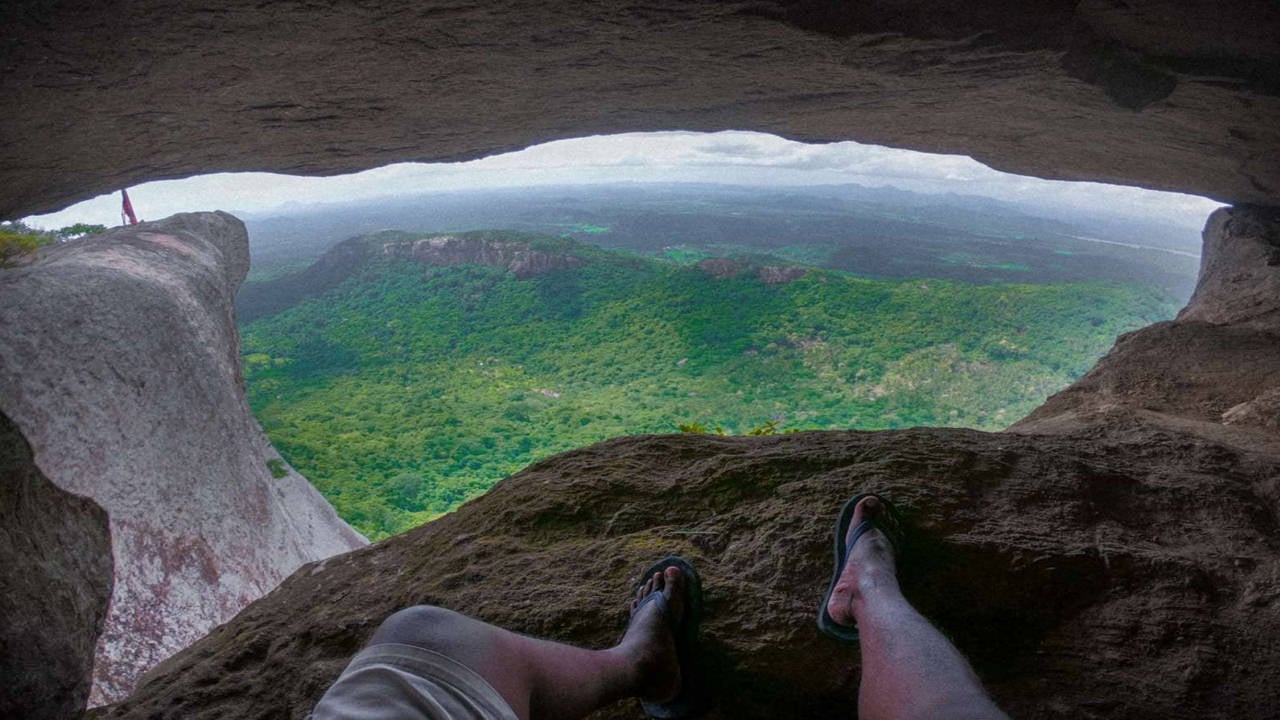
Dolukanda is a forested mountain in the Kurunegala District of Sri Lanka's North Western Province, known equally for its spiritual significance and its ecological character. The mountain is home to the Dolukanda Raja Maha Viharaya, an ancient Buddhist temple that draws pilgrims year-round, and is also identified as one of five sites in Sri Lanka associated with the Ramayana legend — specifically the story of the Sanjeevani, the life-restoring herb that Hanuman was said to have carried from the Himalayas.
The mountain falls under the jurisdiction of the Forest Department and is designated a protected reserve, meaning visitors must obtain a permit before climbing. Arranging your visit in advance is straightforward, but it is an essential step that should not be overlooked.
What is the connection between Dolukanda and the Ramayana?
In the Ramayana, Hanuman was dispatched to the Himalayan mountains to retrieve the Sanjeevani herb to heal Lakshmana. According to Sri Lankan tradition, fragments of the Himalayan mountain range fell across the island during the journey, and Dolukanda is regarded as one of those drops. This makes it part of the broader Ramayana Trail in Sri Lanka, a route that connects several sites across the country to episodes from the epic.
Beyond mythology, there is historical evidence suggesting that Dolukanda was once a significant centre for Ayurvedic medicine. The area is associated with the herbal gardens maintained by the ancient Hela sages and, later, by King Buddhadasa, a revered physician-king celebrated in Sri Lankan history for advancing indigenous medical knowledge around the 4th century CE. Rare medicinal plants still grow on the mountain today, lending some credibility to this long heritage.
What can you see and experience at Dolukanda?
The climb begins at the Dolukanda Raja Maha Viharaya, and it is customary — and practically useful — to inform the resident monk before setting out. A guide is typically available from the temple and is strongly recommended given the forest terrain.
As you ascend, the trail passes through dense vegetation that includes large resin-producing trees, broad-leafed herbaceous plants, and notably a rare parasitic herb known locally as Gardi Raja, which grows on the surface of other plants. The botanical diversity along the route reflects the mountain's historical identity as a medicinal landscape.
- Natural freshwater springs emerge from the rocky outcrops along the trail, and the water is considered safe to drink — worth noting because there is no drinking water source at the summit itself.
- Scattered black stone ruins are visible along the path, indicating that structures once stood here, though many sites have been damaged by unauthorised excavation over the decades.
- At the summit is a flat area called Maligathenna, believed to mark the foundations of an ancient palace. The plateau offers wide views across the surrounding lowlands.
How do you get to Dolukanda from Kurunegala or Colombo?
Dolukanda lies in the Kurunegala District, roughly accessible from both Kurunegala town and the Dambulla Road, making it reachable as a day trip from either Colombo or the Cultural Triangle region.
There are two main approach routes:
- Via Muththettugala Junction: Take the Dambulla Road from Muththettugala Junction, then turn onto the Wellawa–Ganewatta Road and follow signs toward the Dolukanda Temple. The climb starts from the temple grounds.
- Via Ibbagamuwa: Travel along the Kurunegala–Dambulla road to Ibbagamuwa, then take the Madagalla road and alight at Godagala Junction. From here, a rural track leads through the village of Doluwa and across paddy fields to the base of the mountain.
The second route is slower but passes through attractive agricultural countryside and is favoured by those travelling from the Dambulla side.
Do you need a permit to climb Dolukanda?
Yes. Because Dolukanda is gazetted as a forest reserve, entry requires a valid permit from the Sri Lanka Forest Department. Visitors should arrange this in advance or inquire at the local Forest Department office in the Kurunegala area. Entering without a permit is prohibited and can result in penalties.
In addition to the permit, it is advisable to notify the head monk at the Dolukanda Raja Maha Viharaya before beginning the ascent, both as a courtesy and because guides to the summit are arranged through the temple. The climb involves uneven rocky terrain and some degree of physical exertion, so appropriate footwear and sufficient water for the descent are important to carry.
When is the best time to visit Dolukanda?
The Kurunegala District receives rainfall from both the southwest monsoon (May to September) and occasional northeast monsoon showers. The driest and most comfortable period for climbing is generally between December and April, when the trails are firmer and the views from Maligathenna are clearest. The mountain can become slippery and the forest dense with moisture during the monsoon months, making the ascent more challenging.
Early morning starts are recommended regardless of season — not only to avoid midday heat but to experience the mountain when pilgrims and temple activity are at their most active, and the surrounding landscape is at its quietest.
What is the historical and archaeological significance of Dolukanda?
Dolukanda is considered a site of Lord Weeramunda and carries documented historical and archaeological value. The black stone ruins scattered along the trail suggest a settled presence on the mountain at some point in antiquity, though systematic archaeological study of the site has been limited. The association with King Buddhadasa and the Hela medical tradition points to a history that extends well beyond the Ramayana narrative and into recorded Sri Lankan chronicles.
The mountain's dual identity — as a site of living religious practice and as an echo of an ancient medical heritage — makes it a place of layered interest rather than a single-purpose pilgrimage destination. Those with an interest in Sri Lanka's indigenous Ayurvedic traditions will find the botanical landscape as compelling as the historical ruins.