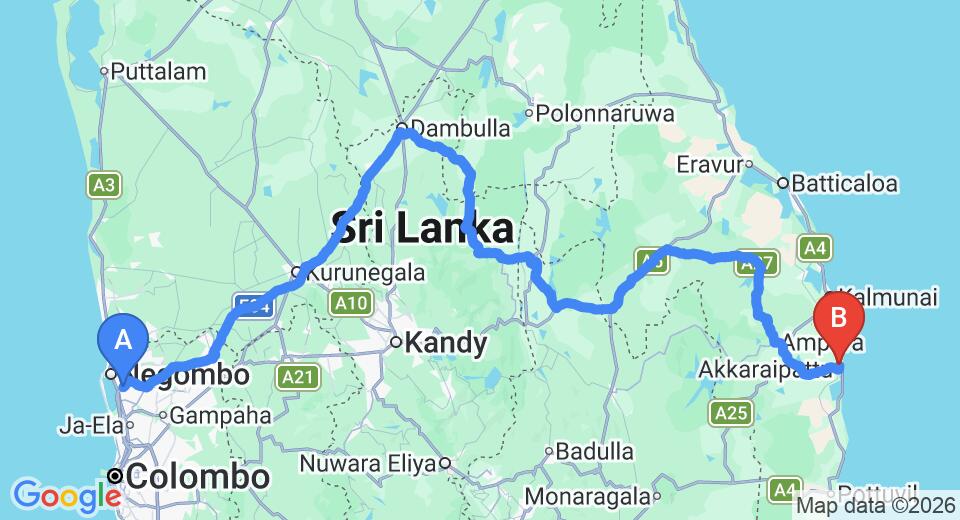
Akkaraipattu sits along Sri Lanka's eastern coastal belt in the Ampara District, roughly midway between Batticaloa to the north and Ampara town to the west. It is one of the more consequential secondary towns on the east coast — not a resort destination, but a genuine community with a layered identity shaped by its Muslim majority alongside Tamil and Sinhalese residents who have coexisted here for generations.
What makes Akkaraipattu culturally distinctive?
The town's population is predominantly Muslim, and that heritage is visible in the Friday mosques that anchor neighbourhood life, the Arabic-inflected place names in older quarters, and the rhythm of daily commerce around prayer times. Tamil-speaking Hindu residents contribute temples and festival calendars of their own, while a smaller Sinhalese community maintains Buddhist religious practice within the same civic space. The result is not a curated multicultural showcase but an organic, working coexistence that has developed over centuries of shared agricultural and trading life on the eastern seaboard.
Religious festivals here follow overlapping calendars. Eid celebrations draw the largest public gatherings, but Thai Pongal and other Tamil harvest observances are equally embedded in the local year. Visitors passing through during a festival period will find street-level activity that feels unrehearsed and unmediated by tourism infrastructure.
What is the economy of Akkaraipattu based on?
Agriculture remains the dominant livelihood. The flatlands around Akkaraipattu are irrigated by a network of rivers and traditional tank systems — an engineering inheritance that predates colonial rule — and paddy cultivation here is among the most productive on the island. Two rice harvests a year are common, and the sight of paddy fields stretching to the horizon defines the landscape on the approaches to town.
Beyond rice, market gardens, small-scale fishing along the lagoon edge, and a growing commercial sector supply the surrounding villages. Weekly markets draw traders and buyers from a wide catchment area, and the main bazaar streets operate at a pace that signals genuine economic activity rather than souvenir trade.
How do I get to Akkaraipattu from Colombo?
The most practical overland route runs east from Colombo on the A4 highway through Ratnapura and across the hill country, then northeast toward Ampara and on to Akkaraipattu — a journey of roughly five to six hours by road depending on conditions. Alternatively, travellers coming from Batticaloa can reach Akkaraipattu in under an hour heading south along the A4 coastal road. The A15 connects Ampara town to Akkaraipattu more directly and is well maintained. No scheduled rail service currently reaches the town, so road transfer or a hired driver remains the standard approach.
What can visitors see and do in and around Akkaraipattu?
Akkaraipattu rewards the kind of traveller who prefers watching a town function over queuing at managed attractions. The morning fish market, the commercial streets around the main junction, and the agricultural periphery all offer textured observation of everyday eastern Sri Lankan life.
- Lagoon edge and coast — The shoreline near Akkaraipattu is largely undeveloped and relatively quiet. Small fishing outriggers work the lagoon, and the beach is accessible without crowds.
- Religious sites — The town contains several old mosques, Hindu kovils, and smaller places of worship that are open to respectful visitors outside prayer times. Dress conservatively and ask locally before entering.
- Surrounding paddy landscape — The irrigation tanks and field networks around the town are worth exploring during planting or harvest seasons (typically April–May and September–October).
- Pigeon Island — Serious snorkellers often use Akkaraipattu as a staging point before heading north; Pigeon Island near Nilaveli is one of Sri Lanka's best coral reef sites.
What is the best time to visit Akkaraipattu?
The Eastern Province operates on a reversed monsoon pattern compared to the west and south of Sri Lanka. The dry season on the east coast runs approximately from May to September, when skies are reliably clear and coastal conditions are calm. The northeast monsoon brings rain from around October through January, which can make travel in the region slower but also fills the tank systems that sustain agriculture through the dry months. Travelling between February and April catches the tail of the dry period and avoids the main festival crowds on the west coast, making it a quieter window to explore the east.
Where can visitors stay in Akkaraipattu?
Accommodation options in Akkaraipattu itself are limited compared to larger tourism hubs. The town functions primarily as a transit and commercial centre rather than a leisure destination, so guesthouses and small hotels serve business travellers and domestic visitors. For those specifically seeking to stay in or near Akkaraipattu, a handful of locally run guesthouses provide clean, functional rooms. Batticaloa, around 50 km north, offers a wider range of accommodation including mid-range hotels, while Ampara town to the west is another practical base.
Is Akkaraipattu safe for tourists?
Like the Eastern Province generally, Akkaraipattu has returned to normalcy after decades of conflict that ended in 2009. The town is considered safe for visitors, and residents are accustomed to occasional travellers passing through. Standard precautions apply — keep copies of identification, be respectful around religious sites during prayer times, and travel during daylight hours on unfamiliar roads. The community atmosphere is generally welcoming, and English is understood in commercial areas, though Tamil and Arabic are the primary spoken languages in most contexts.
What are the practical travel essentials for visiting Akkaraipattu?
| Detail | Information |
|---|---|
| District | Ampara, Eastern Province |
| Distance from Colombo | Around 340 km by road |
| Distance from Batticaloa | Around 50 km south |
| Best season | May – September (dry east coast season) |
| Primary languages | Tamil, Arabic-influenced Sinhala dialect, English in commerce |
| Currency | Sri Lankan Rupee (LKR); ATMs available in town |
| Getting there | Road only; private transfer recommended |