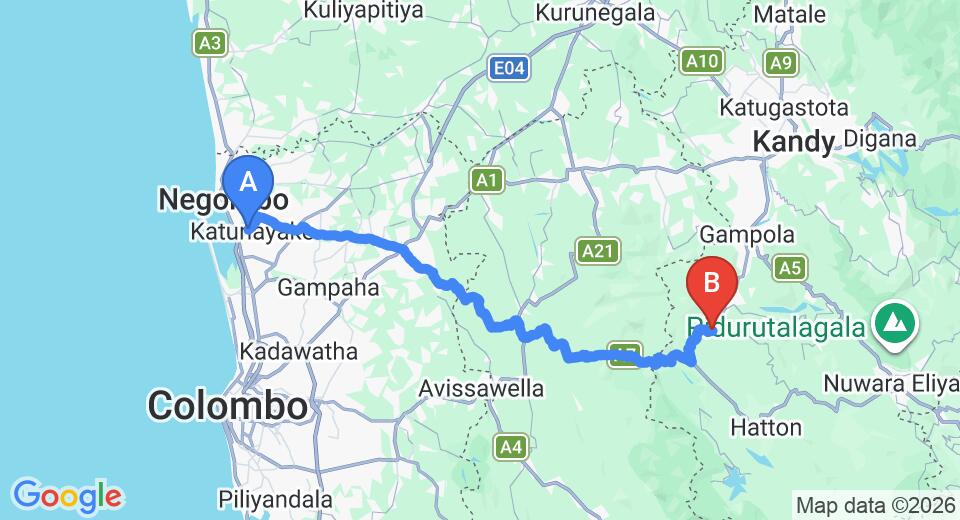
Nawalapitiya sits quietly along the banks of the Mahaweli Ganga, roughly 38 km south of Kandy and around 112 km from Colombo, at an elevation of 589 m above sea level. It is part of Kandy District in Sri Lanka's Central Province — a region defined by rolling hills, river valleys, and the kind of cool, misty air that makes the landscape ideal for tea cultivation. Though it rarely appears on the standard tourist circuit, Nawalapitiya rewards travellers who venture beyond the well-worn path.
What is Nawalapitiya known for?
The town owes its origins to the British colonial period, when it was developed as a centre for coffee production in the mid-19th century. When a blight wiped out the island's coffee crop in the 1870s, planters switched to Ceylon tea, and the estates surrounding Nawalapitiya transitioned accordingly. That colonial-era agricultural identity still shapes the landscape today: the hills around town are carpeted with managed tea and rubber plantations, broken by forest patches and the occasional colonial-era bungalow.
The Mahaweli Ganga — Sri Lanka's longest river — runs through the valley below the town, and its banks offer quiet spots for riverside walks and birdwatching. The river is fed by tributaries descending from the Central Highlands, and the surrounding terrain is green year-round thanks to reliable rainfall.
How do I get to Nawalapitiya from Colombo or Kandy?
Nawalapitiya is straightforward to reach by both rail and road. The town's railway station has been a key junction since 21 December 1874, when the line was extended from Kandy to Nawalapitiya. The station serves as a terminus for several commuter trains and comprises three platforms and two siding loops. In 1885 the line was extended further south to Nanu Oya, making Nawalapitiya an important staging point on the celebrated Hill Country railway route that continues toward Ella and Badulla.
- By train from Kandy: Approximately 1–1.5 hours on the Hill Country line. The journey passes through tea country and is scenic in its own right.
- By road from Colombo: Around 2.5–3 hours via the A1 highway to Kandy, then continuing south on the A5 toward Nawalapitiya.
- By road from Kandy: Roughly 45–60 minutes south along the A5.
A private transfer is often the most comfortable option for travellers arriving directly from Colombo Bandaranaike International Airport with luggage, particularly if staying at one of the estate bungalows outside town.
What can I do around Nawalapitiya?
The primary draw is the surrounding landscape — plantation walks, river scenery, and the cool Central Highlands air. Several activities are worth planning around a stay in the area.
- Tea estate visits: Guided walks through working tea estates give insight into the full cycle of cultivation, plucking, and processing. The Bluefield Tea Gardens in the broader Kandy region offer a well-organised estate experience.
- Riverside walks and birdwatching: The Mahaweli Ganga corridor supports a diverse range of bird species, including kingfishers, cormorants, and various waders. Early mornings are best.
- Waterfalls and forest trails: The hills above Nawalapitiya hide several minor waterfalls and forest trails. The Makandawa Rainforest to the north is worth a detour for those interested in cloud forest ecology.
- Kandy day trips: Nawalapitiya makes a quieter base than Kandy itself for exploring the broader Kandy District. A Kandy city tour can be done comfortably as a day excursion.
- Horton Plains: The road to Horton Plains National Park and World's End passes through Nanu Oya, easily accessible from Nawalapitiya via train or road.
When is the best time to visit Nawalapitiya?
Nawalapitiya receives rainfall from both monsoons owing to its position in the Central Highlands, meaning it stays green throughout the year. The drier and more settled periods — typically January to April and again August to September — offer the clearest skies and best conditions for outdoor walks. The region is cooler than the lowlands at any time of year, so light layers are advisable even in the warmest months. Temperatures rarely climb above the mid-20s Celsius and can drop noticeably at night.
Where does Nawalapitiya fit in the wider Central Province?
The Central Province covers an area of around 5,674 km² and is dominated by the hill country massif that forms the backbone of the island. Nawalapitiya sits at the northern edge of this highland zone, where the terrain begins its gradual rise from the Kandy plains into the higher peaks. To the south, the landscape climbs toward the Nuwara Eliya plateau and the dramatic escarpments of Horton Plains. To the north lies Kandy itself — a UNESCO World Heritage city that served as the last capital of the Kandyan Kingdom and remains the cultural heart of the Central Province.
Kandy's Esala Perahera Festival, one of Asia's largest and oldest religious processions, draws large crowds to the region each July or August. Travellers staying in Nawalapitiya during this period can attend the festival and return to the relative quiet of the valley each evening.
What are the accommodation options in Nawalapitiya?
Nawalapitiya is not a large resort town, and accommodation options reflect its character as a working hill community rather than a tourist hub. The most atmospheric stays tend to be in restored colonial-era estate bungalows, which offer privacy, garden settings, and proximity to the plantations. Okwin Resort and The Tea Cottage Resort are among the established properties in the area, catering to travellers who prefer a slower, more immersive experience over the amenity-heavy hotels found in Kandy or Nuwara Eliya. Hynford Bungalow represents the classic colonial bungalow style, set within an estate environment.
Is Nawalapitiya suitable for families or solo travellers?
The town suits travellers who are comfortable with a quieter pace and are self-directing about activities. Families with children who enjoy nature and walking will find the surroundings engaging, and the cooler temperatures are more comfortable than the coast for extended outdoor time. Solo travellers and couples seeking a retreat from busier tourist centres often appreciate Nawalapitiya precisely because it has not been heavily packaged for tourism. The railway station makes it easy to arrive and depart without a private vehicle, though having a driver gives more flexibility to explore the surrounding estates and viewpoints.